Split, change, cannot mix: Speciation happens when part of a species is cut off and changes in its own way, until the two groups can no longer breed together.
The points to remember
- A species is a group that can interbreed and produce fertile offspring.
- Speciation starts when a population is isolated: no more interbreeding, no gene flow.
- Each part meets different conditions and selection pressures, and gets different mutations.
- Each adapts in its own way, so the parts diverge over many generations.
- In time they cannot interbreed to produce fertile offspring: a new species.
Remember it as: Isolation + different conditions + time = new species.
Real example: about 3 million years ago the Isthmus of Panama rose from the sea and split snapping shrimp into a Pacific and a Caribbean population. Today each pair are separate species: brought together, they rarely mate or produce young.
Use the full test: Say 'cannot interbreed to produce fertile offspring'. A horse and a donkey can mate, but their young, the mule, is infertile, so they are separate species.
Free preview
This is the free notes preview
You're reading the free notes. Aimnova Pro unlocks the full study experience — and you can try it with your first topic free to keep:
- FlashcardsLock in vocabulary and key terms with spaced repetition.
- Practice questionsAnswer exam-style questions and get instant AI marking.
- Mock exams & past-paper vaultSit full mocks and see exactly how examiners award marks.
- Personalised study planA daily plan built around your exam date and weak areas.
The slow movement of Earth's tectonic plates is one of the main ways populations become isolated.
The points to remember
- Plates split continents, open oceans, raise mountains and build volcanic islands.
- These barriers divide one population into isolated groups: no gene flow.
- Drifting plates carry land into new climates, so each group meets different selection pressures.
- Each group adapts differently and gets different mutations: divergent evolution, then speciation.
- New mountains and islands give new habitats at different heights: more niches to fill.
- But a population carried into harsher conditions may go extinct, lowering biodiversity.
Split
- Australia broke away from Antarctica about 35-45 million years ago.
Isolated
- Its marsupials were cut off from mammals on other continents.
New climate
- Australia drifted north into warmer, drier latitudes.
Adapted
- Kangaroos for open grassland, koalas for eucalyptus leaves, wombats for burrowing.
Species
- Most of the world's marsupial species now live only in Australia and New Guinea.
Plates pulling land apart
- Populations isolated
- Divergent evolution
- Speciation: biodiversity rises
Plates bringing land together
- A land bridge: populations meet
- Competition: some species go extinct
- Hybrids can merge species, or form new ones
Keep the plates in every point: In a tectonics question, link each step to the moving plates. A general account of natural selection with no link to plate movement does not count.
Get feedback like a real examiner
Submit your answers and get instant feedback — what you did well, what's missing, and exactly what to write to score full marks.
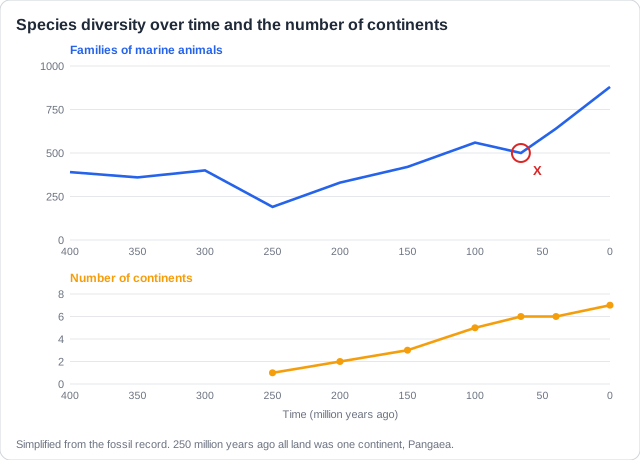
The fossil record shows the link between moving continents and the number of species.
The points to remember
- Give a time with units: 'about 250 million years ago'; a bare number does not count.
- Positive correlation: the more continents, the greater the species diversity.
- Reason: separating continents isolates populations, which leads to speciation.
- Reason: continents move into different climates, so different species evolve.
- Reason: plate movement makes new habitats, such as mountain ranges and islands.
Real example: 250 million years ago all land was one supercontinent, Pangaea. As it split, there were more coastlines, climates and isolated populations; today there are seven continents. The dip at X was a mass extinction, when an asteroid hit Earth 66 million years ago.
Units, or no mark: When you read a time off the graph, always write 'million years ago'. '250' on its own is marked wrong.
Isolated islands are full of endemic species. Speciation explains why.
The points to remember
- An endemic species is found nowhere else.
- A remote island is too far for gene exchange with the mainland: few new arrivals.
- Isolated for a long time, species evolve independently: speciation.
- Varied altitude, climate and habitats give many niches, so many species.
- Adaptive radiation fills empty niches, e.g. with no ground predators.
- Limited resources push species to specialise; a stable climate gives them time.
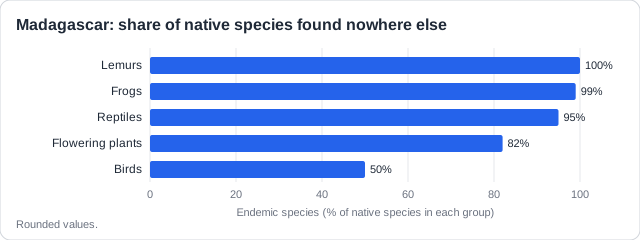
Real example: Madagascar split from Africa about 160 million years ago and from India about 88 million years ago. Its rainforest, dry spiny forest and high plateau hold more than 100 kinds of lemur, all found nowhere else.
Explain the isolation: 'The island is isolated' alone is not enough: say what isolation does (no gene exchange, so species evolve independently). 'Adapted to no predators' alone, or one habitat only such as rainforest, is not enough either.
Another island: flying pigeons reached Mauritius. With no large predators and food on the ground, over many generations they grew larger, lost the power of flight and became a new species, the dodo.
Learn what examiners really want
See exactly what to write to score full marks. Our AI shows you model answers and the key phrases examiners look for.
How this comes up: Paper 2, Section B (b): explain how tectonic plate activity may lead to new species [7].
About 45 million years ago Australia separated from Antarctica and drifted north.
Explain how tectonic plate activity may lead to the formation of new species.
Model answer plan
See the mark-by-mark plan — for / against / judgement, with marking guidance — in study mode.