It starts with differences: Natural selection can only work if individuals differ. That variation comes from the population's genetic diversity.
The points to remember
- Genetic diversity in a population gives variation: no two individuals are the same.
- New variation comes from mutation: random changes in genes (and new mixes when parents breed).
- Mutations are random: they do not happen because an animal needs them.
- Only heritable variation counts: it must be in the genes to be passed on.
Real example: most peppered moths are pale and speckled. A mutation in one gene makes a black form. The first black one was recorded in Manchester in 1848, and the colour passes from parents to young.
Not on purpose: Never write that an animal 'turned dark to hide' or 'mutated to survive'. The variation was already there, by chance; the environment then decides which variants do best.
Free preview
This is the free notes preview
You're reading the free notes. Aimnova Pro unlocks the full study experience — and you can try it with your first topic free to keep:
- FlashcardsLock in vocabulary and key terms with spaced repetition.
- Practice questionsAnswer exam-style questions and get instant AI marking.
- Mock exams & past-paper vaultSit full mocks and see exactly how examiners award marks.
- Personalised study planA daily plan built around your exam date and weak areas.
Every species produces more young than its environment can support. Not all of them can survive.
The points to remember
- Species overproduce: far more young are born than can survive.
- Resources are limited: food, water, space, nest sites, mates.
- So individuals compete, and many die before they can breed.
- Who wins the competition depends on their variation.
Remember it as: Too many young, too little food: only some make it.
Real example: a female Atlantic cod can release several million eggs in one breeding season. Only a tiny fraction survive hunger, predators and cold to become adults.
Use the guide's words: Name the steps as the guide does: variation, overproduction, competition for limited resources, survival and reproduction.
Memorize terms 3x faster
Smart flashcards show you cards right before you forget them. Perfect for definitions and key concepts.
In the competition, the selection pressure decides who wins. Nature keeps what works best there, not the strongest.
The points to remember
- A selection pressure (predators, disease, heat, cold) acts on the population.
- Individuals with an advantageous variation are better adapted: more likely to survive.
- They also reproduce more and leave more offspring.
- Less well adapted individuals die young or breed less: selection eliminates them.
- 'Survival of the fittest': fittest = best suited to that environment.
Real example: in the 1800s, soot from factories blackened tree bark around Manchester. Birds easily spotted pale moths resting on dark bark and ate them, while black moths were hidden. More black moths survived to breed.
Tie it to the pressure: In the exam, say what the pressure is in that case (the birds, the flies, the heat). A general account not linked to the question's pressure cannot get full marks.
Winning matters only because the winners pass their genes on. Generation by generation, the population changes.
The points to remember
- Survivors pass their advantageous genes to their offspring: the variation is heritable.
- So the frequency of the advantageous gene rises in each generation.
- Over many generations the trait becomes dominant: most of the population has it.
- If the environment changes back, selection can reverse the change.
Remember it as: Survive, breed, pass it on, repeat.
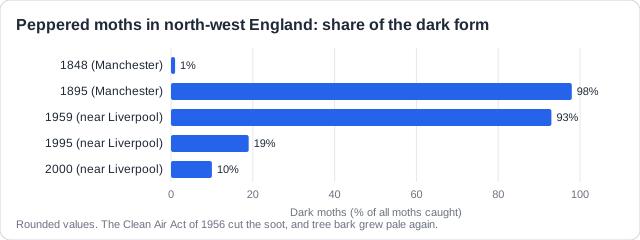
Real example: by 1895 about 98% of Manchester's peppered moths were black. After the Clean Air Act of 1956 the bark grew pale again, pale moths were favoured, and by 2000 black moths were only about 10% near Liverpool.
Know your predicted grade
Take timed mock exams and get detailed feedback on every answer. See exactly where you're losing marks.
Exam questions ask how a population could evolve one trait: resistance, heat tolerance, stripes. Use the same chain every time.
Remember it as: Differ, too many, compete, survive, pass it on.
Variation
- A few pink bollworm caterpillars carried a random mutation that let them survive the Bt poison.
Pressure
- From 2002 Indian farmers grew Bt cotton, which makes a poison that kills bollworms.
Survive
- Bollworms without the mutation died; the resistant ones survived and bred.
Inherit
- Their young inherited the resistance gene.
Spread
- By about 2015 resistant bollworms were common across much of India's cotton.
Two traps: Answer the question asked: if it asks how one trait evolves, do not drift into how new species form. And end with the spread: 'over many generations the trait becomes more common in the population'.
How this comes up: Paper 2, Section A: describe how natural selection led to one trait, in the context given [3].
Zebra stripes may reduce the ability of biting flies to land on the zebra. The flies can spread disease.
Describe how natural selection may have led to the evolution of zebra stripes in response to biting flies.
Model answer plan
See the mark-by-mark plan — for / against / judgement, with marking guidance — in study mode.