Same climate, same kind of ecosystem: A biome is a large-scale ecosystem type shaped mainly by climate. Biomes fall into six broad groups, and each group has its own limiting factors, productivity and biodiversity.
The points to remember
- A biome is shaped mainly by climate: temperature and precipitation.
- Six groups: freshwater, marine, forest, grassland, desert and tundra.
- Each group splits into subcategories: tropical rainforest, temperate forest, boreal forest.
- Climate decides the plants; the plants decide the animals, with their food and shelter.
- Each group has its own limiting factors, productivity and biodiversity.
Remember it as: Water, woods, grass, sand and snow: fresh, salt, forest, grassland, desert, tundra.
On land (terrestrial)
- Forest: tropical rainforest, temperate deciduous, boreal (taiga)
- Grassland: savanna, temperate grassland
- Desert: hot desert, cold desert
- Tundra: Arctic, alpine
In water (aquatic)
- Freshwater: lakes, rivers, wetlands
- Marine: open ocean, coral reefs, estuaries, mangroves
Real example: Brazil holds six biomes: the Amazon tropical rainforest, the Cerrado savanna, the dry Caatinga thorn scrub, the Pantanal wetland, the Atlantic Forest and the Pampas grassland.
Name it in full: Say 'tropical rainforest', not 'rainforest'; 'coniferous forest', not 'forest'. A name without its qualifier does not count.
Free preview
This is the free notes preview
You're reading the free notes. Aimnova Pro unlocks the full study experience — and you can try it with your first topic free to keep:
- FlashcardsLock in vocabulary and key terms with spaced repetition.
- Practice questionsAnswer exam-style questions and get instant AI marking.
- Mock exams & past-paper vaultSit full mocks and see exactly how examiners award marks.
- Personalised study planA daily plan built around your exam date and weak areas.
Why is one biome lush and another bare? Plants need light, warmth, water and nutrients. The one in shortest supply is the limiting factor. It sets the biome's net primary productivity, and so how much life it can feed.
The points to remember
- Plants need light, warmth, water and nutrients; the scarcest one limits growth.
- Productivity is highest where it is warm and wet all year, so photosynthesis never stops.
- It is lowest where it is too cold (tundra) or too dry (desert).
- Biodiversity is highest where conditions are stable and resources plentiful.
- It is lowest where conditions are extreme or change a lot with the seasons.
- Limiting factors keep populations small and food chains short.
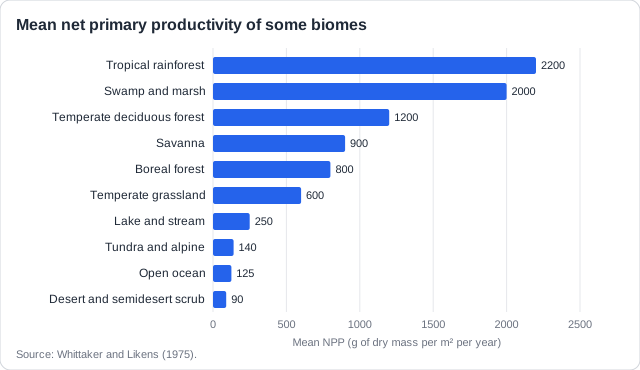
Real example: the Amazon is warm and wet all year, so its plants grow all year: about 2,200 g per m² a year. In the Sahara, water runs out, so it makes only about 90.
Remember it as: Warm and wet: busy. Cold or dry: quiet.
Stop wasting time on topics you know
Our AI identifies your weak areas and focuses your study time where it matters. No more overstudying easy topics.
Tropical rainforest is the most productive and most diverse biome on land. Almost everything about it follows from its climate: hot and wet all year, with no cold or dry season to stop growth.
Tropical rainforest: the points to remember
- Found near the equator, between the tropics: hot all year (over 24 °C) with little seasonality.
- Abundant rain (over 2,000 mm) and high humidity; high insolation all year.
- Highest NPP on land: a major carbon sink that releases a lot of oxygen.
- Highest biodiversity: many endemic species, complex food webs, biodiversity hotspots.
- Stratified: emergent trees above a dense canopy, tall straight trunks with buttress roots.
- Fast decomposition and nutrient turnover, but thin, nutrient-poor, acidic soils.
- Limiting factors: light below the canopy and nutrients in the soil.
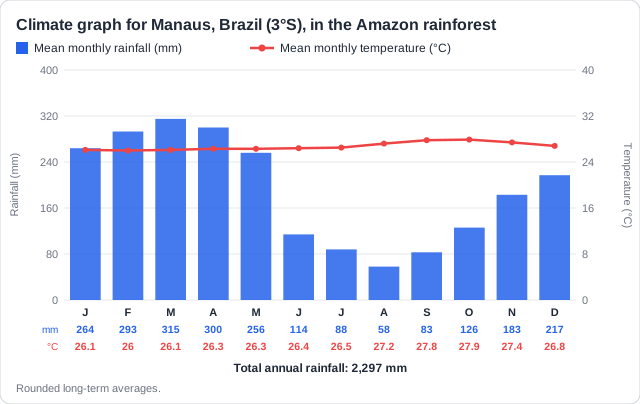
Real example: the Amazon holds about 16,000 tree species and perhaps one in ten of all known species. At Manaus it is 26-28 °C every month, with about 2,300 mm of rain a year.
Be exact: 'Found in the tropics' alone is not a feature. Say what the climate, soil, plants or productivity are like, each in its own sentence.
In a hot desert, water decides everything. Rain is rare and unreliable, so plants are few and small, and everything alive is built to find, store or save water.
Hot desert: the points to remember
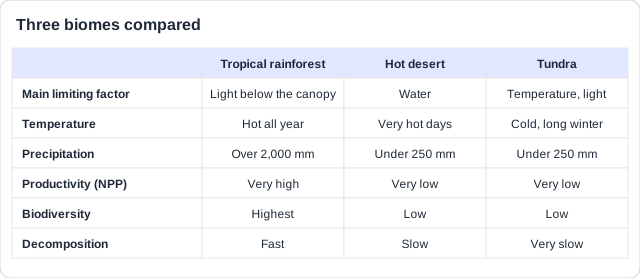
- Water is the limiting factor: under 250 mm of rain a year, often much less.
- Very hot days, often over 40 °C, but cold nights: clear skies let heat escape.
- Very low NPP (about 90 g per m² a year): plants are small and far apart.
- Low biodiversity, but species are specialised: they store water, save water or hide from the heat.
- Slow decomposition (too dry), so soils are thin and poor in organic matter.
Real example: in the Sahara, Aswan in Egypt gets about 1 mm of rain a year. The fennec fox loses heat through its huge ears and hunts at night, when it is cool.
Link the factor to the result: Write the chain: little water, so little photosynthesis, so low NPP, so few species. A feature on its own is one point; the link shows you understand it.
See how examiners mark answers
Answer exam-style questions with model answers. Learn exactly what earns marks and what doesn't.
The tundra lies beyond the tree line, near the poles and on high mountains. Cold and darkness are the limiting factors: plants have only a few warm weeks to grow.
Tundra: the points to remember
- Low mean temperatures: below 0 °C for most of the year, a short growing season.
- Low precipitation, mostly frozen (snow); permafrost below the surface.
- Limited sunlight at high latitude: long dark winters.
- Low primary productivity: small plants, lichens and mosses, no trees.
- Low species diversity and short food chains.
- Slow decomposition in the cold: dead matter builds up as peat.
- Animals migrate or hibernate to survive the winter.
Real example: at Utqiagvik on Alaska's Arctic coast, the mean temperature is about -11 °C and the sun does not rise for about two months in winter. Caribou migrate south for the winter; Arctic ground squirrels hibernate for up to eight months.
Tundra is dry, not wet: Tundra gets about as little precipitation as a desert. 'High rainfall' is wrong; say 'low precipitation, mostly as snow'.
Between the tropics and the poles lie the biomes most people live in: forests where there is enough rain for trees, grasslands where there is not. Each one is a subcategory of the forest or grassland group.
Two more forests and two grasslands
- Boreal forest (taiga): long cold winters, short summers; conifers; moderate NPP, low diversity.
- Temperate deciduous forest: mild, rain all year; trees drop leaves before the cold winter; fertile soil.
- Temperate grassland: moderate rain (250-750 mm), too dry for most trees.
- Savanna: hot, with a wet season and a long dry season; grass with scattered trees.
- Grasslands are kept open by grazing and fire; they grow in a season, not all year.
Boreal forest (taiga)
- Winters below -20 °C
- Needle-leaved conifers shed snow
- Slow decomposition, acid soil
- NPP about 800
Temperate deciduous forest
- Mild, 500-1,500 mm rain
- Broad leaves fall in autumn
- Fast leaf litter decay, fertile soil
- NPP about 1,200
Real example: the Siberian taiga is the largest forest on Earth, mostly larch, pine and spruce. The beech woods of central Germany are temperate deciduous forest, bare in winter and green from May.
Study smarter, not longer
Most students waste 40% of study time on topics they already know. Our AI tracks your progress and optimizes every minute.
Most of the Earth is covered by water, and water biomes are grouped too. Here the key abiotic factor is salinity.
The points to remember
- Water biomes are grouped by salinity: freshwater (under 0.5 parts per thousand) and marine (about 35).
- Freshwater: lakes, rivers and wetlands. Marine: oceans, coral reefs, estuaries, mangroves.
- Limiting factors in water: light (falls with depth), nutrients, dissolved oxygen, temperature.
- Shallow, sunlit, nutrient-rich water (reefs, estuaries, marshes) is very productive; the open ocean is not.
- Mangroves: warm tropical coasts, tides, salty, anaerobic mud; very productive, store much carbon.
Real example: the Sundarbans of Bangladesh and India is the largest mangrove forest on Earth. Twice a day the tide floods it with salt water; the trees send up breathing roots through the airless mud.
Mangroves in the exam: Treat mangroves as a biome shaped by abiotic factors: salinity, flooding by the tides, and warm temperatures.
Many questions hand you a figure and ask you to name a biome or describe its climate. The marks go to exact names and exact numbers read from the figure.
Reading a biome figure
- On a biome diagram, find the temperature on one axis and the precipitation on the other.
- Quote both values for each biome, with units: '20-30 °C and 0-50 cm'.
- On a map, use the key: name the colour exactly as the key does.
- Name the biome in full: 'coniferous forest', 'tropical rainforest', not 'forest' or 'trees'.
- From a climate graph, give numbers: 'over 24 °C every month', 'about 1,800 mm a year'.
- Give one answer when asked for one: only the first is marked.
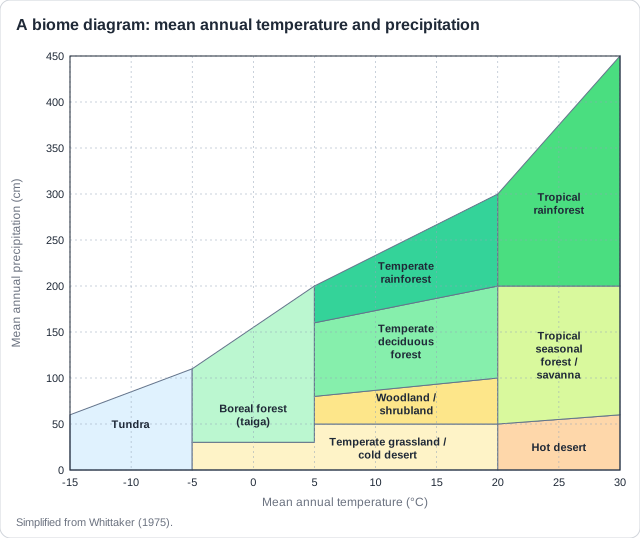
Real example: Cairo has a mean of about 22 °C and 2.5 cm of rain a year: on the diagram, that is hot desert. Manaus, at 27 °C and 230 cm, is tropical rainforest.
Both values, every time: To distinguish two biomes, give the temperature AND the precipitation of each. 'The desert is hot and the tundra is cold' leaves out precipitation and loses the marks.
Practice with exam-style questions
Answer exam-style questions and get AI feedback that shows you exactly what examiners want to see in a full-marks response.
How this comes up: Paper 2, Section B (a): identify four characteristic features of a named biome [4].
The Arctic tundra stretches across northern Alaska, Canada and Russia.
Identify four characteristic features of the tundra biome.
Model answer plan
See the mark-by-mark plan — for / against / judgement, with marking guidance — in study mode.