Ancient sunlight, locked underground: Fossil fuels are the carbon of ancient plants and plankton, stored underground for millions of years. They were made by sinks, and they become sources when we burn them.
The points to remember
- Coal, oil and natural gas are fossil fuels: organic stores of carbon underground.
- They formed when past ecosystems were carbon sinks: plants and plankton took in more CO₂ than was released.
- Their remains were buried before they could decompose, then changed by heat and pressure over millions of years.
- Coal came mostly from swamp forests; oil and gas mostly from plankton in ancient seas.
Remember it as: Made by old sinks, stored for ages, a source when burned.
Real example: the coal of the South Wales valleys formed from swamp forests. Their dead plants sank into the mud and never rotted.
Keep the formation short: You need the idea (past sinks, buried, not decomposed, millions of years), not the detailed chemistry of each fuel.
Free preview
This is the free notes preview
You're reading the free notes. Aimnova Pro unlocks the full study experience — and you can try it with your first topic free to keep:
- FlashcardsLock in vocabulary and key terms with spaced repetition.
- Practice questionsAnswer exam-style questions and get instant AI marking.
- Mock exams & past-paper vaultSit full mocks and see exactly how examiners award marks.
- Personalised study planA daily plan built around your exam date and weak areas.
Every carbon store keeps its carbon for a different length of time: its residence time.
The points to remember
- Residence time = the average time a carbon atom stays in a store.
- A leaf holds carbon for months; a tree trunk for decades to centuries; peat for thousands of years.
- Fossil fuels hold carbon for hundreds of millions of years.
- No natural process brings it back up quickly, so without mining the residence time is unlimited.
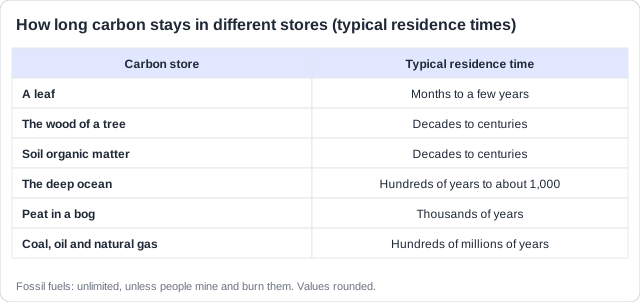
Real example: a carbon atom in an oak leaf may be back in the air within a year, when the leaf falls and rots. A carbon atom in Welsh coal had stayed put for about 300 million years, until the coal was mined.
'Unlimited' has a condition: Fossil fuels have unlimited residence times only without human interference. Mining and burning end the storage at once: say so.
Study smarter, not longer
Most students waste 40% of study time on topics they already know. Our AI tracks your progress and optimizes every minute.
People now dig up fossil fuels far faster than any natural process could, and burn them for energy.
The points to remember
- Extraction (mining, drilling) moves ancient carbon from underground stores to the surface.
- Combustion oxidises it to CO₂ in seconds: the store becomes a source.
- We release in one year carbon that took millions of years to lock away.
- Sinks (plants, oceans) absorb only about half; the rest accumulates in the atmosphere.
- More CO₂, a greenhouse gas, means global warming; more CO₂ dissolving acidifies the oceans.
Remember it as: Dug up in a day, burned in a second, stored for ages.
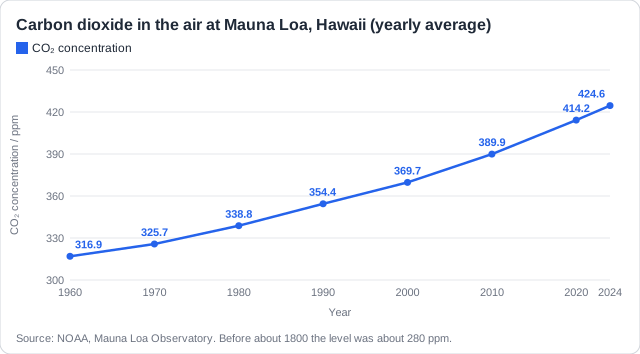
Real example: in 1958 Charles Keeling began measuring CO₂ on Mauna Loa. It has climbed from about 315 ppm to about 425 ppm, mostly from burning fossil fuels.
Reading a rising CO₂ graph: Describe the trend with numbers from the graph (first and last values), then link it to burning fossil fuels: ancient stored carbon released faster than sinks can absorb it.
How this comes up: Paper 2, Section A: a graph of rising CO₂. Explain how burning fossil fuels accounts for the trend [3].
Figure 1 shows the concentration of carbon dioxide in the air at Mauna Loa, Hawaii, since 1960.
Explain how the burning of fossil fuels can account for the trend shown in Figure 1.
Model answer plan
See the mark-by-mark plan — for / against / judgement, with marking guidance — in study mode.