It is all about the balance: Whether an ecosystem is a store, a sink or a source of carbon depends on the difference between the carbon coming in and the carbon going out.
The points to remember
- Carbon comes in by photosynthesis and goes out by respiration, decomposition and fire.
- In more than out: net accumulation, so the ecosystem is a sink.
- Out more than in: net release, so the ecosystem is a source.
- In and out balanced: a store in equilibrium, holding what it has.
- The same ecosystem can change role when it grows, ages, burns or is cleared.
Remember it as: More in = sink. More out = source. Level = store.
Real example: instruments on a tower above Harvard Forest, Massachusetts, have measured its carbon since 1991. Each year the forest takes in about 2 tonnes of carbon per hectare more than it gives out, so it is a sink.
Say which process is bigger: Do not just say 'it takes in carbon'. Every ecosystem does. Say that photosynthesis is greater, or smaller, than respiration.
Free preview
This is the free notes preview
You're reading the free notes. Aimnova Pro unlocks the full study experience — and you can try it with your first topic free to keep:
- FlashcardsLock in vocabulary and key terms with spaced repetition.
- Practice questionsAnswer exam-style questions and get instant AI marking.
- Mock exams & past-paper vaultSit full mocks and see exactly how examiners award marks.
- Personalised study planA daily plan built around your exam date and weak areas.
A forest shows all three roles during its life. Learn these three: they are the most asked example.
The points to remember
- Young forest = sink: fast-growing trees absorb CO₂ and turn it into new biomass.
- Mature forest = store: it contains carbon in biomass for the trees' long lifespans; growth and decay balance.
- Destroyed forest = source: fire, slash-and-burn or clearing releases the stored carbon as CO₂.
- Dead trees that decompose also release CO₂, more slowly.
- Use the verbs: stores contain, sinks absorb, sources release.
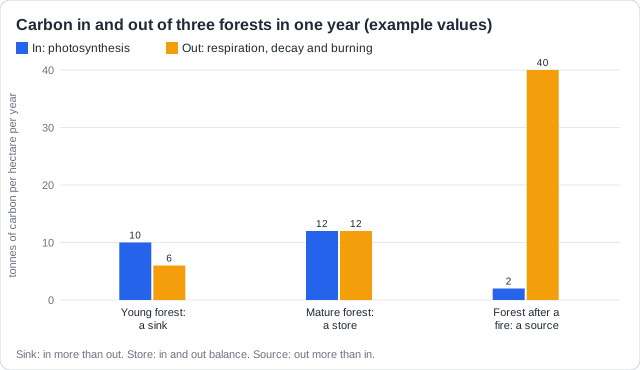
Real example: Bialowieza Forest holds huge amounts of carbon in trees hundreds of years old: a store. A forest newly planted on farmland is a sink.
Too brief is not enough: 'Trees store carbon dioxide' is too short. Say what each role does: a store contains carbon in biomass over time, a sink absorbs CO₂ for photosynthesis, a source releases CO₂ by fire or decay.
Learn what examiners really want
See exactly what to write to score full marks. Our AI shows you model answers and the key phrases examiners look for.
Big idea: Forests are major carbon sinks because trees absorb CO₂ during photosynthesis and store carbon in biomass and soils. Cutting forests can turn a sink into a source.
Where carbon is stored in a tree
Trees store carbon mainly in biomass: carbon-rich tissues built from CO₂ absorbed during photosynthesis.
- Wood (trunk, branches, roots): the biggest store
- Leaves
- Bark
- Leaf litter and soil organic matter under the trees
Photosynthesis moves carbon from the atmosphere into plant biomass (CO₂ becomes organic matter).
What happens to carbon when forests are cut?
The carbon does not disappear: it is transferred to other stores. What happens depends on what happens to the wood after cutting.
- Burning (fastest release): carbon in wood is oxidised, so CO₂ is released quickly
- Decomposition (slower release): decomposers break down dead wood and respire, so CO₂ is released over time (and methane may form where there is little oxygen)
- Timber (delayed release): carbon stays in buildings or furniture, then is released later when the wood decays or burns
- Soil loss: without roots, soil is eroded and its carbon is lost; bare, warmer soil with more oxygen decomposes faster
Deforestation has a double effect: (1) it releases stored carbon, and (2) it reduces future CO₂ uptake because fewer trees remain to photosynthesise.
If a tree falls and stays on the forest floor
Stops
The tree stops photosynthesising.
Decomposers feed
Bacteria and fungi feed on the dead wood and respire.
Most returns
Most of the carbon returns to the atmosphere gradually as CO₂.
Some stays
Some becomes soil organic matter (humus), stored for years to centuries.
Conditions matter: warm, wet, oxygen-rich soils speed decomposition (more CO₂ released). Cold, dry or waterlogged soils slow decomposition (more carbon stored in the soil).
Real example: in Rondonia, Brazil, forest was cleared along new roads from the 1980s. Most of the wood was burned to make pasture, releasing its carbon within days.
Exam sentence: Deforestation increases atmospheric CO₂ because stored carbon is released through burning or decomposition, and fewer trees remain to absorb CO₂ by photosynthesis. Always say where the carbon was stored: in the biomass or in the soil.
Fire turns a forest from a store into a source in hours, and it adds to the enhanced greenhouse effect.
The points to remember
- Burning organic matter releases CO₂, a greenhouse gas, in hours.
- The ground re-radiates heat; greenhouse gases trap that outgoing heat.
- Burned forest photosynthesises less, so less CO₂ is absorbed and CO₂ accumulates.
- Together: more CO₂ in the air, so an enhanced greenhouse effect and warming.
- Warmer, drier weather brings more fires: a positive feedback.
Forest burns
- In 2019-2020, fires burned about 24 million hectares of south-eastern Australia.
CO₂ released
- The carbon in wood and leaves was oxidised to CO₂, a greenhouse gas.
Less uptake
- Burned eucalyptus forest photosynthesised far less while it regrew.
Heat trapped
- The extra CO₂ traps heat re-radiated by the ground, so the climate warms.
Real example: Australia's Black Summer fires released about 715 million tonnes of CO₂, more than the country's usual emissions for a whole year.
Two marks, two links: Link the fire to the extra CO₂, then the CO₂ to trapped heat. 'It causes global warming' alone is too vague.
Never wonder what to study next
Get a personalized daily plan based on your exam date, progress, and weak areas. We'll tell you exactly what to review each day.
Forests are not the only stores. Some of the biggest carbon stores are wet, cold or under the sea, where dead matter decomposes slowly.
The points to remember
- Peat: waterlogged, so little oxygen; dead plants decompose very slowly and pile up as carbon.
- Tundra: cold and frozen ground (permafrost) slow decomposition; thawing turns it into a source.
- Mangroves, seagrass and kelp bury carbon in mud: a big store for their size.
- Draining, clearing or overgrazing these places turns a store into a source.
- Read data carefully: quote numbers with units, and give the full name of a category.
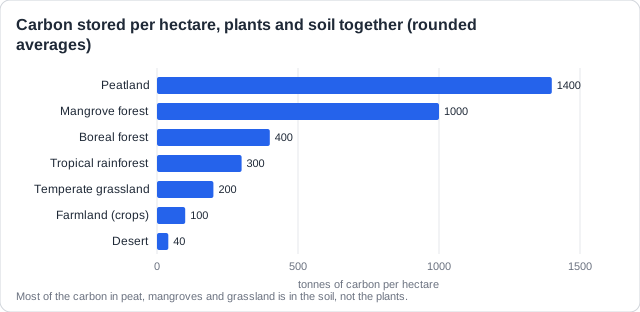
Real example: off California, where sea otters eat the sea urchins, kelp forests grow thick and store far more carbon per square metre than bare urchin barrens.
Reading carbon data: For a difference, subtract and give units: '180 - 14 = 166 g C per m²'. From a map key, give the whole category: 'peatlands and tundra', not 'peatlands'.
How this comes up: Paper 2, Section A: describe how trees act as stores, sinks and sources [3], one mark for each.
Forests cover about a third of the world's land and hold much of its carbon.
Describe how trees in forests can act as stores, sinks and sources in the carbon cycle.
Model answer plan
See the mark-by-mark plan — for / against / judgement, with marking guidance — in study mode.