The same field can go either way: Farmland can store, absorb or release carbon. Most of it sits in the soil organic matter, and farming techniques decide whether that store grows or shrinks.
The points to remember
- A farm's biggest carbon store is its soil organic matter.
- Carbon goes in as crops photosynthesise and leave roots, stubble and manure in the soil.
- Carbon comes out as decomposers respire, and when soil is eroded or burned.
- More in than out: the soil is a sink; more out than in: a source; level: a store.
- The techniques the farmer uses decide which way the balance tips.
Remember it as: Feed the soil and it is a sink; disturb it and it is a source.
Real example: the world's soils hold more carbon than all the world's plants and the atmosphere put together. About a third of the world's land is farmed, so how farmers treat soil matters for the climate.
Name the soil: In farming questions the carbon store is usually the soil. Say 'soil organic matter' or 'soil carbon', not just 'the farm'.
Free preview
This is the free notes preview
You're reading the free notes. Aimnova Pro unlocks the full study experience — and you can try it with your first topic free to keep:
- FlashcardsLock in vocabulary and key terms with spaced repetition.
- Practice questionsAnswer exam-style questions and get instant AI marking.
- Mock exams & past-paper vaultSit full mocks and see exactly how examiners award marks.
- Personalised study planA daily plan built around your exam date and weak areas.
Regenerative agriculture aims to put more carbon into the soil each year than comes out.
Techniques that make soil a sink
- Cover crops: plants grown between harvests keep photosynthesising and add roots and leaves.
- No till: not ploughing keeps the soil undisturbed: less oxygen gets in, so decay slows.
- Crop rotation: changing crops each year, with deep roots and legumes, adds more organic matter.
- Adding manure or compost puts carbon straight into the soil.
- Covered, undisturbed soil also erodes less, so its carbon stays put.
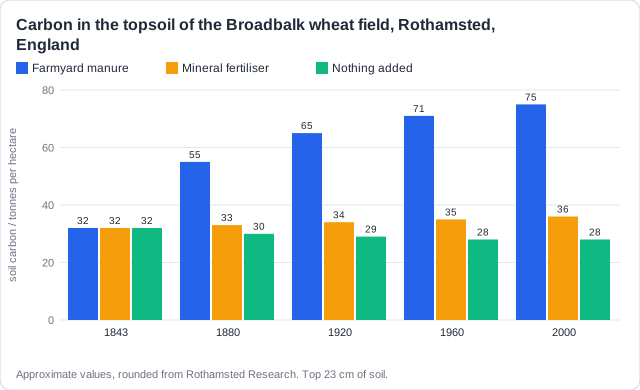
Real example: on the Broadbalk field at Rothamsted, England, wheat has been grown since 1843. Plots given farmyard manure every year now hold more than twice the soil carbon of plots given nothing.
Link the technique to the carbon: 'Cover crops are good for the soil' is not enough. Say how: they photosynthesise and add organic matter, so carbon builds up in the soil.
Memorize terms 3x faster
Smart flashcards show you cards right before you forget them. Perfect for definitions and key concepts.
Other techniques do the opposite: they speed up decomposition or let the soil blow and wash away.
Techniques that make soil a source
- Heavy tillage: ploughing mixes oxygen into the soil, so decomposers release CO₂ faster.
- Ploughed, bare soil is eroded by wind and rain, and its carbon is lost.
- Monoculture: one crop, often with bare soil between harvests and little residue returned.
- Draining a wetland: waterlogged peat gets air, so it decomposes and releases its carbon.
- Farms also release carbon from machinery fuel, fertiliser factories and methane from cattle and rice.
| Technique | What it does to the soil | Role |
|---|---|---|
| Cover crops, no till, rotation | Adds organic matter, slows decay | Sink |
| Heavy tillage | Lets oxygen in, speeds decay, erosion | Source |
| Monoculture | Bare soil, little residue | Source |
| Draining wetland | Peat decomposes | Source |
Real example: in the 1930s Dust Bowl, prairie ploughed for wheat dried out in a drought. Wind blew away the bare topsoil, and its carbon with it.
Say why oxygen matters: Ploughing and draining both let oxygen into the soil. Decomposers need oxygen to respire quickly, so more carbon leaves as CO₂.
Some crops take decades to grow. With timber, what happens after the harvest matters as much as the growing.
The points to remember
- A timber plantation is a sink while its trees grow, for decades before harvest.
- At harvest, what happens to the wood decides where the carbon goes.
- Long-lived products (buildings, furniture) keep the carbon for decades: a store.
- Short-lived products (paper, fuel) release it within months or at once: a source.
- Replanting after harvest starts a new sink; longer rotations hold more carbon.
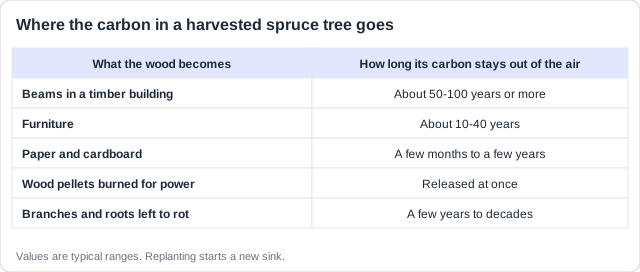
Real example: Mjøstårnet in Norway, finished in 2019, is an 18-storey building made mostly of wood. The carbon its spruce trees took from the air stays locked in its beams for as long as the building stands.
Timber v burning: Carbon in timber products is released slowly, when the wood finally decays or is burned; burning releases it at once. Say which use you mean.
Know your predicted grade
Take timed mock exams and get detailed feedback on every answer. See exactly where you're losing marks.
How this comes up: Paper 2, Section A: explain how named farming techniques make soil a carbon sink [3].
A wheat farmer in Kansas, USA, stops ploughing and starts sowing a mix of rye and clover after each harvest.
Explain how these changes can make the farm's soil act as a carbon sink.
Model answer plan
See the mark-by-mark plan — for / against / judgement, with marking guidance — in study mode.