Catch it and lock it away: carbon sequestration takes carbon dioxide out of the atmosphere, or stops it getting there, and stores it as a solid or a liquid.
The points to remember
- Carbon sequestration captures CO₂ gas, from the atmosphere or from a chimney.
- It stores the carbon in a solid or liquid form, so it stays out of the air.
- It can be natural (plants, soils, oceans) or artificial (carbon capture and storage).
- The longer the carbon stays locked away, the better it is for the climate.
Remember it as: Catch the gas, lock it up as a solid or liquid.
Real example: an oak tree is natural sequestration you can touch. About half the dry weight of its wood is carbon, taken from the air as CO₂ gas and stored for as long as the tree lives.
Say both halves: A definition needs the capture of the CO₂ gas AND its storage as a solid or liquid. 'Storing carbon' alone is too vague.
Free preview
This is the free notes preview
You're reading the free notes. Aimnova Pro unlocks the full study experience — and you can try it with your first topic free to keep:
- FlashcardsLock in vocabulary and key terms with spaced repetition.
- Practice questionsAnswer exam-style questions and get instant AI marking.
- Mock exams & past-paper vaultSit full mocks and see exactly how examiners award marks.
- Personalised study planA daily plan built around your exam date and weak areas.
Nature has sequestered carbon for billions of years. Living things build carbon into their bodies, and some of it is buried before it can rot.
The points to remember
- Trees absorb CO₂ by photosynthesis and turn it into biomass: wood, roots, leaves.
- Dead plant matter builds up in soils and peat where it decomposes slowly.
- In the sea, seagrass, kelp and plankton take up CO₂; some carbon sinks into the sediment.
- Over millions of years, buried organic matter is fossilised into coal, oil and natural gas.
| Natural store | How the carbon gets there | Form |
|---|---|---|
| Trees | Photosynthesis builds wood and roots | Solid biomass |
| Soils and peat | Dead leaves and roots rot slowly | Solid organic matter |
| Seagrass and sea floor | Plants and plankton sink and are buried | Solid sediment |
| Coal, oil and gas | Buried remains fossilised over millions of years | Solid, liquid, gas |
Real example: between 2001 and 2019 the world's forests absorbed about 16 billion tonnes of CO₂ a year, about twice what clearing and fires released from them (Harris and others, 2021).
Fossil fuels count too: Coal, oil and gas are carbon that plants and plankton sequestered long ago. Burning them undoes that sequestration in a few seconds.
See how examiners mark answers
Answer exam-style questions with model answers. Learn exactly what earns marks and what doesn't.
People now copy nature with carbon capture and storage, often shortened to CCS.
How it works, step by step
- Capture: CO₂ is removed from the waste gas of a power station or factory.
- Compress: the CO₂ is squeezed into a liquid, so it can be piped or shipped.
- Store: it is pumped over 1 km down into salty sandstone, old oil or gas fields, or coal seams.
- An impermeable cap rock above stops it escaping; in basalt it can turn into solid rock.
- Direct air capture filters CO₂ straight out of the air, then stores it the same way.
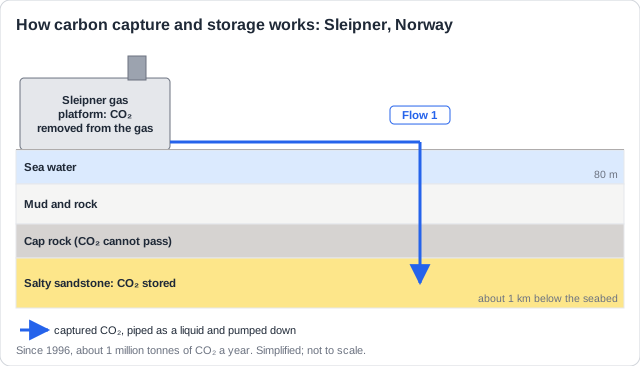
Real example: since 1996, Norway's Sleipner gas field has removed CO₂ from its natural gas and pumped about 1 million tonnes a year into salty sandstone under the North Sea.
Reading a CCS diagram: Follow each numbered flow: where the CO₂ comes from, which rock layer it goes into, and what (if anything) comes back up, such as oil or methane.
Artificial sequestration can help, but it is not a simple fix. Weigh it up with points for and against.
For and against
- For: it removes CO₂ from the biggest sources before it reaches the air.
- For: it lets countries keep using fossil fuels while they switch to cleaner energy.
- Against: CO₂ pumped into an oil field pushes out more oil, which releases more CO₂ when burned.
- Against: it is costly and uses extra energy; a power station burns more fuel to run it.
- Against: it is small: about 50 million tonnes a year, far under 1% of the CO₂ we emit.
- Against: it treats the symptom; it does not cut the burning of fossil fuels.
Remember it as: Stores the waste, but can pump out more oil.
Real example: the Gorgon gas plant in Australia was the world's biggest CCS scheme when it opened in 2019, but in its first years it stored only about a third of the CO₂ it had promised.
The oil-field trap: CO₂ pumped into an oil field is stored, but the extra oil it pushes out is burned. Say both halves: some carbon is stored, yet more fossil carbon is released.
Study smarter, not longer
Most students waste 40% of study time on topics they already know. Our AI tracks your progress and optimizes every minute.
How this comes up: Paper 2, Section A: a drawing of a carbon capture and storage scheme with numbered flows. Outline how two flows capture and store carbon [2].
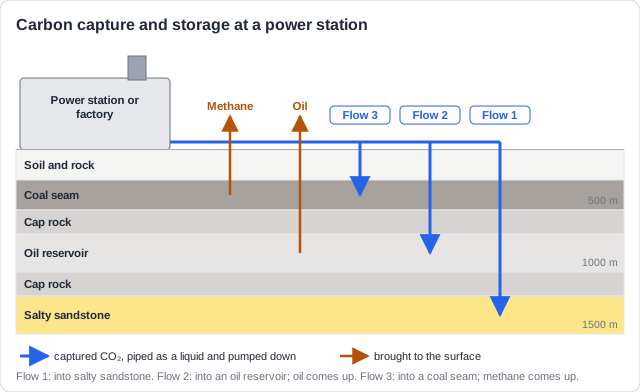
Figure 1 shows a carbon capture and storage scheme at a power station.
Outline how Flows 1 and 2 shown in Figure 1 may contribute to the capture and storage of atmospheric carbon.
Model answer plan
See the mark-by-mark plan — for / against / judgement, with marking guidance — in study mode.