Carbon on the move: Carbon is in every molecule of life: sugars, proteins, fats and DNA. It never stays put: flows carry it between the air, living things, soil, oceans and rock, round and round.
The points to remember
- The carbon cycle is a system: stores are boxes and flows are arrows (see 1.2.3).
- Carbon flows by photosynthesis, feeding, defecation, respiration, death and decomposition.
- People add combustion (burning fossil fuels and forests) and land-use change.
- An arrow points the way carbon moves; a number on it is the size of the flow each year.
- The flows link living (biotic) stores with the air, water, soil and rock (abiotic).
Remember it as: Boxes hold carbon; arrows move it.
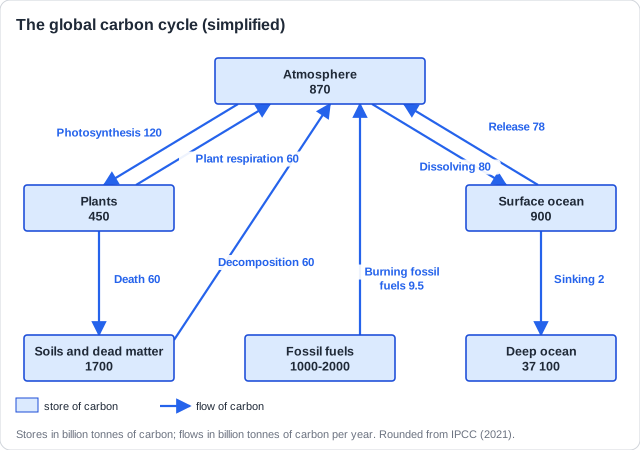
Real example: each year the world's plants take about 120 billion tonnes of carbon out of the air, and about half goes straight back through their own respiration. The carbon atoms in your body were in the air as carbon dioxide only a few years ago.
Read the arrows: Before you answer, check which way each arrow points and which two stores it joins.
Free preview
This is the free notes preview
You're reading the free notes. Aimnova Pro unlocks the full study experience — and you can try it with your first topic free to keep:
- FlashcardsLock in vocabulary and key terms with spaced repetition.
- Practice questionsAnswer exam-style questions and get instant AI marking.
- Mock exams & past-paper vaultSit full mocks and see exactly how examiners award marks.
- Personalised study planA daily plan built around your exam date and weak areas.
Two flows join the atmosphere to living things: photosynthesis takes carbon in, respiration gives it back (the word equations are on 2.2.3).
The points to remember
- Photosynthesis: producers take carbon dioxide from the air into biomass; oxygen goes out.
- Only producers (plants, algae, phytoplankton) can take carbon out of the air.
- Respiration in every organism returns carbon dioxide and water vapour to the air, using oxygen.
- Carbon dioxide dissolves in the oceans (more in cold water), and some returns to the air as a gas.
- Sea creatures lock carbon in shells as calcium carbonate.
- Cattle and flooded rice fields release methane; plants release water vapour (transpiration).
- So the air and living things are open systems that swap matter all the time.
Remember it as: Photosynthesis pulls carbon in; respiration pushes it out.
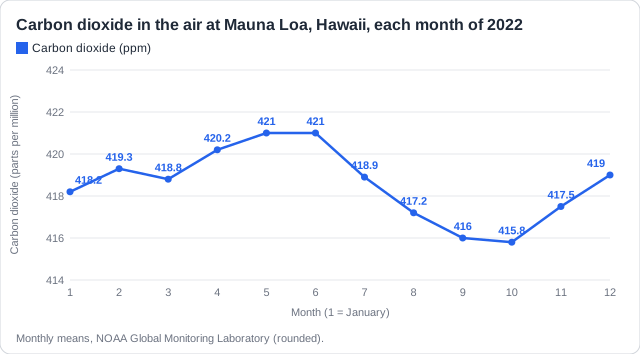
Real example: at Mauna Loa, Hawaii, carbon dioxide falls from about 421 ppm in May to about 416 ppm in October each year, as northern forests photosynthesise through the summer. In winter, respiration and decay win, and it rises again.
Link air and life: In a 'matter exchange' answer, every point must join the atmosphere to living things: say what moves, which way, and by which process.
Study smarter, not longer
Most students waste 40% of study time on topics they already know. Our AI tracks your progress and optimizes every minute.
Carbon also moves between living things and into the soil. Most of it gets back to the air through decomposers.
The points to remember
- Feeding passes carbon in food from producers to consumers along food chains.
- Defecation: undigested food leaves in faeces, carrying carbon to the soil.
- Death: bodies, fallen leaves and roots add carbon to the dead organic matter in soil.
- Decomposition: decomposers feed on dead matter and respire, releasing carbon dioxide.
- Cold, dry or waterlogged ground slows decomposition, so carbon builds up in soil or peat.
- Warm, moist, airy soil speeds it up, so little carbon stays in the soil.
- Warming can thaw permafrost and release its carbon as carbon dioxide and methane.
Remember it as: Eat it, drop it, rot it, breathe it out.
Real example: the frozen soils of the Arctic, the permafrost, hold about 1500 billion tonnes of carbon, nearly twice as much as the air. The cold has stopped dead plants rotting for thousands of years; as the Arctic warms, some is starting to thaw and decay.
Link the climate to a flow: 'It is cold' is not enough. Say what the cold does to a flow: it slows decomposition (more stored) or slows photosynthesis (less taken in).
Every flow is either a transfer or a transformation (see 1.2.4 for the general idea).
The points to remember
- A transfer moves carbon to a new place without changing its form.
- A transformation changes carbon into a new chemical form.
- Transfers: feeding, defecation, death (bodies to the soil), rivers carrying carbon to the sea.
- Transformations: photosynthesis, respiration, decomposition, combustion.
| Flow | Transfer or transformation? | Why |
|---|---|---|
| Feeding | Transfer | Carbon in food moves into the consumer |
| Defecation, death | Transfer | Organic matter moves to the soil |
| Photosynthesis | Transformation | Carbon dioxide becomes glucose |
| Respiration, decomposition | Transformation | Organic matter becomes carbon dioxide |
| Combustion | Transformation | Fuel becomes carbon dioxide |
Remember it as: Transfer: new place. Transformation: new form.
Real example: when a wildebeest in the Serengeti eats grass, the carbon in the grass moves into the animal: a transfer. When it respires the sugars, the carbon becomes carbon dioxide: a transformation.
Say why: Name the flow, then say whether carbon only changes place or changes chemical form.
Practice with exam-style questions
Answer exam-style questions and get AI feedback that shows you exactly what examiners want to see in a full-marks response.
Natural flows in and out of the air were roughly balanced. People have added large new flows, almost all of them into the atmosphere.
The points to remember
- Burning fossil fuels moves carbon from rock stores to the air: nearly 10 billion tonnes a year.
- Deforestation and land-use change move carbon from trees and soil to the air: over 1 billion tonnes a year.
- Only about half of this is taken up by land and ocean sinks; the rest stays in the air.
- Clearing forest cuts the carbon stored in biomass, leaf litter and roots.
- Burning or rotting cleared trees releases their carbon, and fewer trees take in less.
- Bare soil erodes, and warmer, better-aired soil decomposes faster, releasing soil carbon.
- Farm animals (methane) and forest fires are other flows that people increase.
| Store | How carbon leaves it |
|---|---|
| Living things | Respiration, death and decomposition, burning (fires, clearing) |
| Soils | Decomposition, ploughing and erosion, warming |
| Oceans | Released as a gas, more as the water warms |
| Fossil fuels | Burning for energy: the biggest flow people add |
Real example: in Rondonia, Brazil, much of the rainforest was cleared for cattle ranches from the 1970s. The cut trees were burned, releasing their carbon, and the pasture that replaced them takes in far less carbon than the forest did.
Say where the carbon was: For deforestation, name the store (trees, litter, roots, soil) and where the carbon goes (the air). 'It releases carbon' with no store is not enough.
You may be asked to draw part of the carbon cycle, or to read a diagram you are given.
The points to remember
- Boxes for stores, each labelled (e.g. Plants, Atmosphere).
- Arrows for flows, pointing the way carbon moves, each labelled with its process.
- For flows between two stores, show arrows in both directions.
- Draw only the stores you are asked for: extra boxes add no marks.
- To name a lettered arrow, check which two stores it joins and which way it points.
- Human-driven flows: burning fossil fuels, deforestation and land-use change. Volcanoes are natural.
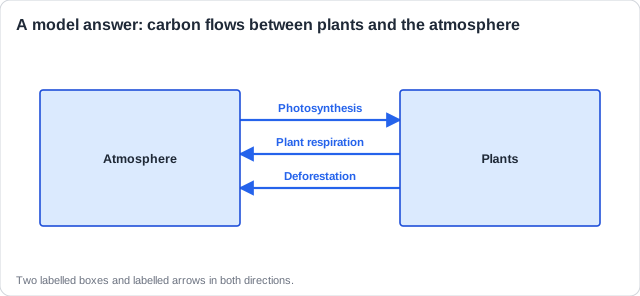
Real example: to draw the flows between the Amazon's trees and the air, draw two boxes, 'Trees' and 'Atmosphere'. One arrow in, 'photosynthesis'; arrows out, 'respiration' and 'burning of cleared forest'.
Both directions: One mark is for the two labelled stores, one for labelled flows going each way. An arrow pointing the wrong way loses the flow mark.
Feeling unprepared for exams?
Get a clear study plan, practice with real questions, and know exactly where you stand before exam day. No more guessing.
How this comes up: Paper 2, Section B (b): explain how matter is exchanged between the atmosphere and living things [7].
The air above a tropical rainforest in Costa Rica is constantly exchanging gases with the forest below.
Explain the exchange of matter between the atmosphere and living organisms.
Model answer plan
See the mark-by-mark plan — for / against / judgement, with marking guidance — in study mode.