Made by life, or not: Carbon is stored in two kinds of compound. Organic carbon is in the stuff of life; inorganic carbon is in simple compounds such as carbon dioxide.
The points to remember
- Organic carbon is in compounds made by living things: sugars, proteins, fats, wood.
- Organic stores: organisms (plants, animals, microbes) and their dead remains in soil and peat.
- Crude oil, natural gas and coal are organic too: they formed from ancient living things.
- Plants make organic carbon by photosynthesis; it passes to animals by feeding.
Remember it as: Organic: once alive. Inorganic: never alive.
Real example: the oil and gas under the North Sea formed from tiny sea plankton that died and were buried in mud about 150 million years ago. Their carbon is still organic, which is why oil and gas burn.
A common slip: Crude oil, natural gas and coal are organic stores, even though they are found in rocks.
Free preview
This is the free notes preview
You're reading the free notes. Aimnova Pro unlocks the full study experience — and you can try it with your first topic free to keep:
- FlashcardsLock in vocabulary and key terms with spaced repetition.
- Practice questionsAnswer exam-style questions and get instant AI marking.
- Mock exams & past-paper vaultSit full mocks and see exactly how examiners award marks.
- Personalised study planA daily plan built around your exam date and weak areas.
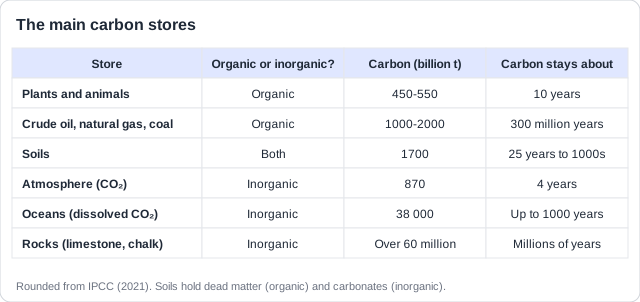
Most of the Earth's carbon is not in living things at all. It sits in the air, the water and the rocks, as simple compounds.
The points to remember
- Inorganic carbon is in simple compounds not made by living tissue: carbon dioxide, carbonates.
- The atmosphere: carbon dioxide gas.
- The oceans: dissolved carbon dioxide and carbonate, over 40 times the carbon in the air.
- Soils: carbonates and carbon dioxide in the air spaces (soils also hold dead organic matter).
- Rocks such as limestone and chalk hold the most carbon of all.
Real example: the White Cliffs of Dover in England are chalk. The carbon in them has been locked away as inorganic carbonate for about 70 million years.
What does not count: Plants, animals, cars and factories are not inorganic stores, and a flow such as burning or photosynthesis is not a store at all.
Memorize terms 3x faster
Smart flashcards show you cards right before you forget them. Perfect for definitions and key concepts.
Stores differ in how long carbon stays in them. Some turn over in a few years, others hold carbon for millions of years.
The points to remember
- A store is in equilibrium when carbon absorbed is balanced by carbon released.
- Residence time is the average time a carbon atom stays in a store.
- Short in the air (about 4 years) and in plants (about 10 years).
- Long in the deep ocean (up to 1000 years) and in rocks (millions of years).
- Fossil fuels: hundreds of millions of years, unless people mine and burn them.
- Burning moves this slow carbon into the air in days, faster than sinks can take it back.
Remember it as: Fast stores turn over in years; slow stores in millions of years.
Fast stores
- Atmosphere: about 4 years
- Plants: about 10 years
- Soils: decades
Slow stores
- Deep ocean: up to 1000 years
- Fossil fuels: hundreds of millions of years
- Rocks: millions of years
Real example: carbon in North Sea oil stayed underground for about 150 million years. Burned in a car engine, it is in the air as carbon dioxide within seconds, and may be in a leaf a few years later.
Why it matters: Fossil carbon had left the active cycle. Burning puts it back far faster than it was stored, so the air's store fills up (see 2.3.7 and 6.2).
How this comes up: Paper 2, Section A: a carbon-cycle picture with its stores. Identify one inorganic store [1].
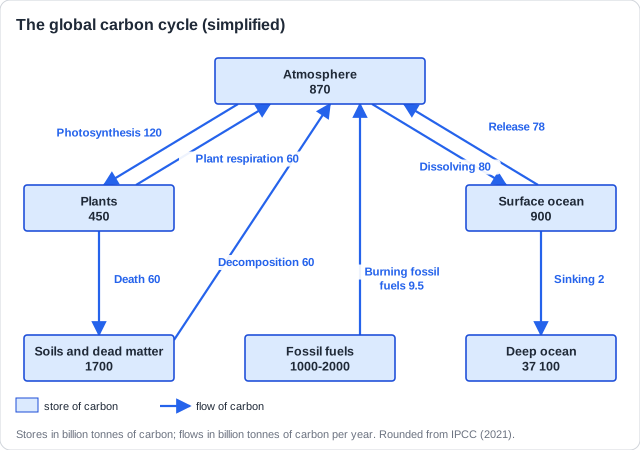
Figure 1 shows a simplified version of the global carbon cycle.
Identify one inorganic carbon store shown in Figure 1.
Model answer plan
See the mark-by-mark plan — for / against / judgement, with marking guidance — in study mode.