Think of a bath: Every store in a cycle has flows in and flows out, like a bath with the tap on and the plug out. Whether it fills, empties or stays level decides what we call it.
The points to remember
- A store (storage) holds an element for a time: carbon in the air, in soil, in trees.
- A store is in equilibrium when what flows in equals what flows out.
- So a store in equilibrium stays the same size over time.
- Store, sink or source depends on the balance of flows, not on how big the store is.
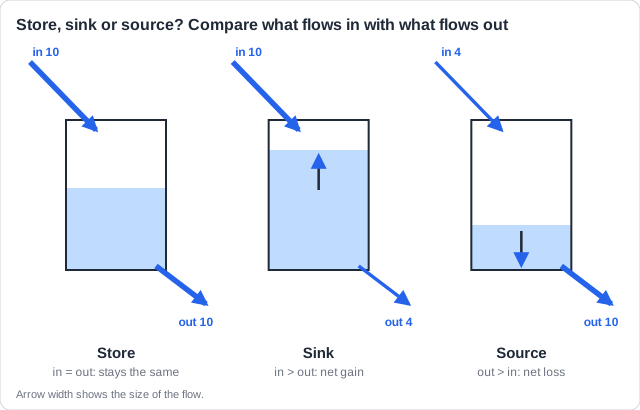
Remember it as: Same in, same out: a steady store.
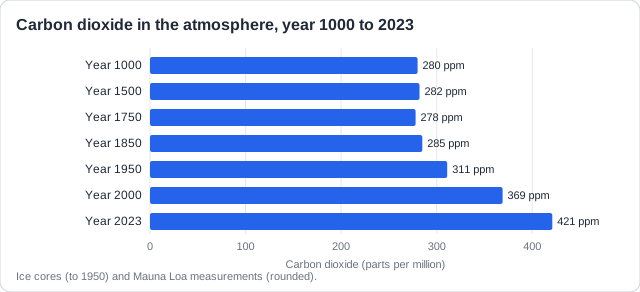
Real example: for about 750 years before 1750, the air held a steady 280 parts per million of carbon dioxide. Plants and oceans took in about as much carbon as respiration and decay put back: the atmosphere was a store in equilibrium.
Stores and flows again: Storages are boxes and flows are arrows in a system diagram (see 1.2.2 and 1.2.3).
Free preview
This is the free notes preview
You're reading the free notes. Aimnova Pro unlocks the full study experience — and you can try it with your first topic free to keep:
- FlashcardsLock in vocabulary and key terms with spaced repetition.
- Practice questionsAnswer exam-style questions and get instant AI marking.
- Mock exams & past-paper vaultSit full mocks and see exactly how examiners award marks.
- Personalised study planA daily plan built around your exam date and weak areas.
When the tap runs faster than the plug drains, the bath fills. A store that keeps gaining is a sink.
The points to remember
- A sink takes in more of an element than it releases: a net accumulation.
- So a sink grows over time.
- Carbon sinks: growing plants (photosynthesis greater than respiration), peat bogs, the oceans.
- Carbon sinks slow global warming by taking carbon dioxide out of the air.
- Say 'more in than out': 'it absorbs carbon' on its own does not show a sink.
Remember it as: Sink soaks: more in than out.
Real example: the Flow Country in northern Scotland is Europe's largest blanket bog. In the cold, waterlogged ground, dead moss hardly rots, so peat has built up for about 9000 years and now holds about 400 million tonnes of carbon: a sink.
Not just 'absorbs': A growing forest both takes in and gives out carbon. It is a sink only because it takes in MORE than it gives out.
See how examiners mark answers
Answer exam-style questions with model answers. Learn exactly what earns marks and what doesn't.
When the plug drains faster than the tap fills, the bath empties. A store that keeps losing is a source.
The points to remember
- A source releases more of an element than it takes in: a net release.
- So a source shrinks over time, and adds the element to other stores such as the air.
- Carbon sources: burning fossil fuels, respiration, burning or clearing forests, drained peat.
- A sink can become a source when people disturb it: a drained bog, a burned forest.
- Say 'more out than in': 'it releases carbon' on its own does not show a source.
Remember it as: Source sends: more out than in.
Sink
- More in than out
- Net accumulation
- The store grows
Source
- More out than in
- Net release
- The store shrinks
Real example: scientists flying over the Amazon from 2010 to 2018 found that its south-east, where forest has been cleared and burned, now releases more carbon than it takes in: once a sink, now a source.
Sinks can switch: When a question describes a disturbance, such as draining, burning or clearing, ask whether the balance flips from 'more in' to 'more out'. (Forests as sinks and sources in detail: 2.3.6.)
Exam data often give the flows in and out as numbers. The label (store, sink or source) comes from a simple subtraction.
The points to remember
- Find what flows in and what flows out, in the same units (e.g. tonnes per year).
- Work out the net: in minus out.
- Net above zero: a sink. Net zero: a store in equilibrium. Net below zero: a source.
- Quote the numbers: 'takes in 12, releases 7, so a net gain of 5 a year: a sink'.
- A clearly labelled diagram (boxes and arrows sized by the flows) can show the same thing.
| Flow (billion tonnes of carbon a year) | Amount |
|---|---|
| Carbon taken up by land plants (photosynthesis) | about 120 |
| Carbon released by land (respiration, decay, fires) | about 117 |
| Net: taken up minus released | about +3: a sink |
Real example: in the 2010s the world's land plants and soils took in about 3 billion tonnes more carbon each year than they released, so the land as a whole was a sink (Global Carbon Project).
Same time, same units: Compare flows over the same period and in the same units. A big store is not a sink unless it is gaining.
Study smarter, not longer
Most students waste 40% of study time on topics they already know. Our AI tracks your progress and optimizes every minute.
How this comes up: Paper 2, Section B (a): outline the difference between the three terms, with named examples [4].
Scientists describe parts of the carbon cycle as stores, sinks or sources.
With reference to named examples, outline the differences between a carbon store, a carbon sink and a carbon source.
Model answer plan
See the mark-by-mark plan — for / against / judgement, with marking guidance — in study mode.