aimnova.
DashboardMy LearningPaper MasteryStudy Plan

Aimnova site navigation

Stay in the loop

Get the latest study resources and updates

New features, study tips and exam insights — straight to your inbox.

IB Diploma

  • IB Past Papers
  • IB Study Notes
  • IB Question Bank
  • IB Mock Exams
  • IB Revision

IB Subjects

  • IB Math AA
  • IB Math AI
  • IB Economics
  • IB Business Management
  • IB Physics
  • IB Biology
  • View all IB subjects→

IB Past Papers

  • IB Math AA HL Past Papers
  • IB Math AA SL Past Papers
  • IB Math AI HL Past Papers
  • IB Math AI SL Past Papers
  • IB Economics HL Past Papers
  • IB Economics SL Past Papers
  • IB ESS Past Papers
  • View all past papers→

Study Resources

  • Study Notes
  • Question Bank
  • Mock Exams
  • Flashcards
  • Revision Guide
  • Exam Skills
  • Command Terms
  • Grade Calculator
  • Exam Timetable 2026

Aimnova

  • Features
  • Pricing
  • For Teachers
  • For Schools
  • For Parents
  • About Us
  • Blog
  • Contact
aimnova.

AI-powered study platform for smarter revision, past-paper analysis and examiner-style feedback.

TermsPrivacyCookies·© 2026 Aimnova. All rights reserved.29b4255

Aimnova is not affiliated with or endorsed by the International Baccalaureate Organization (IB).

NotesESSTopic 2.2Producers: the first trophic level
Back to ESS Topics
2.2.53 min read

Producers: the first trophic level

IB Environmental Systems and Societies • Unit 2

IB exam ready

Study like the top scorers do

Access a smart study planner, AI tutor, and exam vault — everything you need to hit your target grade.

Start Free

Contents

  • What a producer is
  • Counting trophic levels from the producer
  • Exam-style question
Where every food chain starts: producers make their own food by photosynthesis. So they always form the first trophic level of a food chain.

The points to remember

  • Producers make their own food by photosynthesis.
  • They are mostly plants, algae and photosynthetic bacteria.
  • They form the first trophic level of every food chain.
  • Every other organism in the chain gets its energy from them, directly or through other organisms.
Remember it as: Producers produce: they make the food everyone else eats.

Plants

  • On land.
  • Grass, trees, crops such as wheat.

Algae

  • Mostly in water.
  • Seaweeds and phytoplankton.

Photosynthetic bacteria

  • Single cells, in water and soil.
  • For example cyanobacteria.

Real example: the tiny phytoplankton of the oceans carry out about half of all the photosynthesis on Earth, so they are the producers for almost every ocean food chain.

Photosynthesis in one line: How photosynthesis works is taught in 2.2.4. Here you only need: producers use it to make their own food.

Free preview

This is the free notes preview

You're reading the free notes. Aimnova Pro unlocks the full study experience — and you can try it with your first topic free to keep:

  • FlashcardsLock in vocabulary and key terms with spaced repetition.
  • Practice questionsAnswer exam-style questions and get instant AI marking.
  • Mock exams & past-paper vaultSit full mocks and see exactly how examiners award marks.
  • Personalised study planA daily plan built around your exam date and weak areas.
Start Studying Free Full access to Aimnova Pro · cancel anytime

To find an organism's trophic level, start at the producer and count along the arrows. Each step is one level up.

Counting the levels

  • Count from the producer: the producer is level 1.
  • Level 2 = primary consumer (a herbivore, it eats the producer).
  • Level 3 = secondary consumer; level 4 = tertiary consumer.
  • Level 5 = quaternary consumer, often the top carnivore.
  • Give the name and the number: 'tertiary consumer, fourth trophic level'.
Remember it as: Producer 1, herbivore 2, then count the arrows.
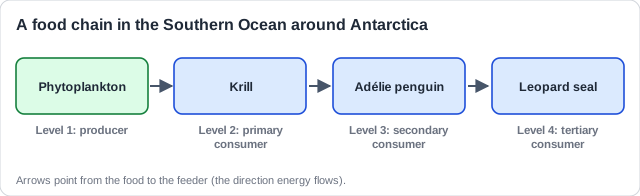
Food chain: phytoplankton, then krill, then Adélie penguin, then leopard seal, labelled levels 1 to 4
Count from the producer: each arrow is one level up.

Real example: in the Southern Ocean, krill are primary consumers at the second trophic level, and leopard seals are tertiary consumers at the fourth.

Words that do not score on their own: 'Top predator', 'top consumer', 'tertiary' or 'third' alone may not get the mark. Write the full name and the number, for example 'tertiary consumer, fourth trophic level'. Only your first answer is marked.

Learn what examiners really want

See exactly what to write to score full marks. Our AI shows you model answers and the key phrases examiners look for.

Try AI Feedback FreeYour first topic is free to keep • No credit card required
How this comes up: Paper 2, Section A, or a Paper 1 resource: a food chain or web. State the trophic level of one organism [1].
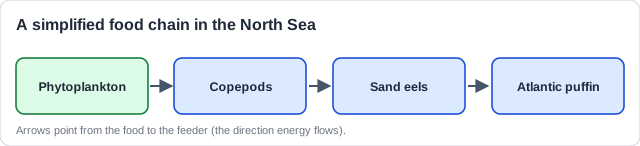
Food chain: phytoplankton, copepods, sand eels, Atlantic puffin
Figure 1
IB-style questionState[1 mark]

Figure 1 shows a simplified food chain in the North Sea.

State the trophic level of the Atlantic puffin.

Model answer plan

See the mark-by-mark plan — for / against / judgement, with marking guidance — in study mode.

Claim your free topic

Try an IB Exam Question — Free AI Feedback

Test yourself on Producers: the first trophic level. Write your answer and get instant AI feedback — just like a real IB examiner.

Giant kelp forests off California grow up to 60 cm a day.

why giant kelp is described as a producer.
[2 marks]

Related ESS Topics

Continue learning with these related topics from the same unit:

2.1.1The biosphere
2.1.2Organisms and species
2.1.3Classification
2.1.4Identification of organisms
View all ESS topics

Practice with flashcards

Spaced repetition flashcards for Producers: the first trophic level

Improve your exam technique

Command terms, paper structure, and mark-scheme tips for ESS

Previous
2.2.4Photosynthesis: from light to biomass
Next
Cellular respiration: releasing energy2.2.6

17 questions to test your understanding

Reading is just the start. Students who tested themselves scored 82% on average — try IB-style questions with AI feedback.

Start FreeView All ESS Topics