Every step leaks: As food is passed along a food chain, energy and organic matter are lost at every step. Only a small part reaches the next trophic level.
The points to remember
- The sun is the main source of energy for almost every food chain; producers capture it.
- At each step only a small part of the energy and organic matter becomes new biomass in the next level.
- The rest is lost: most as heat from respiration, some in waste and in parts not eaten.
- Energy is not destroyed (2.2.2): it leaves as heat, which no organism can use again.
- So there is never 100% transfer of organic matter from one trophic level to the next.
Remember it as: Every step leaks, mostly as heat.
Real example: in an English hay meadow, grasses capture a small part of the sunlight; grasshoppers that eat the grass pass on only a little of its energy to the frogs that eat them.
Where this fits: Why transformations are never 100% efficient (the second law) is on 2.2.8; heat from respiration on 2.2.7.
Free preview
This is the free notes preview
You're reading the free notes. Aimnova Pro unlocks the full study experience — and you can try it with your first topic free to keep:
- FlashcardsLock in vocabulary and key terms with spaced repetition.
- Practice questionsAnswer exam-style questions and get instant AI marking.
- Mock exams & past-paper vaultSit full mocks and see exactly how examiners award marks.
- Personalised study planA daily plan built around your exam date and weak areas.
Energy and matter are lost at four gates between one trophic level and the next. Each gate is a separate point in an answer.
Where the energy and matter go
- Not all the food available is harvested: prey escapes, some plants are never reached.
- Of what is harvested, not all is consumed: bones, bark, shells, roots and skin are left.
- Of what is consumed, not all is absorbed: undigested food leaves as faeces.
- Of what is absorbed, not all is stored: most is respired for movement and warmth, and lost as heat.
- Some absorbed matter also leaves as urine and other waste (excretion).
Remember it as: Harvested, consumed, absorbed, stored: less at every gate.
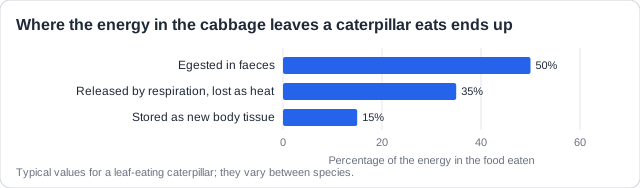
Real example: a cabbage white caterpillar egests about half of the leaf it eats and respires about a third; only about 15% becomes caterpillar that a bird can eat.
'Energy is lost' is not enough: Always say how: 'lost as heat from respiration', 'lost in faeces', 'parts not eaten'. The bare phrase 'energy is lost' is not credited.
See how examiners mark answers
Access past paper questions with model answers. Learn exactly what earns marks and what doesn't.
Put the four losses together and only a small share passes on each time.
The points to remember
- Typically only about 10% of the energy in one trophic level reaches the next: about 90% is lost.
- The figure varies, roughly 5-20%, between ecosystems, levels and species.
- Aquatic food chains are often a little more efficient than food chains on land.
- Warm-blooded birds and mammals lose more energy as heat than cold-blooded animals such as fish and insects.
- Less energy at each level is why food chains are short (2.2.14).
Remember it as: About a tenth goes up; nine tenths go out.
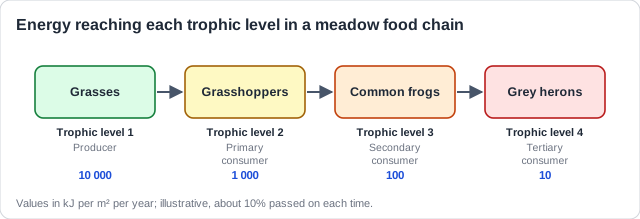
Real example: a grey heron needs the energy of many frogs, which needed many grasshoppers, which needed a large area of grass.
Numbers, not rules: The 10% figure is a rough guide, not a fixed law. Explain the losses; that is what the marks reward.
How this comes up: Paper 2, Section A: using named examples from a food web, explain the energy transfer between the producer and the primary consumer [2].
In a vegetable garden, cabbage plants are eaten by cabbage white caterpillars, which are eaten by blue tits.
Using named examples, explain the energy transfer between the producer and the primary consumer.
Model answer plan
See the mark-by-mark plan — for / against / judgement, with marking guidance — in study mode.