What moves along a food chain: In a food chain, carbon compounds, and the chemical energy they contain, pass from one organism to the next when it is eaten.
The points to remember
- When one organism eats another, its carbon compounds pass to the eater.
- The chemical energy stored in those compounds passes on with them.
- Each arrow in a food chain shows this transfer, from the food to the eater.
- So carbon compounds and energy move step by step along the chain, from the producer upwards.
- Energy flows one way only: it never goes back down the chain.
Remember it as: Eat the food, take its carbon and its energy.
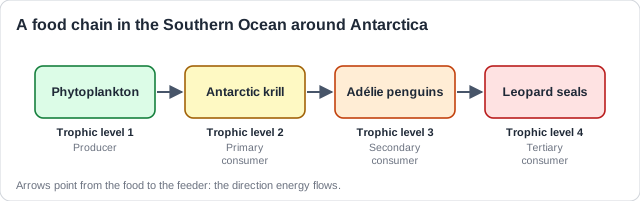
Real example: around Antarctica, the carbon compounds a krill makes from the phytoplankton it eats end up in an Adélie penguin, and then in the leopard seal that catches the penguin.
Which way the arrow points: An arrow means 'is eaten by': it points from the food to the eater, the way energy flows. Drawn from the eater to the food, it is backwards. Moving from prey to predator is a transfer: the compounds change place, not form (1.2.4).
Free preview
This is the free notes preview
You're reading the free notes. Aimnova Pro unlocks the full study experience — and you can try it with your first topic free to keep:
- FlashcardsLock in vocabulary and key terms with spaced repetition.
- Practice questionsAnswer exam-style questions and get instant AI marking.
- Mock exams & past-paper vaultSit full mocks and see exactly how examiners award marks.
- Personalised study planA daily plan built around your exam date and weak areas.
The stages in a food chain are called trophic levels. Every organism in a chain sits at one of them.
The points to remember
- Each stage in a food chain is a trophic level: the position an organism occupies, counted from the producer.
- Trophic level 1: producers (plants, algae). Level 2: primary consumers, the herbivores.
- Level 3: secondary consumers. Level 4: tertiary consumers. Level 5: quaternary. The last is the top predator.
- To state a level, give the name and add the number: 'secondary consumer (trophic level 3)'.
- An omnivore can feed at more than one trophic level.
Remember it as: Count from the producer: 1, 2, 3, 4.
Real example: in phytoplankton, krill, Adélie penguins, leopard seals, the penguin is a secondary consumer at trophic level 3.
Say the name: 'Trophic level 1' alone, 'third consumer', 'prey' or 'animal' may not be credited when a question says 'State'. Write 'producer' or 'secondary consumer', then add the number.
Practice with real exam questions
Answer exam-style questions and get AI feedback that shows you exactly what examiners want to see in a full-marks response.
Papers often give a food web and ask for the trophic level of one organism, or for a producer.
Reading levels from a food web
- Find the producers first: no arrows point into them.
- Follow the arrows to the eater, counting each step from the producer.
- An organism's level depends on the chain it is in; in a web it can sit in several chains.
- Use the names in the figure: 'Antarctic krill', not 'an animal'.
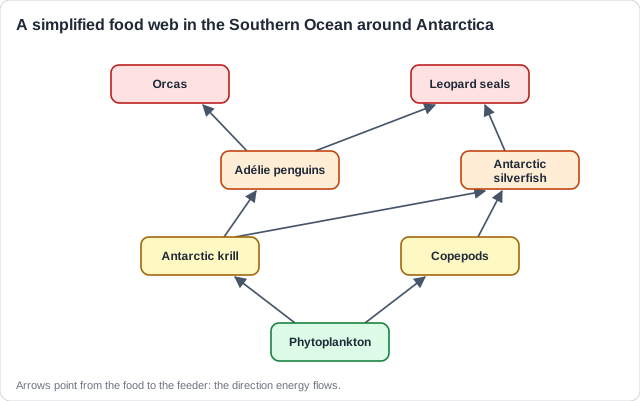
Try it: krill are primary consumers. Leopard seals eating penguins are tertiary consumers, but eating silverfish that ate krill they are also tertiary; orcas eating penguins are tertiary too.
Name a producer: Asked for a producer, give one organism from the figure, such as 'phytoplankton' or 'ice algae'.
Dead organisms and waste from every trophic level end up with the decomposers.
The points to remember
- Decomposers feed on dead matter and waste from every level, so they have no single place in a chain.
- That is why they are usually left out of food chains.
- They still take in carbon compounds and the chemical energy in them.
- Their respiration turns that chemical energy into heat, which is lost from the food web.
- In a food web, they link to every level through dead matter.
Remember it as: Every level ends up with the decomposers.
Real example: on the Antarctic sea floor, bacteria feed on dead krill, penguin droppings and the bodies of seals alike, so they take carbon compounds from several trophic levels at once.
Their feeding strategies: Which organisms are decomposers, detritivores and scavengers is on 2.2.9.
Feeling unprepared for exams?
Get a clear study plan, practice with real questions, and know exactly where you stand before exam day. No more guessing.
How this comes up: Paper 2, Section A: short parts on a food chain, such as outlining why decomposers are left out [2].
A student draws the food chain phytoplankton, krill, Adélie penguins, leopard seals, and asks where the bacteria on the sea floor belong.
Outline why decomposers are not usually included in food chains.
Model answer plan
See the mark-by-mark plan — for / against / judgement, with marking guidance — in study mode.