Reducing urban air pollution at Higher Level: The same strategies as SL, through different cities: Paris, Mexico City, Stockholm, Shenzhen, Medellin and London's 2023 ULEZ. At HL, judge each one through law and economics: who pays, how it is enforced, and whether people accept it.
Practise this as you read
- Place each strategy at a level of the model.
- Weigh laws against technology, with a named city for each.
Free preview
This is the free notes preview
You're reading the free notes. Aimnova Pro unlocks the full study experience — and you can try it with your first topic free to keep:
- FlashcardsLock in vocabulary and key terms with spaced repetition.
- Practice questionsAnswer exam-style questions and get instant AI marking.
- Mock exams & past-paper vaultSit full mocks and see exactly how examiners award marks.
- Personalised study planA daily plan built around your exam date and weak areas.
Three places to act: Air pollution can be managed where it starts (the activity), where it escapes (the release) or where it does harm (the impact). The pollution management model puts these in order.
The three levels
- Level 1, change the activity: burn less fuel: public transport, cycling, renewable energy, efficient homes.
- Level 2, control the release: catalytic converters, scrubbers, emission laws, low emission zones.
- Level 3, clean up and restore: trees and green spaces, health care, warnings, cleaning buildings, liming acid ponds.
- Level 1 stops pollution at its source, but needs money and behaviour change.
- Level 2 is effective and easy to enforce, but people keep burning fuel, and rich firms may just pay fines.
- Level 3 is short-term and can be costly: it treats the damage, not the cause.
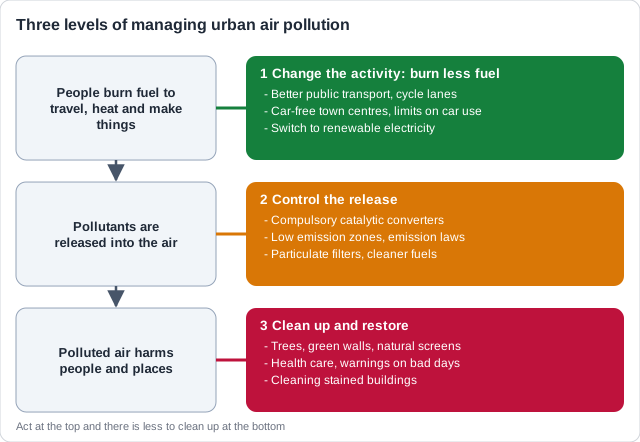
Real example: Paris acts at all three levels. It closed the riverside expressway along the Seine to cars in 2016 and built hundreds of kilometres of cycle lanes (level 1); its Crit'Air stickers keep the oldest vehicles out of the city (level 2); and it plants trees in squares and schoolyards (level 3).
Memorize terms 3x faster
Smart flashcards show you cards right before you forget them. Perfect for definitions and key concepts.
The most sustainable strategies change how people move, so less fuel is burned in the first place. This is level 1.
Changing how people travel
- Improved public transport: metros, trams and fast bus lanes carry many people for little fuel each.
- Infrastructure for cycling: safe, separate cycle lanes and bike-sharing schemes.
- Limited car use: driving bans by number plate, car-free days, caps on new cars.
- Pedestrianised town centres: streets closed to traffic, so no exhaust where people walk.
- Planning: homes, jobs and shops close together, so trips are short; working from home.
- Campaigns: car sharing, walking to school, and travel advice on high-pollution days.
Better options
- Metros, trams, bus lanes
- Protected cycle lanes
- Bike-sharing schemes
Fewer cars
- Driving bans by number plate
- Car-free days
- Caps on new cars
Car-free places
- Pedestrianised centres
- School streets
- Mixed-use neighbourhoods
Reading a transport graph: Car use rises with incomes and status, and falls with caps, charges and better public transport. Cycling rises with safe lanes and subsidies; it falls as roads get busier and people can afford cars.
Real example: in 1989 Mexico City began Hoy No Circula ('today it does not drive'): each car is banned on one weekday, chosen by the last digit of its number plate. Studies found little effect on air quality, because many families bought a second, often older, car.
A ban needs an alternative: Limiting cars works only if people have another way to travel. Without good public transport, people find a way round the rule.
Laws, charges and money can make polluting more expensive and cleaner choices cheaper. They act at levels 1 and 2.
Laws, zones and charges
- Low emission zones: older, dirtier vehicles pay or are banned in part of the city.
- Congestion charges: drivers pay to enter the centre (London, Singapore, Stockholm).
- Standards: limits on what vehicles and factories may emit; air-quality targets (WHO).
- Cleaner fuel rules: low-sulfur fuel, leaded petrol banned.
- Money: pollution taxes, subsidies for electric vehicles and renewables, scrappage of old cars, cap and trade.
- Agreements with neighbouring regions or countries for pollution that crosses borders.
- Laws only work if they are enforced and people have alternatives.
Congestion charge
- Pay to drive into the centre
- Cuts the number of vehicles
- Money can fund buses
Low emission zone
- Older, dirtier vehicles pay or are banned
- Cuts the dirtiest exhausts
- Pushes people to cleaner cars
Real example: Stockholm tested a congestion tax in 2006, and traffic crossing the charging line fell by about a fifth. People were doubtful at first, but after the trial they voted to keep it, and it became permanent in 2007.
Know your predicted grade
Take timed mock exams and get detailed feedback on every answer. See exactly where you're losing marks.
Technology can clean up exhausts and chimneys without anyone changing their habits. This is mostly level 2, controlling the release.
Technology at the source
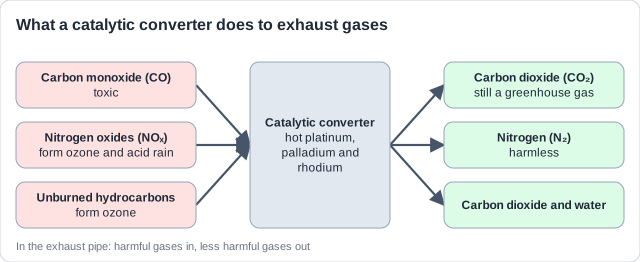
- Compulsory catalytic converters: turn CO, NOₓ and hydrocarbons into CO₂, nitrogen and water.
- Particulate filters trap soot from diesel exhausts.
- Electric, hybrid and hydrogen vehicles: no or less exhaust; but the electricity's source matters.
- Industry: scrubbers spray lime and water to remove SO₂; electrostatic precipitators remove particles.
- Fuel switching: coal to gas or renewables; at home, clean cookstoves, heat pumps, insulation.
- Technology is fast, but costly, and more cars can cancel out cleaner engines.
- For ozone, cut VOCs as well as NOₓ: car sharing, fewer solvent-based paints, less livestock methane.
Real example: Shenzhen, China, replaced its whole fleet of more than 16,000 buses with electric buses by the end of 2017, so they release no exhaust in the city's streets.
Limits of the technology: Catalytic converters cost money, still release carbon dioxide, and use rare metals (platinum, palladium, rhodium) that are mined and often stolen. Electric vehicles need charging points, and their electricity may come from coal.
Plants can clean some of the air once it is polluted, and they make cities nicer to live in. This is mostly level 3, clean-up.
Green solutions
- Growing trees: leaves trap particles and take up some gases; shade cools streets.
- Natural screens: hedges between a busy road and a school or pavement block some fumes.
- Green walls and roofs: plants on buildings, where there is no room for trees.
- They also cool the city, hold rainwater and give wildlife a home.
- Limits: they clean only a little air; a dense canopy in a narrow street can trap exhaust; some trees release VOCs.
- Planning rules can require greenery: Singapore makes new buildings replace the green space they cover.
Remember it as: Trees help, but no city can plant its way out of its traffic.
Real example: from 2016 Medellín, Colombia, planted 30 Green Corridors. The city reports streets about 2 °C cooler, and the trees trap some of the traffic's particles.
Do not overclaim: Trees and green walls clean only a small share of a city's air. In an evaluation, say so: they treat the symptom, not the cause.
Get feedback like a real examiner
Submit your answers and get instant feedback — what you did well, what's missing, and exactly what to write to score full marks.
Many questions ask you to evaluate a strategy, or to judge one approach against another. Use the same checklist every time, and finish with a judgement.
Judging a strategy
- Effectiveness: how much does pollution fall, and does it just move elsewhere?
- Cost: who pays: the government, drivers, companies?
- Equity: does it fall hardest on poorer people?
- Enforcement and support: can it be policed, and will people accept it?
- Values: technocentric people trust technology; anthropocentric people trust laws and planning; ecocentric people want less consumption.
- Percentage change = (new - old) / old x 100: Beijing (58 - 89.5) / 89.5 x 100 = -35 %.
Strengths
- Big fall in roadside NO₂
- Pushes people to cleaner cars
- Money funds buses
Limitations
- Costly for poorer drivers
- Unpopular in outer London
- Does not cut car numbers much
Real example: when London extended its ULEZ to the whole city in August 2023, the dirtiest vehicles became rarer and City Hall reported falling NO₂. But many outer-London drivers and businesses opposed it, and a scrappage scheme was needed to help poorer owners replace old cars.
How this comes up: HL Paper 1: a fact file on a city, then 'Describe how PM2.5 could be managed' [4]: four different strategies, each matched to the city.
Kathmandu, Nepal, lies in a bowl-shaped valley. Its PM2.5 is high in the dry winter months, from old diesel vehicles, brick kilns on the valley floor, dust from unpaved roads and rubbish burning.
Describe how PM2.5 levels in Kathmandu could be managed.
Model answer plan
See the mark-by-mark plan — for / against / judgement, with marking guidance — in study mode.