Changing value at Higher Level: The same statement as SL, with different real cases: cork, which lost value to screw caps and won it back, and uranium after Fukushima. At HL, link value to economics and politics: prices, taxes, treaties and energy security.
Practise this as you read
- Explain a rise and a fall in the value of one named resource.
- Read a price graph and link each change to a reason.
Free preview
This is the free notes preview
You're reading the free notes. Aimnova Pro unlocks the full study experience — and you can try it with your first topic free to keep:
- FlashcardsLock in vocabulary and key terms with spaced repetition.
- Practice questionsAnswer exam-style questions and get instant AI marking.
- Mock exams & past-paper vaultSit full mocks and see exactly how examiners award marks.
- Personalised study planA daily plan built around your exam date and weak areas.
Value is not fixed: The value of natural capital is dynamic: a resource that was precious can become almost worthless, and one nobody wanted can become valuable.
Why value changes
- Technology: a new use raises value (lithium in batteries); a substitute lowers it (kerosene for whale oil).
- Economics: demand, price, the cost of extraction, and gluts of supply all move value.
- Culture and society: changing attitudes, e.g. animal rights made real fur less wanted.
- Politics: laws, taxes, treaties and energy security push value up or down.
- Environment: new knowledge of harm (climate change) or of benefits (biodiversity) changes value.
- Scarcity: as a resource runs out, extraction costs more and its value changes.
- Place: value also varies between regions, e.g. cork matters most where wine is made.
Remember it as: Tools, money, minds, laws, nature, scarcity and place: seven reasons value moves.
Value goes up when
- A new use is found
- Demand or energy security grows
- Awareness favours it (renewables)
Value goes down when
- A cheaper substitute appears
- Attitudes or laws turn against it
- Its harm becomes clear
Real example: natural cork is valued most in wine regions such as Portugal and France, where it seals bottles, and far less where wine is not made: value varies by place as well as time.
Show the change: Saying a resource has high value is not enough. Say what changed, why, and whether its value rose or fell.
Study smarter, not longer
Most students waste 40% of study time on topics they already know. Our AI tracks your progress and optimizes every minute.
The guide asks for two named examples of change over time. Learn each one as a short story: what it was used for, what changed, and why.
Bark
- Cork is the bark of the cork oak; it is stripped by hand every nine years without felling the tree. Portugal produces about half of the world's cork
1990s
- Plastic stoppers and screw caps took over many wine bottles, partly because some cork spoiled the wine: value fell
Fix
- Cork makers found ways to stop the spoiling, and cork found new uses in flooring, insulation and shoes: technology
Today
- Cork is valued as natural and recyclable, and its oak forests as habitat for the rare Iberian lynx: value rose again
Real example: cork's value fell when cheap substitutes arrived, then rose again with new uses and a greener image.
Different reasons, different marks: Four marks need four different reasons. One example can give more than one reason, as long as each reason is a different kind.
A second example, this time with a graph. Uranium shows politics and attitudes changing value.
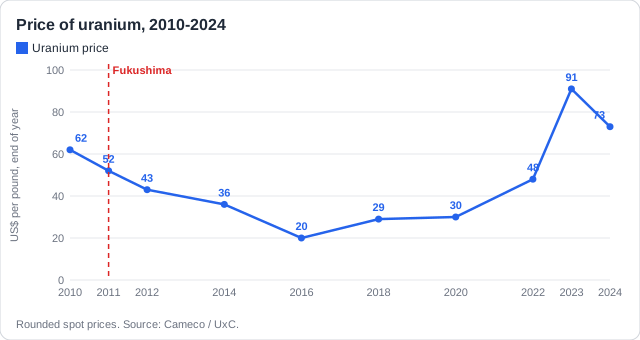
Why uranium's value changed
- Down: after the Fukushima accident in March 2011, fear of nuclear power grew.
- Down: Japan shut its reactors and Germany decided to close all its nuclear plants.
- Up: nuclear power emits almost no carbon dioxide, so climate goals raised demand.
- Up: at COP28 in 2023, over 20 countries pledged to triple nuclear power by 2050.
Real example: uranium fell from about US$62 a pound at the end of 2010 to about US$20 in 2016, then rose to about US$91 by the end of 2023. Germany closed its last three reactors in April 2023.
Practice with exam-style questions
Answer exam-style questions and get AI feedback that shows you exactly what examiners want to see in a full-marks response.
How this comes up: Paper 2, Section B (a): four different reasons, [1] each, each with an example.
The price of uranium fell by about two-thirds between 2010 and 2016, then more than quadrupled by the end of 2023.
Outline four reasons why the value of natural capital such as uranium changes over time.
Model answer plan
See the mark-by-mark plan — for / against / judgement, with marking guidance — in study mode.