Harm from UV at Higher Level: The same effects as SL, with different evidence: phytoplankton near Davis Station, melanoma by sex and in Australia, and the cancers SunSmart prevented. HL papers ask you to list health risks beside an ozone-hole graph: keep the human effects and the effects on ecosystems apart.
Practise this as you read
- Name each effect with its cause: UVB burns, UVA ages, DNA damage causes cancer.
- Quote the data when a question gives it.
Free preview
This is the free notes preview
You're reading the free notes. Aimnova Pro unlocks the full study experience — and you can try it with your first topic free to keep:
- FlashcardsLock in vocabulary and key terms with spaced repetition.
- Practice questionsAnswer exam-style questions and get instant AI marking.
- Mock exams & past-paper vaultSit full mocks and see exactly how examiners award marks.
- Personalised study planA daily plan built around your exam date and weak areas.
UV hits the base of the food web: Phytoplankton make the food for almost all ocean life. UV slows their photosynthesis, and the loss passes up the food chain.
The points to remember
- UV (mainly UVB) reduces photosynthesis in phytoplankton.
- Phytoplankton float near the sunlit surface, so they cannot escape the UV.
- They are the base of ocean food webs: less phytoplankton means less food for krill, fish, whales and penguins.
- So UV lowers the productivity of the whole ecosystem.
- Phytoplankton also take in carbon dioxide, so less of them means less carbon taken up by the ocean.
- On land, UV damages leaves and slows plant growth, including crops.
More UV
- More UVB reaches the sea surface.
Phytoplankton
- Less photosynthesis, slower growth.
Krill
- Less food, so fewer krill.
Whales, penguins
- Less food further up the chain.
Real example: near Davis Station, East Antarctica, Australian scientists grew phytoplankton in the open in spring (1997-2000). When ozone fell below 300 Dobson units, their growth fell by more than half over two months.
Remember it as: Less phytoplankton, less food for everything above it.
See how examiners mark answers
Answer exam-style questions with model answers. Learn exactly what earns marks and what doesn't.
UV does more than burn. It carries enough energy to damage the DNA inside cells.
The points to remember
- UV has enough energy to damage DNA in living cells.
- When a damaged cell divides, the damage can be copied as a mutation.
- Mutations in skin cells can lead to skin cancer.
- Melanoma is the most dangerous skin cancer; other skin cancers are more common but less deadly.
- DNA damage harms all living things: plants, plankton, animals and people.
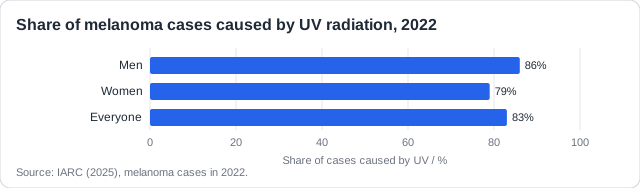
Real example: UV caused 86% of melanomas in men and 79% in women in 2022. The highest rate of UV-caused melanoma was in Australia and New Zealand: about 76 cases per 100,000 people, where sunshine is strong and many people have fair skin.
Use the words 'mutation' and 'cell division': 'UV damages DNA, causing mutations when cells divide, which can lead to skin cancer' is the full chain. 'UV causes cancer' alone is too short.
Skin cancer is the best known harm, but UV hurts people in several other ways, in the skin and in the eyes.
The points to remember
- Sunburn: red, painful skin, caused mainly by UVB.
- Premature ageing of the skin: UVA reaches deep into the skin, causing wrinkles and spots.
- Cataracts: the lens of the eye turns cloudy, which can cause blindness; up to 10% of cataracts may come from UV.
- Skin cancer, including melanoma, from DNA damage.
- A weaker immune system: UV on the skin can lower the body's defences.
- The one benefit: a little UVB makes vitamin D.
Skin
- Sunburn (UVB).
- Premature ageing (UVA).
- Skin cancer.
Eyes
- Cataracts: a cloudy lens.
- Sunburn of the eye surface.
Body
- Weaker immune system.
- Benefit: vitamin D.
Real example: the World Health Organization's cancer agency scientists estimate that Victoria's SunSmart campaigns prevented about 103,000 skin cancers and 1,000 deaths between 1988 and 2003.
Keep the right effect with the right radiation: Sunburn, cataracts and skin cancer come from UV. Ground-level ozone in smog harms the lungs; do not give UV effects for it.
Study smarter, not longer
Most students waste 40% of study time on topics they already know. Our AI tracks your progress and optimizes every minute.
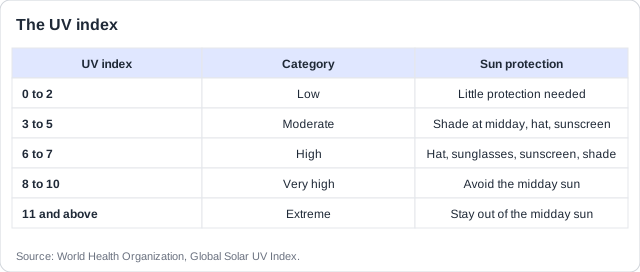
Papers give data on UV and its harm, then ask you to read it or to list effects. The UV index is the scale forecasts use.
The points to remember
- The UV index tells you how strong the Sun's UV is: the higher the number, the faster skin burns.
- 0-2 low, 3-5 moderate, 6-7 high, 8-10 very high, 11+ extreme.
- Protect your skin at 3 or above.
- When you use data, quote the numbers: 'at a UV index of 11, cases rose to 34'.
- A 'list' question on human health: name human effects only, not effects on plants or plankton.
Real example: in summer, the midday UV index in Queensland, Australia, often reaches 11 or more: extreme, the top of the scale.
Read the question's target: 'List two risks to human health': skin cancer, cataracts, sunburn, premature ageing, DNA damage. Effects on phytoplankton or crops score nothing here.
How this comes up: Paper 2, Section A: list or explain the harm UV does, usually beside a figure about the ozone layer. One effect per mark, and only the effects the question asks for.
A graph shows that the area of thin ozone over Antarctica grew between 1980 and 2000. People in southern Chile and Argentina live close to its edge.
List two risks to human health that may have increased.
Model answer plan
See the mark-by-mark plan — for / against / judgement, with marking guidance — in study mode.