The natural ozone balance at Higher Level: The same balance as SL, with the chemistry written out: at HL you need the equations for ozone formation and destruction. Learn the four reactions here; the next micro adds the reactions by which human-made chemicals speed up the destruction.
Practise this as you read
- Write the four equations of the cycle from memory.
- Explain the steady state as equal rates of formation and destruction.
Free preview
This is the free notes preview
You're reading the free notes. Aimnova Pro unlocks the full study experience — and you can try it with your first topic free to keep:
- FlashcardsLock in vocabulary and key terms with spaced repetition.
- Practice questionsAnswer exam-style questions and get instant AI marking.
- Mock exams & past-paper vaultSit full mocks and see exactly how examiners award marks.
- Personalised study planA daily plan built around your exam date and weak areas.
Ozone is never finished: High in the stratosphere, sunlight makes ozone and sunlight breaks it down, every second of the day.
The points to remember
- Made, step 1: high-energy UV splits an oxygen molecule (O₂) into two oxygen atoms.
- Made, step 2: each oxygen atom joins an oxygen molecule to make ozone (O₃).
- Broken, step 3: ozone absorbs UV and splits into an oxygen molecule and an oxygen atom.
- Broken, step 4: an oxygen atom meets an ozone molecule, and they make two oxygen molecules.
- Step 3 is how the ozone layer absorbs UV: the UV's energy is used to split the ozone.
HL: the equations: O₂ + UV → O + O
O + O₂ → O₃ (formation)
O₃ + UV → O₂ + O, and O + O₃ → 2 O₂ (destruction)
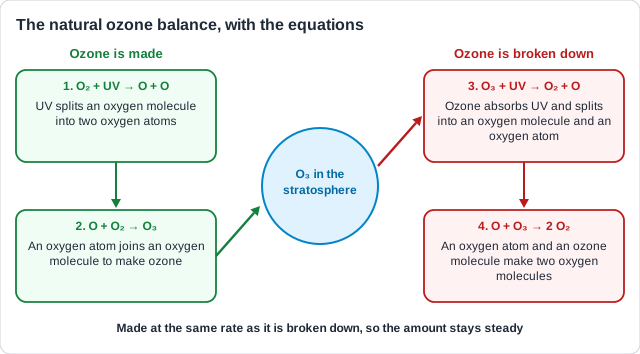
Remember it as: UV makes it, UV breaks it.
Real example: the steps above are the Chapman cycle (Sydney Chapman, 1930). Most ozone is made over the tropics, where the Sun's UV is strongest, and is then carried towards the poles.
Get feedback like a real examiner
Submit your answers and get instant feedback — what you did well, what's missing, and exactly what to write to score full marks.
If ozone is made and destroyed all the time, why does the ozone layer not grow or vanish? Because the two processes run at the same rate.
The points to remember
- Ozone is made and broken down at the same time, all the time.
- When the two rates are equal, the amount of ozone stays about the same.
- This is a steady-state equilibrium: things keep changing, but the total stays steady.
- If ozone builds up, more of it is there to be broken down, so it falls back: a negative feedback.
- So the concentration of ozone stayed about constant over long periods of time.
Inputs to the ozone store
- UV splits oxygen molecules
- Oxygen atoms join oxygen to make ozone
Outputs from the ozone store
- Ozone absorbs UV and splits
- Oxygen atoms and ozone make oxygen
Link 1.2: a steady state: Like a bath with the tap on and the plug out: if water flows in as fast as it drains, the level stays the same, even though the water is always changing.
Real example: in spring, ozone over Antarctica measured about 300 Dobson units from the 1950s into the 1970s, year after year: formation and destruction were in balance.
How this comes up: A short Paper 2 question on how ozone forms and breaks down, or why its amount stays steady. Give each step in order, one per mark.
In the stratosphere, ozone is made and destroyed by natural reactions driven by sunlight.
Using chemical equations, outline how ozone is formed and destroyed naturally.
Model answer plan
See the mark-by-mark plan — for / against / judgement, with marking guidance — in study mode.