Halogens and ozone at Higher Level: This statement is Higher Level only. It goes inside the ozone layer to show how a few chlorine and bromine atoms from CFCs and halons can destroy huge amounts of ozone. You need the steps and the two equations.
Practise this as you read
- Outline how CFCs damage the ozone layer, step by step.
- Explain why one chlorine atom can destroy so many ozone molecules.
Free preview
This is the free notes preview
You're reading the free notes. Aimnova Pro unlocks the full study experience — and you can try it with your first topic free to keep:
- FlashcardsLock in vocabulary and key terms with spaced repetition.
- Practice questionsAnswer exam-style questions and get instant AI marking.
- Mock exams & past-paper vaultSit full mocks and see exactly how examiners award marks.
- Personalised study planA daily plan built around your exam date and weak areas.
A safe gas low down, a destroyer high up: ozone-depleting substances (ODSs) such as CFCs are harmless where we use them. The trouble starts when they reach the stratosphere: there, sunlight breaks them apart and frees halogens that destroy ozone.
The points to remember
- ODSs are man-made carbon compounds that contain halogens: chlorine, fluorine or bromine.
- CFCs were used as coolants in fridges and air conditioners, in aerosol sprays and in foam.
- They are released when sprays are used or old appliances leak or are scrapped.
- They are so stable that they drift up for years into the stratosphere without breaking down.
- There, strong UV light splits them and sets free highly reactive chlorine atoms.
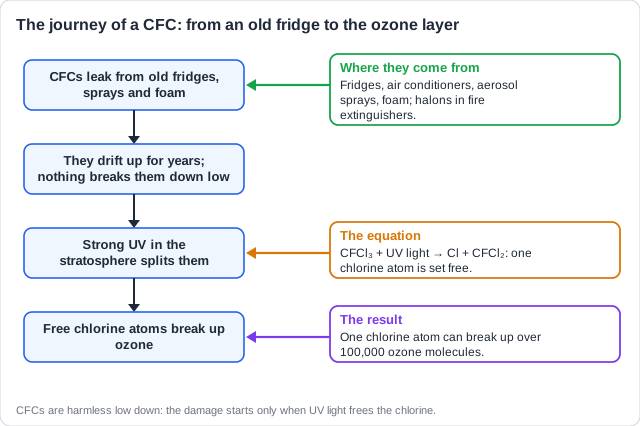
Real example: in 1974 two chemists in California, Mario Molina and Sherwood Rowland, asked where the CFCs from spray cans end up. Their answer, published in the journal Nature, was the stratosphere, where UV light would split them and free chlorine to attack ozone. Industry called it science fiction. Eleven years later the ozone hole was found, and in 1995 they shared the Nobel Prize in Chemistry with Paul Crutzen. CFC-11 had been the propellant in many sprays.
Know your predicted grade
Take timed mock exams and get detailed feedback on every answer. See exactly where you're losing marks.
The freed chlorine is a free radical: it reacts with almost anything it meets. In the stratosphere it meets ozone, and it destroys it in a chain reaction.
The chain reaction
- Step 1: a chlorine atom takes an oxygen atom from ozone: Cl + O₃ → ClO + O₂.
- Step 2: a free oxygen atom takes it back: ClO + O → Cl + O₂. The chlorine is free again.
- Overall, ozone is turned into ordinary oxygen: O₃ + O → 2 O₂.
- Chlorine is a catalyst: it is not used up, so it repeats the cycle again and again.
- So one chlorine atom can destroy over 100,000 ozone molecules before it is removed.
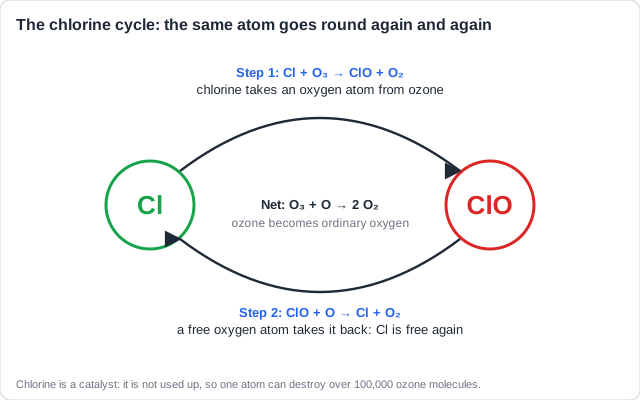
Remember it as: Steal, give back, repeat: chlorine is never used up.
Real example: in August and September 1987 a NASA high-altitude plane, the ER-2, flew from Punta Arenas in southern Chile into the air over Antarctica. James Anderson's instruments measured chlorine monoxide (ClO) and ozone together. Where ClO shot up, ozone fell away, like a mirror image. It was the proof that chlorine from CFCs was destroying the ozone.
Two traps: Do not write that CFCs destroy ozone themselves: it is the chlorine they release. And chlorine is a catalyst, so do not say it is 'used up' when it reacts.
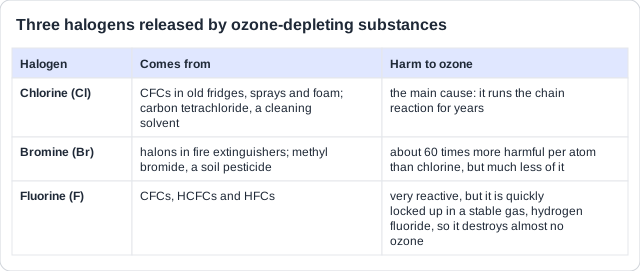
Three halogens are released by ozone-depleting substances. They are all very reactive, but they do very different amounts of harm.
Chlorine, bromine and fluorine
- Chlorine does most of the damage: CFCs carry a lot of it.
- Bromine, from halons and methyl bromide, is about 60 times more harmful per atom.
- Fluorine is also released, but it is quickly locked up in a stable gas, so it destroys almost no ozone.
- Chlorine is removed only slowly, into harmless reservoir gases such as hydrogen chloride.
- CFCs last 50-100 years in the air, so ozone is still being destroyed decades after the ban.
Bromine sources
- halons in fire extinguishers
- methyl bromide sprayed on fields
- Both banned under the Montreal Protocol
Why chlorine lingers
- CFC-12 lasts about 100 years in the air
- Chlorine slowly ends up in reservoir gases
- So damage goes on long after a ban
Real example: in 2018 scientists noticed that CFC-11, banned since 2010, was falling far more slowly than it should. Air samples traced the extra gas to factories in eastern China making foam insulation with it illegally. After a crackdown, the emissions fell back by 2019. A banned gas still released somewhere reaches the same stratosphere.
Get feedback like a real examiner
Submit your answers and get instant feedback — what you did well, what's missing, and exactly what to write to score full marks.
How this comes up: Paper 2, Section A: a short Outline or Explain [2-4] on how CFCs damage ozone, often next to a graph of the ozone hole. Credit goes to the steps: release, UV splits the CFC, chlorine breaks down ozone.
In 2018 scientists found that emissions of CFC-11, a banned ozone-depleting substance, had risen again. The gas was traced to factories in eastern China using it to make foam insulation.
Outline how CFC-11 released by these factories affects the ozone layer.
Model answer plan
See the mark-by-mark plan — for / against / judgement, with marking guidance — in study mode.