UV radiation at Higher Level: The same chain as SL (shorter wave, higher frequency, more energy, more harm) with different examples: welders' 'arc eye' and Australia's sunbed ban. At HL the energy of UV also explains the chemistry ahead: UV is what splits oxygen and ozone molecules in the stratosphere.
Practise this as you read
- Build the chain from wavelength to harm in every answer.
- Name the band and how much of it the ozone layer absorbs.
Free preview
This is the free notes preview
You're reading the free notes. Aimnova Pro unlocks the full study experience — and you can try it with your first topic free to keep:
- FlashcardsLock in vocabulary and key terms with spaced repetition.
- Practice questionsAnswer exam-style questions and get instant AI marking.
- Mock exams & past-paper vaultSit full mocks and see exactly how examiners award marks.
- Personalised study planA daily plan built around your exam date and weak areas.
Shorter wave, more energy, more danger: Ultraviolet (UV) sits just past violet light. Its short waves carry more energy than light, enough to damage the molecules that cells are made of.
The points to remember
- The shorter the wavelength, the higher the frequency.
- The higher the frequency, the more energy the radiation carries.
- UV has a shorter wavelength than visible light, so it carries more energy.
- That energy can break the bonds in molecules such as DNA and proteins.
- So UV poses a greater danger to life than visible light or infrared.
Shorter wavelength
UV waves are shorter than the waves of visible light.
Higher frequency
More waves pass each second.
More energy
Each burst of UV carries more energy than visible light.
Danger to life
Enough energy to break bonds in DNA and proteins.
Remember it as: Short wave, strong punch.
Real example: welders wear dark masks because the electric arc gives out strong UV. Without one, the UV burns the cornea within hours: a painful 'arc eye', a sunburn of the eye.
Never wonder what to study next
Get a personalized daily plan based on your exam date, progress, and weak areas. We'll tell you exactly what to review each day.
UV is split into three bands by wavelength. Each one damages living things, but how much of each reaches the ground depends on the ozone layer.
The points to remember
- UVC (100-280 nm): the shortest wavelength and the most energy; all of it is absorbed by ozone and oxygen.
- UVB (280-315 nm): most is absorbed by ozone; the rest causes sunburn, DNA damage, skin cancer and cataracts.
- UVA (315-400 nm): mostly passes the ozone layer; about 95% of the UV that reaches the ground.
- UVA goes deep into the skin: it causes premature ageing and adds to the risk of skin cancer.
- All three damage living things; the shorter the wavelength, the more harm per unit of radiation.
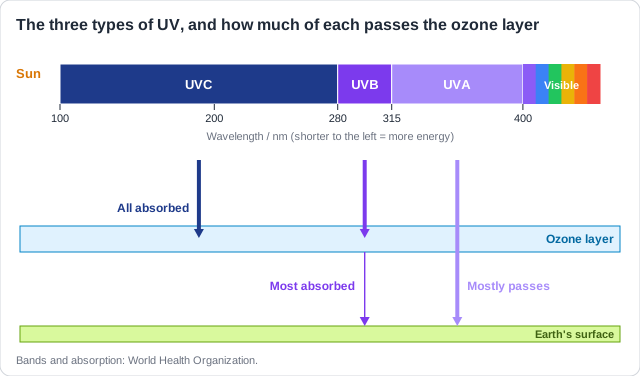
UVC
- 100-280 nm: most energy.
- All absorbed high up.
UVB
- 280-315 nm: most absorbed.
- Sunburn, skin cancer, cataracts.
UVA
- 315-400 nm: mostly passes.
- Ages skin; adds to cancer risk.
Real example: after evidence that sunbeds cause skin cancer, most of Australia banned commercial sunbeds from 2015. Sunbeds use mostly UVA, the band that passes the ozone layer.
Not 'blocks all UV': Ozone absorbs all UVC and most UVB. It does not block all UV: most UVA, and some UVB, still reach the ground.
How this comes up: A short Paper 2 question asks why one type of radiation is more harmful than another. Build the chain: wavelength, frequency, energy, then the harm.
Skiers in the Alps can get sunburnt on a cold, bright day, but never from the light of a lamp.
Explain why UVB is more dangerous to living things than visible light.
Model answer plan
See the mark-by-mark plan — for / against / judgement, with marking guidance — in study mode.