A sustainable food supply, at Higher Level: Different examples from SL: Israel's drip irrigation, the Dutch protein goal, Apeel, Viet Nam's low-emission rice, HB4 wheat and New Zealand's dropped farm-emissions price. At HL, judge each strategy through law and policy (taxes, plans) and economics (who pays); alternative farming systems are 5.2.14-5.2.16.
Practise this as you read
- Evaluate one strategy to cut emissions from food production.
- Outline household actions that cut emissions from food.
Free preview
This is the free notes preview
You're reading the free notes. Aimnova Pro unlocks the full study experience — and you can try it with your first topic free to keep:
- FlashcardsLock in vocabulary and key terms with spaced repetition.
- Practice questionsAnswer exam-style questions and get instant AI marking.
- Mock exams & past-paper vaultSit full mocks and see exactly how examiners award marks.
- Personalised study planA daily plan built around your exam date and weak areas.
Three aims: The world must feed more people without destroying the land, water and climate that farming needs. Global strategies aim at three things at once.
The points to remember
- Reduce demand for high-impact food, and reduce food waste.
- Reduce greenhouse gas emissions from producing food.
- Increase productivity without increasing the area of land farmed.
- A sustainable food supply also keeps soil, water and biodiversity healthy.
- And it must be economically viable: farmers will not adopt a method that loses money.
- At sea: catch quotas below the maximum sustainable yield keep fish coming.
Example (HL): Israel. Israeli farmers developed modern drip irrigation in the 1960s, so dry land grows more crops with less water.
Practice with exam-style questions
Answer exam-style questions and get AI feedback that shows you exactly what examiners want to see in a full-marks response.
The fastest way to cut farming's impact is to need less of the foods that do the most harm: beef, lamb and dairy.
The points to remember
- Plant-based meat substitutes look and taste like meat but are made from plants or fungi.
- Taxes, labels and campaigns can shift people towards plant foods.
- Schools and canteens can serve smaller meat portions or meat-free days.
- Households can eat less meat, buy sustainably produced food and choose less packaging.
- Buying local, seasonal food cuts transport, but heated greenhouses can outweigh that.
- Planting trees absorbs CO2 but does not cut the emissions from food itself.
Remember it as: Less beef, less waste, less land.
Example (HL): the Netherlands. The Dutch government aims for people to get half their protein from plants by 2030; today about 60% still comes from animals.
Food that is wasted wastes all the land, water, energy and fertilizer used to grow it. In richer countries most waste is in shops and homes.
In shops (distribution)
- Keep food at the right temperature; better packaging.
- Store food well and keep pests out.
- Sell 'ugly' fruit and vegetables.
- Discount or donate food near its date.
In homes (use)
- Buy only what will be eaten; plan meals.
- Check use-by dates; store food properly.
- Freeze or re-cook leftovers.
- Buy 'ugly' produce; give away spare food.
- Education campaigns against waste.
The points to remember
- Extended shelf life (coatings, better packaging, longer-lasting varieties) means less spoils before it is eaten.
- Selling locally cuts distribution losses.
- Composting deals with waste after it happens: it does not reduce waste at home.
Example (HL): Apeel. This US firm coats fruit such as avocados with a thin, edible layer made from plant oils, so it loses water more slowly and lasts about twice as long.
Feeling unprepared for exams?
Get a clear study plan, practice with real questions, and know exactly where you stand before exam day. No more guessing.
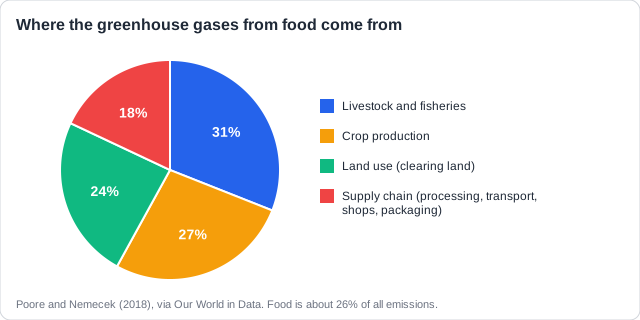
Most of food's greenhouse gases come from the farm: methane from cattle and rice, and nitrous oxide from fertilizer.
The points to remember
- Ruminants: feed additives, seaweed or low-methane breeds cut methane from digestion.
- Low-methane rice: draining paddies for short spells, or new varieties, cuts methane.
- Nitrogen loss: test soil and apply fertilizer only where needed; grow legumes that fix nitrogen.
- Nitrous oxide matters even in small amounts.
- Manure: cover it and capture the methane as biogas for power.
- Fossil fuels: renewable power for barns, feed mills, trucks and fridges, and local feed, cut CO2, but not methane.
Example (HL): Viet Nam. In 2023 it approved a plan for 1 million hectares of high-quality, low-emission rice in the Mekong Delta by 2030, draining paddies for short spells and using less fertilizer.
Growing more on the land already farmed saves forests and grasslands from being cleared.
Genetic modification: for
- Higher yields; resists pests, so less pesticide.
- Drought tolerance: crops survive dry years.
- Better nutrition, as in Golden Rice.
Genetic modification: against
- Genes may spread to wild plants.
- Companies control and patent the seeds.
- Long-term effects unknown; ethical objections.
The points to remember
- In-field solar fertilizer: small solar units make nitrogen fertilizer on the farm from air and water, with no fossil fuel.
- Precision farming uses soil tests and sensors to give each part of a field what it needs.
- Integrated pest management cuts crop losses to pests.
Example (HL): HB4 wheat. In 2020 Argentina approved the world's first GM wheat, bred to keep its yield in drought years.
Memorize terms 3x faster
Smart flashcards show you cards right before you forget them. Perfect for definitions and key concepts.
To evaluate a strategy, name it, give its strengths and weaknesses, then judge it.
The points to remember
- Name the strategy: a name alone gets no mark.
- For: what it cuts (methane, land, waste), with evidence.
- Against: cost, how widely it can be used, what it leaves out (other gases, other stages).
- Judge: a balanced conclusion with evidence.
- Check all three pillars: environmental, economic (jobs, income) and social (culture).
- Example features: moving herds lets grass recover (no overgrazing); unploughed meadows store carbon; local sales cut transport.
Not enough on its own: 'It is more expensive' needs a reason: who pays, and why it stops people using it. 'Less pollution' alone, or tourism income, does not show a farm is sustainable.
Example (HL): New Zealand. About half its emissions come from farming. A plan to price farm emissions was dropped in 2024 after strong opposition from farmers: a strategy fails if farmers will not accept it.
How this comes up: Paper 1 or Paper 2 can give a fact file and ask you to evaluate one strategy to cut emissions [3]: strengths, weaknesses and a judgement.
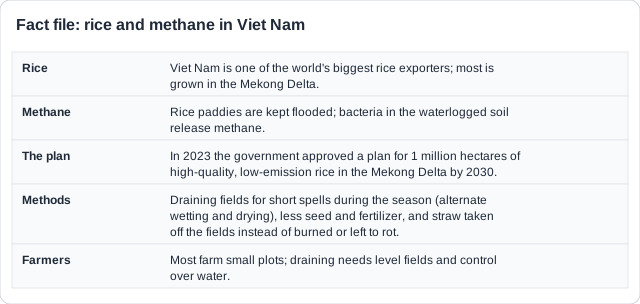
The fact file describes rice farming and methane in Viet Nam.
Evaluate alternate wetting and drying as a strategy to reduce greenhouse gas emissions from rice production.
Model answer plan
See the mark-by-mark plan — for / against / judgement, with marking guidance — in study mode.