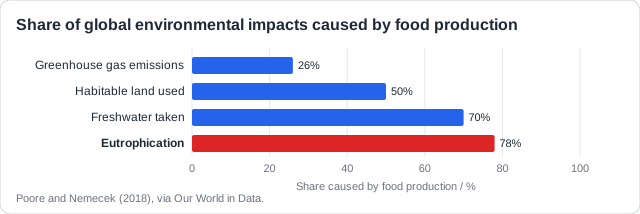
Eutrophication's cause at Higher Level: The same statement as SL, told through different cases: the Lake 226 experiment that proved phosphorus was limiting, agriculture's 78% share of the world's eutrophication, and rivers that run out of oxygen in a drought. At HL, link the cause to toxic blooms (4.4.10) and to more frequent dead zones (4.4.11).
Practise this as you read
- Explain why a bloom needs a limiting nutrient to be added.
- Describe how low flow and warm water lead to anoxia.
Free preview
This is the free notes preview
You're reading the free notes. Aimnova Pro unlocks the full study experience — and you can try it with your first topic free to keep:
- FlashcardsLock in vocabulary and key terms with spaced repetition.
- Practice questionsAnswer exam-style questions and get instant AI marking.
- Mock exams & past-paper vaultSit full mocks and see exactly how examiners award marks.
- Personalised study planA daily plan built around your exam date and weak areas.
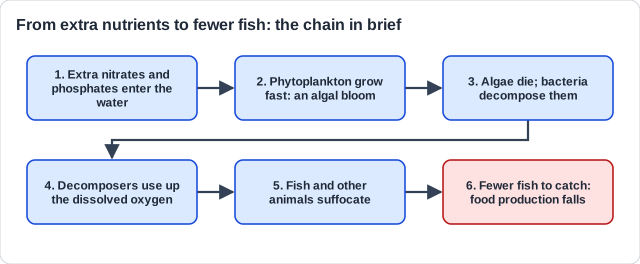
Too much food for algae: Eutrophication is what happens when water is over-fed. Extra nitrates and phosphates make phytoplankton grow out of control: an algal bloom}}.
The points to remember
- Eutrophication happens in lakes, estuaries and coastal waters.
- The cause: extra mineral nutrients, especially nitrates and phosphates.
- The result: excessive growth of phytoplankton, an algal bloom.
- A bloom happens only if growth was limited before by too little phosphate or nitrate.
- In lakes, phosphate is usually the one in short supply; at sea, nitrate often is.
- Humans cause it by releasing fertilisers, sewage and detergents into water.
Remember it as: Feed the water, grow the algae.
Example (HL): Lake 226, Canada, 1973. Scientists split a small lake in Ontario in two with a plastic curtain. Both halves got extra carbon and nitrogen; only one half also got phosphorus. Within weeks that half turned bright green with algae, and the other did not: phosphorus had been the limiting factor.
Name the nutrient properly: Write 'nitrates' and 'phosphates' (or fertiliser, sewage, manure). 'Nitrogen' or 'phosphorus' on its own, or just 'run-off', does not name the pollutant.
Get feedback like a real examiner
Submit your answers and get instant feedback — what you did well, what's missing, and exactly what to write to score full marks.
The nutrients come from many places at once. Most reach the water in rain that washes over fields and streets, so they are hard to trace to one pipe.
The points to remember
- Fertilisers washed off farmland: the largest source in most places.
- Manure and slurry from farm animals, especially large livestock farms.
- Sewage, treated or untreated, from towns and cities.
- Detergents that contain phosphates.
- Nitrogen oxides from vehicles and power stations, falling in rain.
- Urban run-off: fertiliser from lawns, parks and golf courses.
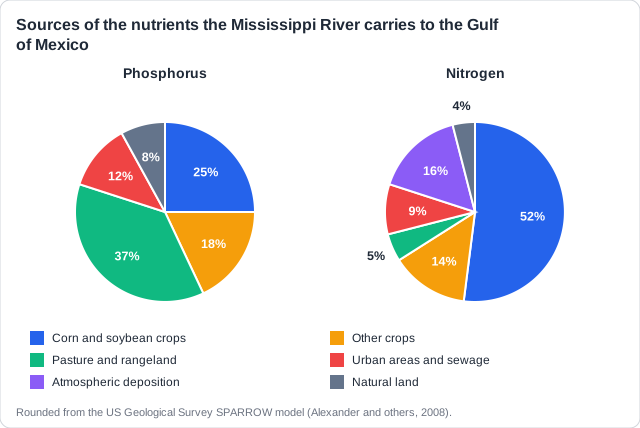
Reading the pies (HL). Corn and soybean supply 52% of the Mississippi's nitrogen, and only 9% comes from towns and sewage. The same is true worldwide: food production causes about 78% of all eutrophication, more than any other of its impacts.
Phosphorus travels on soil: Nitrate dissolves and washes straight into rivers. Phosphate sticks to soil, so it reaches rivers when soil is eroded: that is why grazed pasture supplies so much of it.
Questions often name one source, such as untreated sewage or a crop grown near the coast, and ask for the problem it causes. Name the problem, then say how it happens.
Untreated sewage in a river
- Eutrophication: its nitrates and phosphates feed algal blooms.
- Hypoxia: bacteria decomposing it use up the oxygen.
- A rotten-egg smell of hydrogen sulphide, from decay with no oxygen.
- Pathogens: disease for swimmers, and in shellfish that filter the water.
- Cloudy water: less light, so less photosynthesis.
A crop farmed near the coast
- Fertiliser run-off feeds algal blooms, some of them toxic red tides.
- Pesticides poison coastal animals and can bioaccumulate.
- Eroded sediment clouds the water, so less light and productivity.
- Sediment smothers animals living on the sea bed, such as corals.
Example (HL): the Coata River, Peru, 2016. Untreated sewage from towns near Lake Titicaca turned the river green and used up its oxygen. About 10 000 Titicaca water frogs, a critically endangered species, were found dead along 50 km of the river.
Name the problem AND outline it: 'Eutrophication' alone is half an answer: add how, for example 'because sewage adds nitrates and phosphates'. 'Thermal pollution', or just 'loss of biodiversity', does not answer a sewage question.
Learn what examiners really want
See exactly what to write to score full marks. Our AI shows you model answers and the key phrases examiners look for.
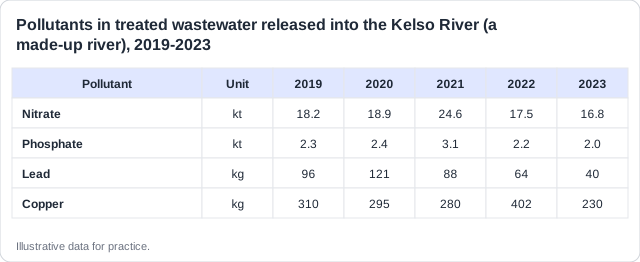
A table of pollutants can show when eutrophication was most likely: look for the year when nitrate AND phosphate are both highest. Metals such as lead do not feed algae.
Once the bloom starts, a chain follows. Many questions want the whole chain, ending with what it does to the fish or animal named in the question (the next page explains it in full).
HL: why a river in a dry summer runs out of oxygen
- Low flow: a dry winter leaves still pools that are not flushed.
- Organic matter (leaves, sewage, dead algae) is decomposed, using up oxygen.
- Low water concentrates nutrients and algae, so blooms form and block light.
- Slow, shallow water warms fast, and warm water holds less oxygen.
- Deep pools stratify: the bottom layer is cut off from air and turns anoxic.
Link it to what the question asks: If the question asks about food production, your chain must end with fewer fish or shellfish to catch. Describing eutrophication without that link scores at most 3 of 4.
How this comes up: Paper 1 gives a case study of a river or lake and asks how low oxygen develops [3]; Paper 2 asks you to read a chart and name a pollutant [1 + 1].
In December 2018 and January 2019, about a million fish died in the Darling River at Menindee, Australia, after a long drought had left the river as a chain of warm, still pools with algal blooms.
Describe how anoxic conditions can develop in a river during a drought.
Model answer plan
See the mark-by-mark plan — for / against / judgement, with marking guidance — in study mode.