UNCLOS and the high seas at Higher Level: This statement is Higher Level only. It explains who controls fishing in which parts of the ocean, why the high seas are hard to protect, why selling fishing rights can be unfair, and what the new High Seas Treaty does.
Practise this as you read
- Outline the exclusive economic zone and the high seas.
- Discuss the equity of selling access to a fishing zone.
Free preview
This is the free notes preview
You're reading the free notes. Aimnova Pro unlocks the full study experience — and you can try it with your first topic free to keep:
- FlashcardsLock in vocabulary and key terms with spaced repetition.
- Practice questionsAnswer exam-style questions and get instant AI marking.
- Mock exams & past-paper vaultSit full mocks and see exactly how examiners award marks.
- Personalised study planA daily plan built around your exam date and weak areas.
Who owns the sea?: Near the coast, the sea is managed by the coastal country. Further out, it belongs to everyone. The UN Convention on the Law of the Sea draws the lines.
The points to remember
- UNCLOS (1982) is the UN treaty that sets the rules for the oceans; about 170 countries have joined.
- Each coastal country has an exclusive economic zone (EEZ) reaching 370 km (200 nautical miles) out to sea.
- Inside its EEZ, the country's government controls fishing: it can set quotas, sell licences and ban boats.
- It also controls oil, gas and mining there.
Remember it as: 370 km is yours; beyond it is everyone's.
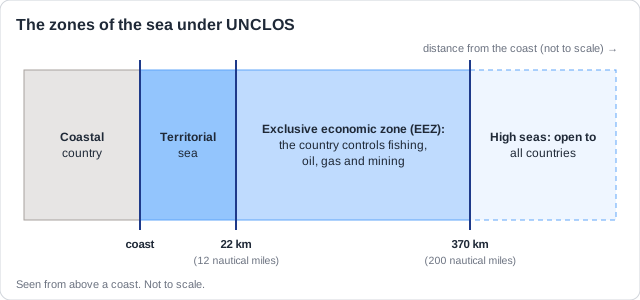
Real example: in 1975 Iceland pushed its fishing zone out to 200 nautical miles, an idea UNCLOS later made law for every country. After the 'Cod Wars' with the UK, British trawlers had to leave in 1976, and Iceland alone decided who fished its cod.
Never wonder what to study next
Get a personalized daily plan based on your exam date, progress, and weak areas. We'll tell you exactly what to review each day.
Outside the EEZs, nobody is in charge. Rules exist only where countries have agreed them, through regional fisheries bodies.
The high seas
- Beyond the EEZs lie the high seas: almost 60% of the ocean (about 64% of its surface).
- They belong to no country: boats of every nation may fish there.
- Regulation is limited: regional fishing bodies set rules only for their member countries and some species.
- Boats far from land are hard to watch; some switch off their trackers or register in countries with weak rules.
- So the high seas suffer overfishing and illegal fishing: a tragedy of the commons.
Remember it as: Everyone's sea is nobody's job.
2020
Nearly 300 Chinese fishing vessels gathered just outside the EEZ around Ecuador's Galápagos Islands.
Target
They fished for jumbo flying squid, food for the islands' sharks and fur seals.
Problem
In the high seas, Ecuador could not stop them: its laws end at the edge of its EEZ.
Some countries earn money by selling fishing rights in their EEZ. This raises questions of equity and justice.
Selling access: an equity and justice issue
- A poor coastal country can sell access to its EEZ to foreign fleets for money.
- Equity issue: the fish are a shared resource, but the benefit goes to the government and foreign fleets.
- Justice issue: local small-scale fishers lose catches, income and food.
- Large foreign boats can overfish a stock the local people depend on.
- Managing for local people instead: limit foreign catches and spend the money on local fisheries.
Remember it as: Sold to the fleet, lost to the village.
Mauritania, West Africa
- From 2021 to 2026 the EU pays about 60 million euros a year for its boats to fish in Mauritania's EEZ.
- Boats from ten EU countries may catch up to about 280,000 tonnes a year.
- Only about 3 million euros a year goes to support local fishing.
Local fishers
- Thousands fish from small wooden boats called pirogues.
- They compete with big trawlers for the same fish.
- Neighbouring Senegal's deal with the EU ended in November 2024 and was not renewed.
Stop wasting time on topics you know
Our AI identifies your weak areas and focuses your study time where it matters. No more overstudying easy topics.
After nearly 20 years of talks, the UN agreed a treaty to protect the high seas. Its full name is the agreement on biodiversity beyond national jurisdiction (BBNJ).
The High Seas Treaty
- The High Seas Treaty (agreed 2023) is the UN agreement to protect life in the high seas.
- It came into force on 17 January 2026; more than 100 countries had joined by September 2026.
- It allows marine protected areas on the high seas.
- New activities need environmental impact assessments.
- Benefits from high-seas genes (for medicines) are shared, with help for poorer countries.
Remember it as: Protect, assess, share.
Strengths
- For the first time, protected areas can be set up in the high seas.
- It is legally binding on every country that joins.
Limits
- It binds only countries that join: the USA has not.
- Fishing limits stay with the regional fishing bodies.
- Its first meeting, to agree how it works, is due only in January 2027.
How this comes up: Paper 2 or Paper 1: a fact file on a fishing deal or on the high seas, with 'outline' [2-4], or an essay part on governing the oceans [7-9].
Mauritania, in West Africa, sells the right to fish in its exclusive economic zone to boats from the European Union.
Outline the equity and justice issues raised when a country sells access to its fishing zone.
Model answer plan
See the mark-by-mark plan — for / against / judgement, with marking guidance — in study mode.