The risks of fishing at MSY at Higher Level: This statement is Higher Level only. It explains why fishing at the maximum sustainable yield is risky, how going over it can make a stock fall faster and faster, and how managers reduce the risk.
Practise this as you read
- Outline challenges in using the MSY to manage a fishery.
- Explain the positive feedback that follows overfishing.
Free preview
This is the free notes preview
You're reading the free notes. Aimnova Pro unlocks the full study experience — and you can try it with your first topic free to keep:
- FlashcardsLock in vocabulary and key terms with spaced repetition.
- Practice questionsAnswer exam-style questions and get instant AI marking.
- Mock exams & past-paper vaultSit full mocks and see exactly how examiners award marks.
- Personalised study planA daily plan built around your exam date and weak areas.
A target nobody can see clearly: The maximum sustainable yield sounds exact. In fact it is worked out from estimates, so the real number is never known for sure.
The points to remember
- The MSY is calculated from a model, using estimates of the stock's size and breeding rate.
- Fish are hard to count: they move, migrate and live deep or out of sight.
- Surveys are infrequent (often once a year) and costly, so the data are soon out of date.
- Most models look at one species and ignore the food web, bycatch and habitat damage.
- So the MSY is only an estimate: aiming at exactly that catch will sometimes take too many.
Remember it as: The MSY is a guess with a number on it.
Real example: off Newfoundland, Canada, scientists thought the cod stock was larger than it was. The catch limits, set close to the estimated sustainable level, were really far above it, and the stock collapsed in 1992.
Study smarter, not longer
Most students waste 40% of study time on topics they already know. Our AI tracks your progress and optimizes every minute.
Even a perfect estimate would be out of date the next year, because the number of young fish that survive changes with the weather and the ocean.
No room for a bad year
- Fish stocks rise and fall naturally from year to year.
- El Niño and La Niña, disease and predators can cut the number of young fish in one season.
- A catch fixed at the MSY leaves no buffer for a bad year.
- In a bad year the same catch takes more than the stock can replace.
Remember it as: Fish at the limit, and a bad year pushes you over it.
El Niño
In 2023 an El Niño warmed the sea off Peru.
Survey
Peru's marine institute sampled the anchoveta: 80-90% were young fish that had not yet bred.
Decision
The government cancelled the first fishing season of 2023 instead of taking the usual catch.
Cost
The fishmeal industry lost about 1 billion US dollars, but the young fish were left to grow and breed.
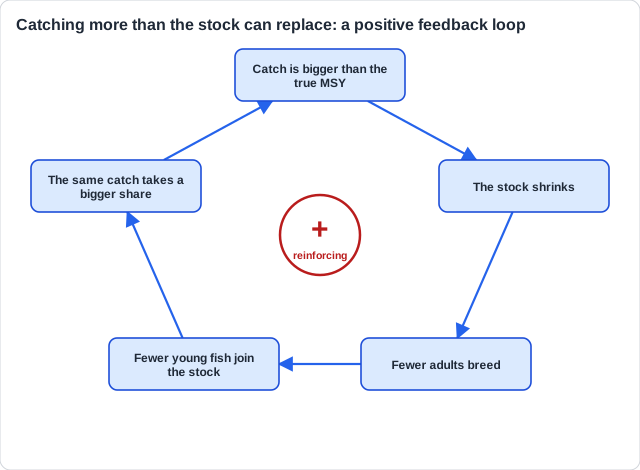
What happens if the catch goes over the MSY? Each year the stock gets smaller, and a smaller stock produces fewer young, so it shrinks faster still.
Positive feedback
- Catching more than the MSY shrinks the stock.
- Fewer adults means fewer eggs and young: the stock's reproductive potential falls.
- The big, old females that lay the most eggs are often caught first.
- If the catch stays the same, it takes a bigger share of a smaller stock.
- This is positive feedback: each turn of the loop pushes the stock down faster, towards collapse.
Remember it as: Fewer fish, fewer babies, even fewer fish.
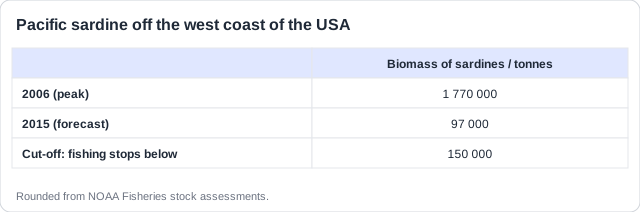
Real example: the Pacific sardine off the west coast of the USA fell from about 1.77 million tonnes in 2006 to under 100,000 tonnes by 2015. A cooler ocean meant fewer young sardines survived, and fishing went on taking the older, breeding fish.
Practice with exam-style questions
Answer exam-style questions and get AI feedback that shows you exactly what examiners want to see in a full-marks response.
Because the MSY is uncertain and stocks vary, careful managers aim below it and decide in advance what they will do when a stock falls.
Managing the risks
- Set the catch below the MSY, leaving a safety margin (a precautionary approach).
- Agree a rule in advance: cut or stop fishing when the stock falls below a set level.
- Survey often and update the quota every year, or every season.
- Allow for the food web: leave enough fish for seabirds, seals and bigger fish.
- Enforce the quota with logbooks, tracking and inspections, even when jobs are at stake.
Remember it as: Aim below the line, and know when to stop.
Rule in action
- Pacific sardine: when the stock fell below the 150,000 tonne cut-off, the fishery closed automatically in July 2015.
- Barents Sea capelin: no fishing if next spring's spawning stock may be under 200,000 tonnes.
Why it is hard
- Jobs and rising demand for fish push governments to set bigger quotas.
- Quotas are hard to enforce at sea, so catches can still go over the MSY.
Link every challenge to the MSY: Say how each problem makes the MSY wrong or makes it go over: 'fish migrate, so the counts are inaccurate, so the MSY may be set too high'.
How this comes up: Paper 1 (May 2026, HL): a fact file on a fishery, with 'outline two challenges in the use of MSY as a guide to managing it' [2]. Paper 2: explain the risks of fishing at the MSY [3-7].
Off the west coast of the USA, the Pacific sardine stock fell from about 1.77 million tonnes in 2006 to about 97,000 tonnes in 2015.
Explain how harvesting above the maximum sustainable yield can lead to a rapid decline in a fish stock.
Model answer plan
See the mark-by-mark plan — for / against / judgement, with marking guidance — in study mode.