Productivity, stratification and nutrients at Higher Level: This statement is Higher Level only. It joins four ideas: how productive water is, how its layers form, how nutrients are mixed up, and what happens when people add too many nutrients.
Practise this as you read
- Explain why stratified water has low productivity.
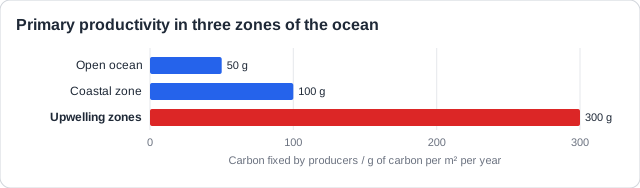
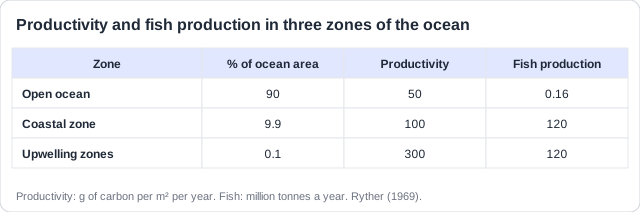
- Explain why coasts, shallow seas and upwellings are the most productive waters.
Free preview
This is the free notes preview
You're reading the free notes. Aimnova Pro unlocks the full study experience — and you can try it with your first topic free to keep:
- FlashcardsLock in vocabulary and key terms with spaced repetition.
- Practice questionsAnswer exam-style questions and get instant AI marking.
- Mock exams & past-paper vaultSit full mocks and see exactly how examiners award marks.
- Personalised study planA daily plan built around your exam date and weak areas.
Light from above, nutrients from below: Producers such as phytoplankton need sunlight and nutrients. In the sea these two are usually in different places: the light at the top, the nutrients at the bottom.
The points to remember
- Producers in water need light and nutrients (nitrate and phosphate).
- Light reaches only the top layer, at most about 200 m down in clear ocean water.
- Dead plankton and waste sink, so nutrients build up in the deep, dark water.
- So productivity is high only where nutrients are brought back up into the light.
Remember it as: Light from above, nutrients from below: productivity where they meet.
Surface water
- Plenty of light.
- Nutrients soon used up.
- Producers can photosynthesise.
Deep water
- Dark: no photosynthesis.
- Rich in nutrients from sinking dead matter.
- Few producers.
Real example: the Sargasso Sea is famous for its clear, deep-blue water. It looks clean because it holds very little phytoplankton: the sunny surface water has almost no nutrients.
See how examiners mark answers
Answer exam-style questions with model answers. Learn exactly what earns marks and what doesn't.
Why do the nutrients stay at the bottom? Because the water is in layers. A thermocline separates them.
Stratification and mixing
- Thermal stratification: a warm, light surface layer floats on cold, dense deep water.
- The layers barely mix, so the boundary between them acts as a barrier.
- Producers use up the nutrients in the surface layer, and none are replaced from below.
- So strongly stratified water has low productivity, even in bright sunshine.
- Mixing by storms, cooling or upwelling brings nutrients up, and productivity rises.
Remember it as: Layers lock the nutrients down; mixing lets them out.
Winter
- Storms and cold air mix the water from top to bottom. Nutrients reach the surface, but the days are too short and dark for much growth.
Spring
- Longer days warm the surface. A light layer forms and holds phytoplankton in the sun, with plenty of nutrients: a huge spring bloom, seen from space.
Summer
- The water is strongly stratified. The surface nutrients are used up and are not replaced, so productivity falls despite the strong sunshine.
Autumn
- Cooling and storms break up the layers. Nutrients come back up, and a smaller autumn bloom grows before winter.
The tropical open ocean is stratified all year: its surface is always warm. That is why most of it, like the Sargasso Sea, has low productivity.
So the most productive water is where nutrients are brought up into the light. That happens mainly near coasts and in shallow seas.
Why coasts and upwellings are the most productive
- Upwellings bring cold, nutrient-rich deep water to the sunlit surface.
- In shallow seas, waves and tides stir nutrients up from the seabed, and light reaches far down.
- Where two currents meet, the water mixes and nutrients are brought up.
- Rivers carry nutrients from the land into coastal water.
- More producers means more energy passes along the food chain, so more fish.
Remember it as: Stir the nutrients up or wash them in: that is where the fish are.
Real example: the Grand Banks were one of the richest fishing grounds on Earth. The water is shallow, and the cold Labrador Current meets the warm Gulf Stream there, so the water mixes and nutrients reach the light.
Two traps: Do not say that high biodiversity causes high productivity: it is the other way round.
Do not explain high productivity with sunlight alone: link it to the nutrients that are brought up.
Study smarter, not longer
Most students waste 40% of study time on topics they already know. Our AI tracks your progress and optimizes every minute.
People also add nutrients. Nutrient loading rises when rivers carry fertiliser from farms and sewage from towns.
Nutrient loading and stratification together
- Nutrient loading: extra nitrate and phosphate enter water from fertiliser and sewage.
- Some extra nutrients raise productivity; too much causes huge algal blooms.
- The algae die and sink; decomposers use up the oxygen in the bottom water.
- Stratification stops fresh oxygen from the surface reaching the bottom water.
- Oxygen falls so low that animals leave or die: a dead zone.
Remember it as: Too much food at the top, no oxygen at the bottom.
Loading
- The Mississippi River carries nitrogen fertiliser from the farms of the USA's Corn Belt into the Gulf.
Bloom
- The extra nutrients feed huge blooms of phytoplankton near the river mouth.
Decay
- The algae die and sink. Bacteria decompose them and use up the oxygen near the sea floor.
Layers
- Fresh, warm river water floats on the salty sea, so no new oxygen mixes down to the bottom.
Dead zone
- In 2025 the low-oxygen area covered about 11,400 km². Fish and shrimp swim away or die. Autumn storms mix the water and end it.
Mixing
- Brings nutrients up and oxygen down.
- Raises productivity.
Stratification
- Blocks both.
- Low productivity at the top, low oxygen below.
Loading
- Adds nutrients from the land.
- With stratification: blooms, then dead zones.
How this comes up: Paper 1 or Paper 2: a map or a table of a coast, with 'explain why productivity is high here' [2], or data on a seasonal bloom or a dead zone, with 'explain' [2-4].
Each year in the North Sea, the amount of phytoplankton peaks in April and May, then falls in summer.
Explain why the productivity of the North Sea falls in summer.
Model answer plan
See the mark-by-mark plan — for / against / judgement, with marking guidance — in study mode.