Aquaculture at Higher Level: Different examples from SL: Vietnam's pangasius, Thailand's shrimp ponds and Sanggou Bay. At HL, ask who gains (export firms, consumers far away) and who pays (coastal villages that lose mangroves), and what rules or labels could make farms cleaner.
Practise this as you read
- Link each impact to its cause on the farm.
- Judge which kind of aquaculture, at what scale.
Free preview
This is the free notes preview
You're reading the free notes. Aimnova Pro unlocks the full study experience — and you can try it with your first topic free to keep:
- FlashcardsLock in vocabulary and key terms with spaced repetition.
- Practice questionsAnswer exam-style questions and get instant AI marking.
- Mock exams & past-paper vaultSit full mocks and see exactly how examiners award marks.
- Personalised study planA daily plan built around your exam date and weak areas.
Farming the water: Aquaculture farms fish, molluscs (mussels, oysters), crustaceans (shrimp, crabs) and aquatic plants (seaweed). Since 2022 it has supplied more of the world's aquatic animals than wild capture.
The points to remember
- More demand: a growing, richer population wants more protein, and fish is seen as healthy.
- Wild stocks are depleted: capture fisheries cannot catch much more.
- Little spare farmland: water can produce food where crops cannot grow.
- Profitable: it needs fewer boats and fishers than wild fishing, and its technology keeps improving.
- Economic development: jobs and exports for coastal and rural areas, especially in Asia.
- Food security: a steady supply all year, close to where people live.
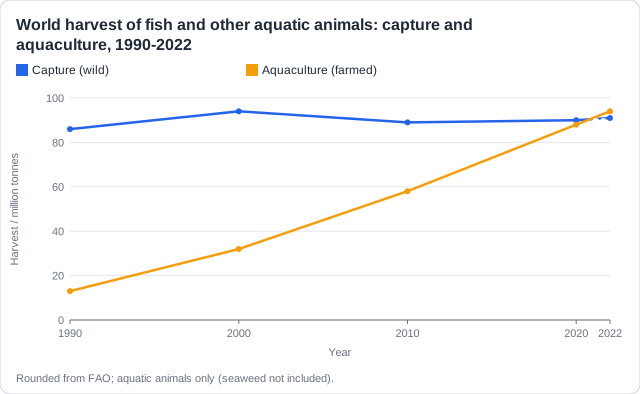
Example (HL): pangasius in Vietnam. In the Mekong Delta, a catfish called pangasius is raised in deep ponds. Within about 20 years it grew from a local food into an export sold in over 100 countries, creating many jobs.
A reason for growth needs a link: Say what changed and why it raises output: 'wild fisheries are depleted, so demand shifts to farmed fish' scores; 'fish is popular' alone does not.
Learn what examiners really want
See exactly what to write to score full marks. Our AI shows you model answers and the key phrases examiners look for.
Data questions often show a chart of seafood harvests by group: wild capture, aquaculture, and a projection for 2050. Read it in three steps: which bar, which colour, which year.
The points to remember
- An increase in tonnes = projected value - today's value. Do not give a percentage unless asked.
- A percentage increase = (new - old) ÷ old x 100, for example in the number of farm sites.
- Molluscs are easy to farm: small, barely move, packed close, and many filter-feed, so they need no feed.
- Crustaceans such as shrimp grow fast, take high stocking densities and sell at a high price.
- Freshwater fish (carp, tilapia) eat plants and cheap feed and grow well in ponds.
- Marine fish are hard to farm: many are big, migrate, need lots of feed and space; wild capture is cheaper, and many buyers prefer wild fish.
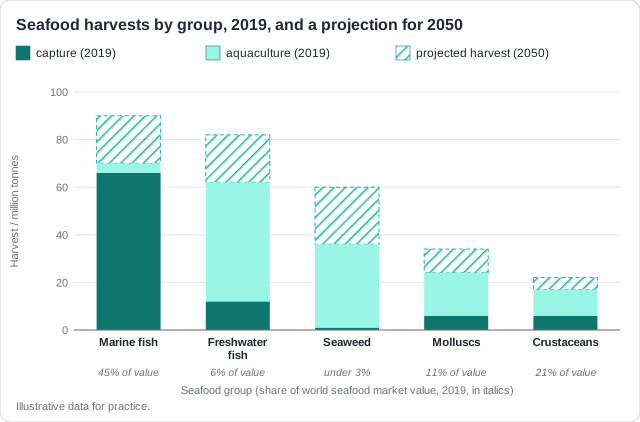
Example (HL), from the chart: marine fish are 66 million tonnes wild but only 4 farmed. Two reasons: many marine fish are large and migratory, so farming them is costly; and wild shoals are still big enough to catch cheaply.
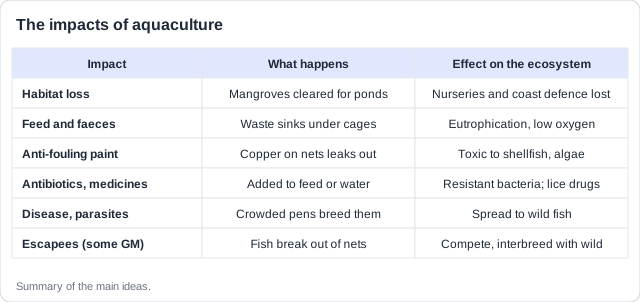
Most farms keep many animals in a small space and feed them. That brings six main impacts, each with a clear cause: from clearing mangroves, to waste that causes eutrophication, to escaped fish that are genetically modified.
The points to remember
- Habitat loss: mangroves and wetlands are cleared for ponds; nets and cages trap wild animals.
- Feed and faeces: waste sinks and feeds algae, causing eutrophication, low oxygen and smothered sea beds.
- Anti-fouling agents: copper paint that stops weed growing on nets is toxic to shellfish and algae.
- Antibiotics and other medicines: they reach the water, harm wild life and breed resistant bacteria.
- Disease and parasites spread from crowded pens to wild fish.
- Escapees compete with wild fish and interbreed, diluting wild genes; some are non-native or GM.
Name the pollutant and the ecosystem: 'Pollution' alone is not enough: say 'uneaten feed sinks and causes eutrophication under the cages'. Other impacts: farmed fish eat fishmeal, so wild fish are overfished; inland ponds can use up fresh water and make soil salty.
Never wonder what to study next
Get a personalized daily plan based on your exam date, progress, and weak areas. We'll tell you exactly what to review each day.
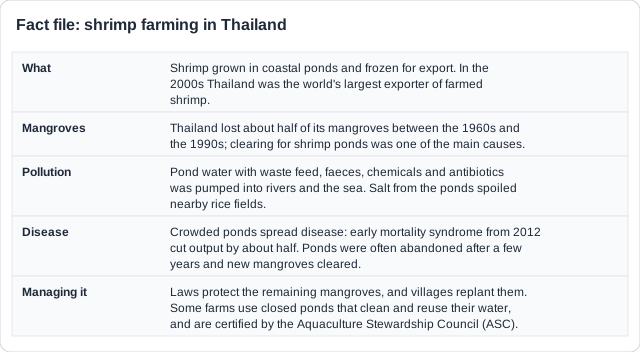
Example (HL): shrimp farming in Thailand. Thailand built a huge export industry by digging shrimp ponds along its coasts, many of them where mangroves once stood.
The points to remember
- Habitat loss: mangroves cleared, so fish nurseries and storm protection are lost.
- Pollution: waste feed, faeces, chemicals and antibiotics flushed into the sea.
- Disease spread through crowded ponds; ponds were abandoned and more mangrove cleared.
- Managed by: protecting and replanting mangroves, closed ponds that clean and reuse water, and certification (ASC).
Using an example in an answer: Name the place and species, give two or three impacts with their effect, then one management technique and how it reduces an impact.
Each impact has a technique that reduces it. The best known is integrated multi-trophic aquaculture (IMTA).
The points to remember
- IMTA: mussels filter out small particles; sea cucumbers or lobsters eat the large ones.
- Seaweed takes up dissolved nutrients and CO2 and gives out oxygen: lower BOD, no eutrophication.
- Recirculating systems: no escapes, waste collected.
- Vaccines and cleaner fish in place of antibiotics and lice drugs.
- Lower stocking density, and farms sited away from wild salmon rivers, in well-flushed water.
- Farm herbivores (carp, tilapia) that need no fishmeal; protect mangroves; certify farms.
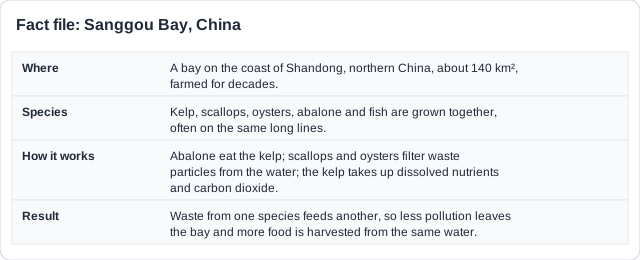
Example (HL): Sanggou Bay, China. Kelp, scallops, oysters and abalone are grown together across the bay. Abalone eat the kelp, shellfish filter the water and kelp absorbs nutrients, so more food is harvested with less pollution.
An integrated farm is not pollution-free: For its negative impacts, give disease, escapees, habitat lost to cages, or medicines. Do not give eutrophication or low oxygen: those are what the system reduces.
Stop wasting time on topics you know
Our AI identifies your weak areas and focuses your study time where it matters. No more overstudying easy topics.
Questions ask you to evaluate aquaculture as a food source for the future, or to compare it with wild capture fisheries. Give both sides, then a judgement.
Strengths
- Less pressure on wild fish stocks.
- Food for a growing population: food security.
- Jobs and income, especially for coastal and developing countries.
- Efficient: fish turn feed into meat far better than cattle.
- Healthy protein; technology keeps improving it.
- IMTA gives several crops and recycles nutrients.
Limitations
- Habitat loss, such as mangroves.
- Pollution from feed, faeces, antibiotics, copper.
- Disease and escapees (some non-native or GM).
- Carnivores need fishmeal from wild fish.
- High costs; big farms push out small ones; hard to certify.
- Not possible for many large marine fish, such as tuna.
The points to remember
- Efficiency: farms produce more food per hectare and burn less fuel than boats; wild capture needs no feed.
- Impacts: capture causes overfishing, bycatch and trawl damage; farms cause pollution, disease and escapees.
- Scale matters: small, mixed farms (pond polyculture) are efficient and low impact; large monocultures of carnivores have the most impacts.
Example (HL): two kinds of farm. Pangasius ponds in Vietnam produce cheap protein but drain polluted water into the Mekong. Sanggou Bay's mixed farm recycles its waste. A good judgement says which kind of aquaculture, at what scale.
How this comes up: Paper 2 Section A reads a harvest chart (identify, calculate, a reason, two reasons [2], evaluate [4]); Paper 1 asks about farming near a marine park [2]; Section B asks you to evaluate aquaculture [7] or compare it with wild fisheries [9].
A chart shows that world seafood harvests are projected to rise from about 210 million tonnes in 2019 to about 290 million tonnes in 2050.
Evaluate the use of aquaculture in meeting the projected harvest of global seafood.
Model answer plan
See the mark-by-mark plan — for / against / judgement, with marking guidance — in study mode.