Species and habitat conservation at Higher Level: The same statement as SL, with different examples: Kew's seed bank, the California condor, Kaziranga and the Great Barrier Reef. At HL, expect a [9] essay weighing ex situ against in situ conservation.
Practise this as you read
- Name two ex situ and two in situ measures, each with a real example.
- Weigh successes and failures of both, then judge how far each works alone.
Free preview
This is the free notes preview
You're reading the free notes. Aimnova Pro unlocks the full study experience — and you can try it with your first topic free to keep:
- FlashcardsLock in vocabulary and key terms with spaced repetition.
- Practice questionsAnswer exam-style questions and get instant AI marking.
- Mock exams & past-paper vaultSit full mocks and see exactly how examiners award marks.
- Personalised study planA daily plan built around your exam date and weak areas.
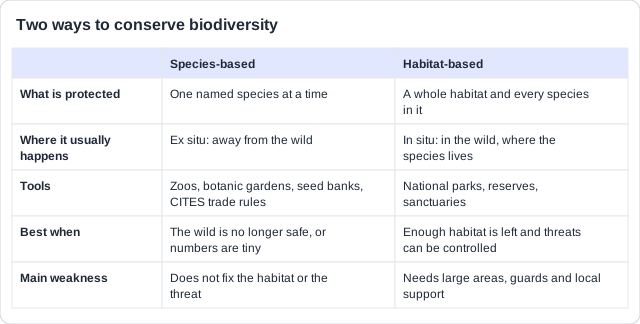
One species, or its whole home?: Species-based conservation saves particular species, usually ex situ. Habitat-based conservation protects the place they live, usually in situ.
The points to remember
- Species-based conservation protects particular species, one at a time.
- It tends to use ex situ strategies: away from the wild.
- Habitat-based conservation protects a whole habitat and every species in it.
- It tends to use in situ strategies: in the wild, where the species lives.
- 'Tends to' matters: some species measures work in the wild, and a mix of both is common.
Remember it as: Species: take it out to save it. Habitat: save the place, save them all.
Real example: every surviving California condor was taken into zoos in 1987 to be bred (species-based, ex situ). Kaziranga National Park in India protects the grassland where rhinos, tigers, elephants and swamp deer live together (habitat-based, in situ).
Know your predicted grade
Take timed mock exams and get detailed feedback on every answer. See exactly where you're losing marks.
Ex situ measures protect a species outside its natural habitat, like moving a rare painting into a museum for safety. The four to know are zoos, botanic gardens, seed banks and CITES.
The points to remember
- Zoos and wildlife parks: captive breeding, then reintroduction to the wild.
- Botanic gardens: living plant collections, grown and returned to the wild.
- Seed banks: seeds dried and frozen, keeping genetic diversity for decades.
- Tissue culture and freezing (cryopreservation) store genetic material.
- CITES: controls international trade in a threatened species, wherever it lives.
- Ex situ is an emergency back-up when the wild is no longer safe.
Ex situ example 1
- Millennium Seed Bank, Kew, England
- Stores seeds of about 40,000 wild plant species
- Seeds are grown and replanted to restore wild plant populations
Ex situ example 2
- California condor: 27 birds left in 1987, all taken into zoos
- Bred in San Diego and Los Angeles; releases began in 1992
- About 560 today, more than 340 flying free
CITES in action: in 2017 all eight species of pangolin were given CITES's highest protection, banning international trade in their scales and meat.
Why it is used: Ex situ is an emergency back-up when survival in the wild is impossible or very risky.
In situ measures protect species by protecting where they live. Because the whole habitat is protected, every species in it gains, including ones nobody has studied yet.
The points to remember
- National parks: large areas protected by law, often open to visitors.
- Reserves: areas set aside mainly for wildlife, with stricter limits on people.
- Sanctuaries: protected places for particular animals, often guarded.
- In situ protects whole ecosystems, natural behaviour and interactions between species.
- It needs large areas, guards and local support.
In situ example 1
- Kaziranga National Park, India
- About two-thirds of the world's greater one-horned rhinos
- Armed guards patrol against poachers
In situ example 2
- Great Barrier Reef Marine Park, Australia, 1975
- About 344,000 km² of reef and sea
- Zones where fishing is banned let fish and corals recover
More on protected areas: How reserves are managed and designed (fences against pests, size, shape, corridors) is taught in 3.3.5 and 3.3.6. Here, learn which measures are in situ and why they suit habitat-based conservation.
Get feedback like a real examiner
Submit your answers and get instant feedback — what you did well, what's missing, and exactly what to write to score full marks.
Papers often give a fact file on one species and ask you to evaluate zoos, or to compare a zoo's approach with a habitat approach. Learn the points for both sides.
The points to remember
- Zoos give a safe haven, a chance to breed and to research the species.
- They educate visitors and raise funds for conservation in the wild.
- But zoos are expensive, hold few individuals, and cannot copy the natural habitat.
- Captive animals may suffer stress or lose survival skills; some say captivity is wrong.
- Zoo money could go to habitat protection; zoos do not remove the cause of decline.
- The habitat approach helps many species at once, is often cheaper, and needs no captivity.
Remember it as: Zoos: safe, breed, teach, fund. But: costly, few, captive, cause untouched.
Advantage of the zoo (species-based)
- Specialised, safe conditions for one species
- Breeds a critically endangered species for release
- Keeps genetic diversity in a managed programme
- Education, money and popular flagship species
Advantage of the habitat approach
- Conserves whole ecosystems and food webs
- Keeps species in their natural environment
- Often cheap and simple to set up
- More ethical: no animals kept in captivity
Real example: the pink pigeon of Mauritius fell to about 10 wild birds around 1990. Birds bred in zoos and aviaries were released, and about 500 now live wild, but rats, cats and disease still kill them, so the forest must be managed too.
Two answers that score nothing: 'Zoos prevent extinction' on its own is too vague: say how (safe breeding for release, a back-up population). And 'the habitat approach does not need much space' is wrong: it needs a lot.
Most ex situ programmes aim to breed a species and then return it to the wild, by reintroduction. Reintroduction only works if the ecosystem is ready to support the species again.
The points to remember
- Reintroduction works when the original threat is removed (poaching, predators, poison).
- The habitat must be protected or restored, with enough space and food.
- Captive populations are small: low genetic diversity and inbreeding.
- Hand-reared animals may lack survival skills, so many die soon after release.
- Judge a programme by the numbers and by whether the threats are gone.
Remember it as: Fix the threat, fix the habitat, then release.
More likely to succeed
- The original threat is removed
- Habitat restored, with enough space and food
- Many founders: good genetic diversity
- Released animals trained and monitored
More likely to fail
- Threats continue (poaching, predators, poison)
- Habitat too small or fragmented
- Few founders: inbreeding
- Hand-reared animals lack survival skills
Real example: the Hawaiian crow survived only in captivity after 2002. Birds released from 2016 were killed by the native Hawaiian hawk, and releases stopped in 2019: captive-bred crows had not learned to escape predators.
Evaluating a programme: Pros from the data (numbers up, extinction prevented, targeted methods). Cons from the threats still there (invasive predators, habitat loss, low genetic diversity, cost). Then judge: 'overall...'.
Learn what examiners really want
See exactly what to write to score full marks. Our AI shows you model answers and the key phrases examiners look for.
How this comes up: Paper 2, Section B (c) [9]: weigh ex situ against in situ conservation, with named examples and a supported judgement.
Some people argue that breeding centres and seed banks can save species even where their habitats are being destroyed.
To what extent can species-based conservation succeed without habitat-based conservation?
Model answer plan
See the mark-by-mark plan — for / against / judgement, with marking guidance — in study mode.