Seral stages at Higher Level: The same rule as SL, with different places: Kilauea's lava flows, the Sefton dunes and Esthwaite North Fen. Keep the chain in mind: each stage changes the conditions, then loses the place to the next through competition.
Practise this as you read
- Explain each replacement as a chain: change, colonise, outcompete.
- Name the conditions each stage changes.
Free preview
This is the free notes preview
You're reading the free notes. Aimnova Pro unlocks the full study experience — and you can try it with your first topic free to keep:
- FlashcardsLock in vocabulary and key terms with spaced repetition.
- Practice questionsAnswer exam-style questions and get instant AI marking.
- Mock exams & past-paper vaultSit full mocks and see exactly how examiners award marks.
- Personalised study planA daily plan built around your exam date and weak areas.
Each stage prepares the next: Each seral community changes the conditions around it. That lets the next community move in and outcompete it, stage after stage, until a stable climax is reached.
The rule for every succession
- Each seral community changes the environmental conditions of its area.
- The new conditions suit other species better, so they can colonise.
- The newcomers outcompete the old community (for light, water, space) and replace it.
- The cycle repeats until a stable climax community is reached.
- Bare rock: mosses and lichens start soil formation, so larger plants can colonise.
Remember it as: Change it, lose it: each community changes the place, then loses it to the next.
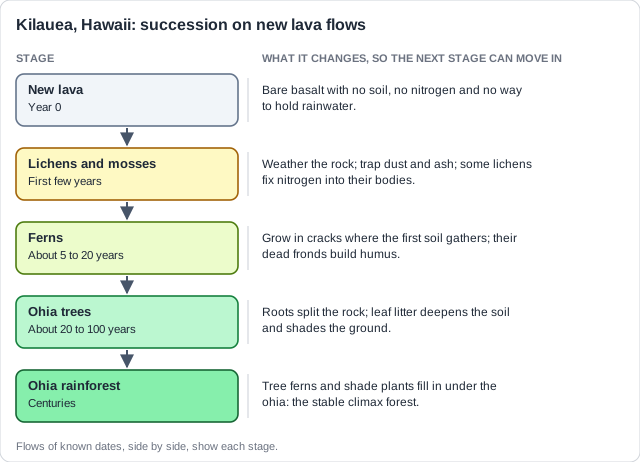
Real example: on Kilauea, lava flows of known dates lie side by side. On new flows lichens and mosses weather the rock and trap dust; within about 20 years ferns grow in the cracks; then ohia trees take root and, over centuries, form rainforest.
Link every step: Write each step as a chain: 'mosses add humus, so the soil holds water, so grasses can root'. A list of plant names with no changes explains nothing.
Stop wasting time on topics you know
Our AI identifies your weak areas and focuses your study time where it matters. No more overstudying easy topics.
On sand dunes the stages lie side by side: the youngest dunes by the sea, the oldest inland. Walking inland is like walking forward in time, as humus builds up in the sand.
How each dune stage changes the sand
- Pioneer grasses tolerate salt and trap blown sand, building the dune.
- Marram binds the sand; its dead leaves add the first humus.
- Humus lets the soil hold water and nutrients; rain washes out the salt.
- The soil turns more acidic; heath, then shrubs and trees, can grow.
- Marram needs fresh sand: on stable dunes it is outcompeted and replaced.
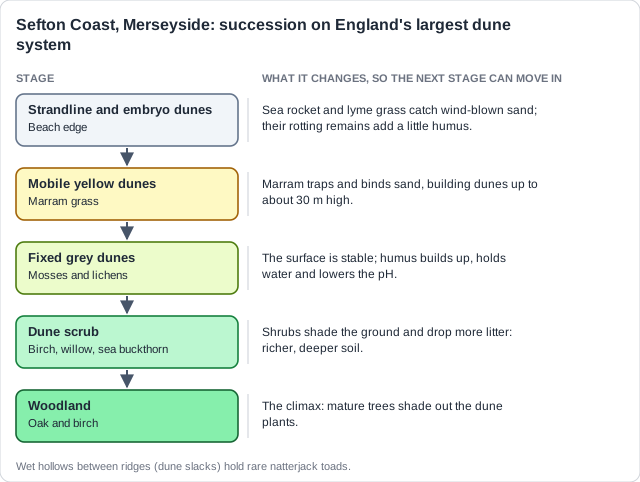
Real example: the Sefton Coast runs from bare beach to woodland. Marram builds dunes up to about 30 m high; behind them, mosses fix the grey dunes, and scrub and trees follow where the soil is deepest.
Marram is not killed by the others: Marram grows best when fresh sand buries it. On stable, older dunes it gets no new sand, so it is outcompeted: the conditions it made now suit other plants better.
A lake or pond can fill in and become dry land. Each community traps silt and adds dead matter, so the water gets shallower, stage by stage.
How a lake fills in
- Water plants trap silt; their dead remains settle on the bed.
- Reeds root in the shallows and build peat: the water gets shallower.
- The peat rises above the water: fen plants take over from the reeds.
- Trees such as alder and willow dry the ground and shade out the fen.
- Where the ground is dry enough, woodland is the climax.
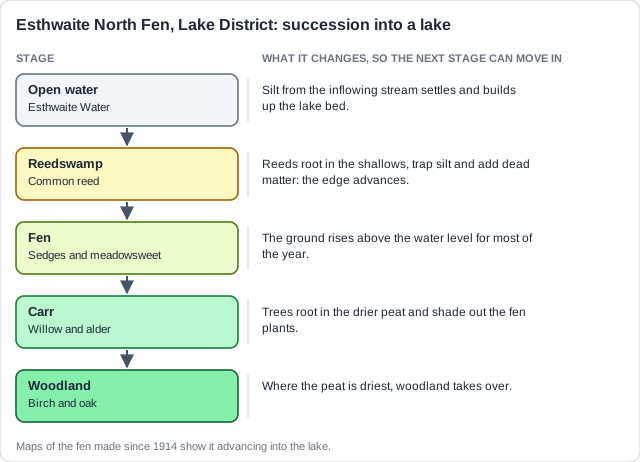
Real example: at Esthwaite North Fen, maps made since 1914 show the reedswamp and fen advancing into the lake as silt and peat build up, with willow and alder carr following behind on the drier peat.
Name the change, then the newcomer: 'The reeds build peat, so the ground rises above the water, so fen sedges can grow and outcompete the reeds.' Change, then colonise, then outcompete.
See how examiners mark answers
Answer exam-style questions with model answers. Learn exactly what earns marks and what doesn't.
Why does a succession stop? Each stage keeps changing the conditions until one community is in balance with the climate and soil. That community can replace itself, so it stays: the climax.
Changes, competition, climax
- The changes are abiotic: deeper soil, more humus, nutrients and water; less salt; more shade.
- Each stage often makes conditions worse for itself and better for the next.
- Replacement is by competition: the better-suited newcomers win light, water and space.
- Change slows once the community is in balance with the climate and soil: a stable climax.
- Which climax is reached depends on the climate: oak woodland in lowland England, rainforest in Hawaii.
A seral stage
- Changes the conditions
- Makes the place better for others
- Is replaced through competition
The climax
- In balance with climate and soil
- Its own young can grow under it
- Stable: not replaced
Real example: before 1980, the slopes of Mount St Helens carried old-growth Douglas fir and western hemlock forest. That is the climax the Pacific Northwest's climate supports; hemlock seedlings grow in its shade, so it renews itself.
Stable, not frozen: A climax still has births, deaths and small changes, but its species replace themselves, so the community as a whole stays the same unless a disturbance strikes.
How this comes up: Paper 2, Section B, part (a): outline how one stage of a succession allows the next to colonise [4].
The Morteratsch Glacier in Switzerland has retreated about 3 km since 1860, uncovering bare rock and gravel. Mosses and lichens are the first living things on it.
Outline how pioneer mosses and lichens on bare rock allow larger plants to colonise.
Model answer plan
See the mark-by-mark plan — for / against / judgement, with marking guidance — in study mode.