Shifting biomes at Higher Level: The same statement as SL, with different examples: the Arctic's fast warming, beech forest on Montseny, Florida's mangroves, Chimborazo since 1802 and the growing Sahara. Expect to read a country's biome map or profile and describe how warming could redraw it.
Practise this as you read
- Describe how warming and rainfall change a biome map.
- Weigh how far and how fast biomes can really move.
Free preview
This is the free notes preview
You're reading the free notes. Aimnova Pro unlocks the full study experience — and you can try it with your first topic free to keep:
- FlashcardsLock in vocabulary and key terms with spaced repetition.
- Practice questionsAnswer exam-style questions and get instant AI marking.
- Mock exams & past-paper vaultSit full mocks and see exactly how examiners award marks.
- Personalised study planA daily plan built around your exam date and weak areas.
The climate is on the move: Global warming is raising the Earth's average temperature and changing where and when it rains. Because each biome matches a climate, a moving climate means moving biomes.
The points to remember
- The Earth's average temperature is about 1.1-1.2 °C higher than in 1850-1900.
- Climate is the long-term average, so a changing climate means the averages are moving, not one hot day.
- Places are getting warmer, with longer growing seasons and fewer frosts.
- Rainfall patterns are changing: some regions get wetter, others drier.
- The poles and high mountains are warming fastest.
- So the climate zones themselves are moving towards the poles and uphill.
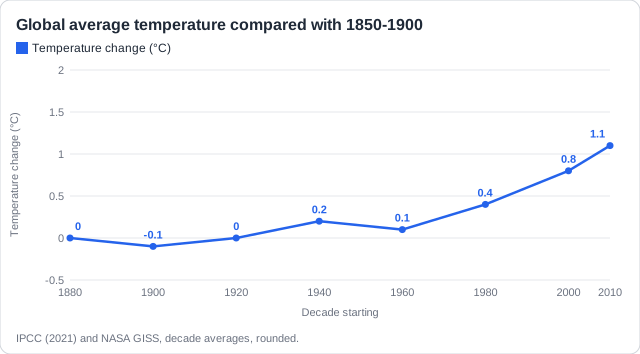
Real example: since 1979 the Arctic has warmed about four times faster than the world as a whole, so the climate of the far north is changing fastest of all.
Get feedback like a real examiner
Submit your answers and get instant feedback — what you did well, what's missing, and exactly what to write to score full marks.
Why do biomes move? Every species has a tolerance range. Change the climate, and the places that suit it change too.
The points to remember
- Each species lives within a tolerance range of temperature and water.
- A biome exists where its climate is: set by temperature and rainfall.
- When the climate warms, a place moves outside the range of some of its species.
- They die out at the warm edge and spread into new areas at the cool edge.
- So the whole biome's boundary moves: towards the poles and to higher altitude.
Remember it as: Up and out: biomes climb the mountains and head for the poles.
Warmer
- Montseny, near Barcelona, has warmed by about 1.5 °C since the 1950s.
Out of range
- Beech trees need cool, moist air; the lower slopes became too hot and dry.
New space
- Higher up, the heathland became cool enough for beech.
Shift
- The beech forest's upper edge moved about 70 m uphill since 1945.
Link the climate to the species: Do not just say 'the biome moves'. Say what changed (temperature or rainfall), that species need conditions within their tolerance range, and which way the boundary moves.
Moving away from the equator, the climate gets colder. So as the world warms, each biome's conditions are found further towards the poles.
The points to remember
- Warmer conditions let biomes move towards the poles (north in the northern hemisphere).
- Boreal forest and shrubs spread north into the tundra.
- Warm-climate biomes spread into cooler areas: tropical and sub-tropical conditions cover more land.
- The coldest biomes shrink: Arctic tundra has the Arctic Ocean behind it.
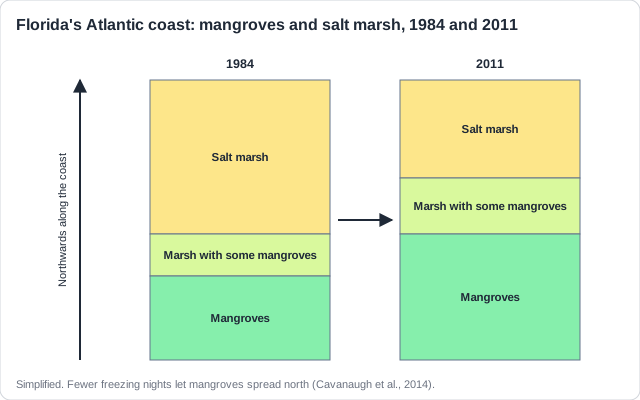
Real example: on Florida's Atlantic coast, fewer freezing winter nights let mangroves survive further north; between 1984 and 2011 their area doubled near St Augustine, replacing salt marsh.
Nowhere left to go: Poleward shifts squeeze the coldest biomes. Arctic tundra cannot move further north than the Arctic Ocean, so it shrinks.
Learn what examiners really want
See exactly what to write to score full marks. Our AI shows you model answers and the key phrases examiners look for.
Climbing a mountain is like travelling towards the poles: it gets colder, so the biomes sit in bands. Warming lifts every band.
The points to remember
- Air cools about 0.6 °C per 100 m of height, so a mountain has zones like bands.
- Warming moves every zone uphill: each 1 °C is roughly 150 m.
- The treeline rises and forest grows into alpine meadow.
- Alpine biomes near the top shrink: a mountain gets narrower towards the summit.
- At the top there is nowhere higher to go, so alpine species can be lost.
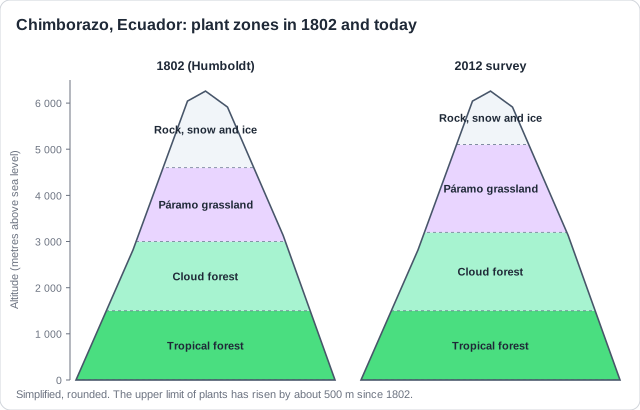
Real example: in 1802 the explorer Alexander von Humboldt mapped plant zones on Chimborazo, Ecuador. When scientists repeated his survey in 2012, the highest plants grew about 500 m higher, and the páramo had moved up with them.
Global warming changes rain as well as heat. Since biomes depend on both, a change in rainfall moves them too.
The points to remember
- Biomes depend on rainfall as well as temperature.
- Where it gets wetter, wet biomes (such as wet sub-tropical forest) grow, and dry ones shrink.
- Where it gets drier, forest can turn to savanna and grassland to desert.
- Longer droughts bring more fires, which speed the change.
- So biomes shift sideways as well as poleward and uphill.
Wetter
- Wet forest spreads
- Dry biome area shrinks
- Wetlands grow
Drier
- Forest turns to savanna
- Grassland turns to desert
- More fires
Real example: the Sahara grew by about 10% during the 20th century as rainfall fell along its edges, pushing the desert south into the Sahel.
Never wonder what to study next
Get a personalized daily plan based on your exam date, progress, and weak areas. We'll tell you exactly what to review each day.
The trend is poleward and uphill, but real biomes do not slide neatly across a map. Many move slowly, in pieces, or are blocked.
The points to remember
- Barriers block movement: seas, mountains, cities and farmland; habitats are fragmented.
- Soils take decades to centuries to form, so trees cannot root in new places quickly.
- Trees live long and spread slowly by seed, so biomes lag behind the climate.
- Species move at different speeds, so biomes break up into new mixes rather than move whole.
- Growing seasons and migration patterns change, so ecosystems become less stable.
- A biome shift is caused by climate change, not by people clearing land.
Speeds up shifts
- Fast warming at poles and peaks
- Droughts and fires
- Pests surviving milder winters
Slows or blocks shifts
- Seas, mountains, cities
- Slow soils and slow trees
- Farmland in the way
Real example: in the Scottish Highlands, a warmer climate would let Scots pine grow higher up the hills, but red deer eat the seedlings, so on most hills the treeline stays hundreds of metres below its natural height; only where deer are fenced out or culled do young pines climb.
Not the same as clearing land: A biome shift is caused by the changing climate. Cutting down a forest for farms is land-use change, not a biome shift, although it can block one.
How this comes up: Paper 1: a map or profile of a country's biomes, then describe how global warming might change them [2].
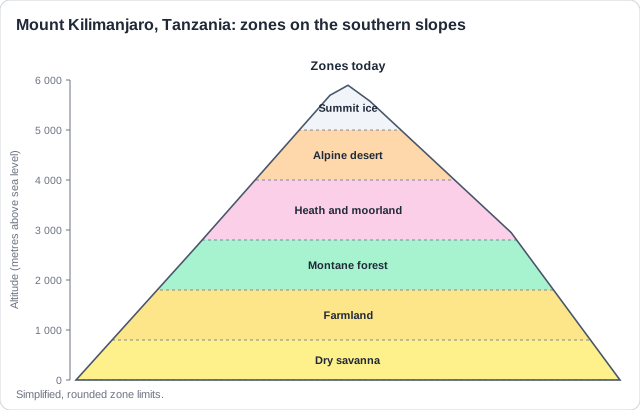
Read both figures first: the zones tell you what can move, the facts tell you which way.
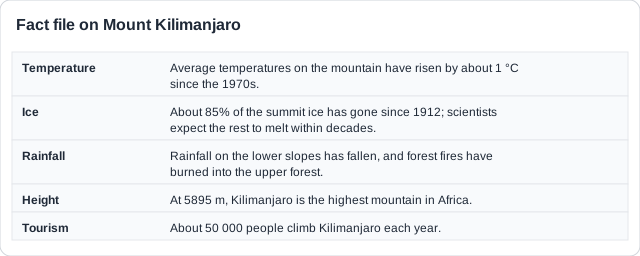
Figure 1 shows the zones on the southern slopes of Mount Kilimanjaro and Figure 2 gives facts about its changing climate.
Describe how global warming might alter the distribution of biomes on Mount Kilimanjaro.
Model answer plan
See the mark-by-mark plan — for / against / judgement, with marking guidance — in study mode.