Oceans and carbon dioxide at Higher Level: The same ideas as SL, with different examples: the Southern Ocean, El Niño and the Global Carbon Budget. At HL, expect to read a depth profile and explain several ways a warming, more acidic ocean could absorb less carbon.
Practise this as you read
- Read a temperature and CO₂ profile in both directions.
- Explain each way the ocean sink could weaken or grow.
Free preview
This is the free notes preview
You're reading the free notes. Aimnova Pro unlocks the full study experience — and you can try it with your first topic free to keep:
- FlashcardsLock in vocabulary and key terms with spaced repetition.
- Practice questionsAnswer exam-style questions and get instant AI marking.
- Mock exams & past-paper vaultSit full mocks and see exactly how examiners award marks.
- Personalised study planA daily plan built around your exam date and weak areas.
The ocean is a giant carbon sponge: Carbon dioxide from the air dissolves into seawater. The ocean surface is a two-way street: CO₂ goes in and comes back out all the time.
The points to remember
- CO₂ from the air dissolves into seawater at the surface: it becomes part of the water.
- More CO₂ in the air above means more CO₂ dissolves.
- Wind and waves mix the surface, so fresh water keeps meeting the air.
- Dissolved CO₂ stays in the water with no living things needed: the physical pathway.
- The oceans hold about 38 000 billion tonnes of carbon, about 45 times the atmosphere.
Remember it as: In from the air, into the water: like the fizz in a sealed drink.
Think of a fizzy drink: the CO₂ in it is invisible because it is dissolved, like sugar in tea. Seawater holds CO₂ in the same way, not as bubbles.
Real example: In the Southern Ocean around Antarctica, fierce westerly winds whip up the cold surface water. It takes up about 40% of all the CO₂ from human activity that the oceans absorb.
Know your predicted grade
Take timed mock exams and get detailed feedback on every answer. See exactly where you're losing marks.
CO₂ does not stay dissolved forever. It comes out of solution and escapes as a gas when the water warms or when deep water rises in an upwelling.
The points to remember
- Cold water holds more dissolved CO₂; warm water holds less.
- When water warms, CO₂ comes out of solution and escapes as a gas.
- Upwelling brings deep, CO₂-rich water to the surface, where the gas escapes.
- Respiration and decomposition in the sea release CO₂ into the water.
- So cold polar seas mostly absorb CO₂; warm tropical seas often release it.
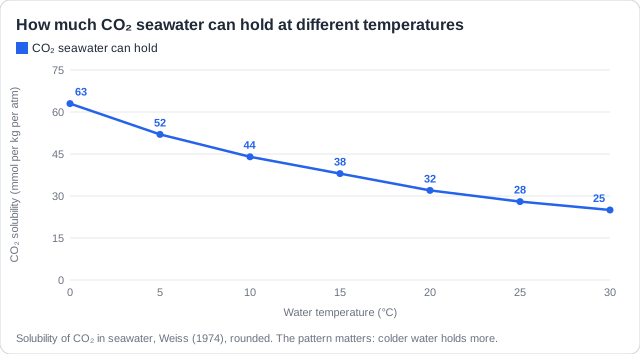
Reading the relationship: Say both halves: 'as temperature decreases, dissolved CO₂ increases', or 'as temperature increases, dissolved CO₂ decreases'. It is the same reason a warm fizzy drink goes flat faster.
Real example: during the strong El Niño of 2015-16, warm water spread across the tropical Pacific and upwelling off Peru weakened, so the region gave off less CO₂ to the air than usual.
Living things move carbon too. Tiny phytoplankton take in dissolved CO₂, just as trees do on land.
The points to remember
- Phytoplankton use dissolved CO₂ in photosynthesis: the biological pathway.
- The carbon becomes part of their bodies, then passes along the food chain.
- Dead plankton, faeces and shells sink to the deep ocean: the biological pump.
- In the deep ocean and sea-floor mud, carbon can stay for thousands of years.
- Some is buried in sediments and may become rock over millions of years.
Physical pathway
- CO₂ simply dissolves
- No living things needed
- Cold water carries it down as it sinks
Biological pathway
- Phytoplankton photosynthesise
- Carbon joins the food chain
- Remains, faeces and shells sink to the deep
Remember it as: Dissolve it, eat it, sink it.
Real example: tiny shrimp-like krill in the Southern Ocean eat phytoplankton, and their fast-sinking faeces carry millions of tonnes of carbon into the deep ocean each year.
Get feedback like a real examiner
Submit your answers and get instant feedback — what you did well, what's missing, and exactly what to write to score full marks.
Net gain of a store: Net gain = (all flows in) − (all flows out)
The ocean as a sink
- A carbon sink takes in more carbon than it gives out.
- Net gain = (flows in) − (flows out), using every arrow into and out of the store.
- Advantage: oceans are large, absorb a lot of CO₂ and so slow global warming.
- Advantage: dissolved CO₂ supports photosynthesis by phytoplankton (primary productivity).
- Disadvantage: more dissolved CO₂ causes ocean acidification, harming coral reefs and shellfish.
Worked example: A simplified carbon cycle shows ocean uptake 80, ocean loss 78, rivers into the ocean 0.9 and burial in sediments 0.2 (billion tonnes of carbon a year).
Net gain = (80 + 0.9) − (78 + 0.2) = 80.9 − 78.2 = 2.7 billion tonnes of carbon a year.
A positive answer means more carbon goes in than comes out: the ocean is a sink. A negative answer would make it a source.
Two traps: Count every flow: forgetting rivers or burial gives the wrong answer. And for an advantage, say what the sink does (absorbs CO₂, slows warming), not just 'it is a carbon sink'.
The ocean is a sink, but it cannot keep up. Fossil fuels release carbon that was stored for millions of years in a few decades, and a warming ocean may absorb less in future.
The points to remember
- Burning fossil fuels releases carbon faster than the ocean can absorb it.
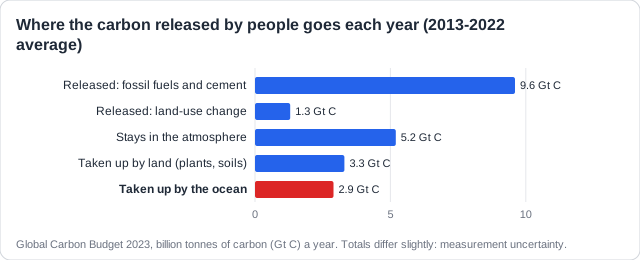
- The ocean takes up only about a quarter of the CO₂ we release; much of the rest stays in the air.
- Warmer oceans hold less CO₂, and may release some.
- The more CO₂ dissolves, the closer surface water gets to saturation, so uptake slows.
- Warm surface layers mix less with deep water (stratification), so fewer nutrients rise.
- Acidification can reduce phytoplankton, so the biological pump weakens.
Two words to use: saturation (the water cannot take up much more) and stratification (a warm lid on the ocean that stops mixing).
Could weaken the sink
- Warmer water holds less CO₂
- Stratification cuts nutrients
- Acidification harms plankton
- Rising seas destroy coastal marshes and mangroves
Could strengthen it
- More CO₂ in the air pushes more in
- Warmth may speed photosynthesis in cold seas
Real example: The ocean's uptake rose from about 1.1 billion tonnes of carbon a year in the 1960s to about 2.8 in the 2010s, but emissions rose faster, so the share left in the air kept growing.
Learn what examiners really want
See exactly what to write to score full marks. Our AI shows you model answers and the key phrases examiners look for.
How this comes up: Paper 2, Section A: a depth profile of temperature and dissolved CO₂, then explain how continued burning of fossil fuels could affect the ocean's ability to act as a carbon sink [5].
Scientists monitoring the Southern Ocean report that its surface water is warming and becoming more acidic.
Explain different ways that the continued burning of fossil fuels could affect the ability of the oceans to act as a carbon sink.
Model answer plan
See the mark-by-mark plan — for / against / judgement, with marking guidance — in study mode.