Producers at Higher Level: The same ideas as SL, with different examples: photosynthetic bacteria in the open ocean and an Arctic chain up to the polar bear. At HL, food chains in Paper 2 often carry pollutant data: you must still find the producer first.
Practise this as you read
- Name the producer in any chain, even with water or sediment shown beside it.
- Count up to five trophic levels, giving the name and the number.
Free preview
This is the free notes preview
You're reading the free notes. Aimnova Pro unlocks the full study experience — and you can try it with your first topic free to keep:
- FlashcardsLock in vocabulary and key terms with spaced repetition.
- Practice questionsAnswer exam-style questions and get instant AI marking.
- Mock exams & past-paper vaultSit full mocks and see exactly how examiners award marks.
- Personalised study planA daily plan built around your exam date and weak areas.
Where every food chain starts: producers make their own food by photosynthesis. So they always form the first trophic level of a food chain.
The points to remember
- Producers make their own food by photosynthesis.
- They are mostly plants, algae and photosynthetic bacteria.
- They form the first trophic level of every food chain.
- Every other organism in the chain gets its energy from them, directly or through other organisms.
Remember it as: Producers produce: they make the food everyone else eats.
Plants
- On land.
- Grass, trees, crops such as wheat.
Algae
- Mostly in water.
- Seaweeds and phytoplankton.
Photosynthetic bacteria
- Single cells, in water and soil.
- For example cyanobacteria.
Real example: a photosynthetic bacterium called Prochlorococcus is thought to be the most numerous photosynthesising organism on Earth: one millilitre of sunlit sea water can hold about 100,000 of them.
Photosynthesis in one line: How photosynthesis works is taught in 2.2.4. Here you only need: producers use it to make their own food.
Learn what examiners really want
See exactly what to write to score full marks. Our AI shows you model answers and the key phrases examiners look for.
To find an organism's trophic level, start at the producer and count along the arrows. Each step is one level up.
Counting the levels
- Count from the producer: the producer is level 1.
- Level 2 = primary consumer (a herbivore, it eats the producer).
- Level 3 = secondary consumer; level 4 = tertiary consumer.
- Level 5 = quaternary consumer, often the top carnivore.
- Give the name and the number: 'tertiary consumer, fourth trophic level'.
Remember it as: Producer 1, herbivore 2, then count the arrows.
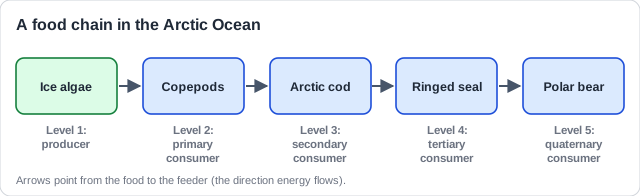
Real example: in the Arctic, copepods eat the algae under the sea ice. The polar bear, five steps up, is a quaternary consumer at the fifth trophic level.
Words that do not score on their own: 'Top predator', 'top consumer', 'tertiary' or 'third' alone may not get the mark. Write the full name and the number, for example 'tertiary consumer, fourth trophic level'. Only your first answer is marked.
How this comes up: Paper 2, Section A: a food chain with pollutant levels. Identify one organism by its trophic level [1].
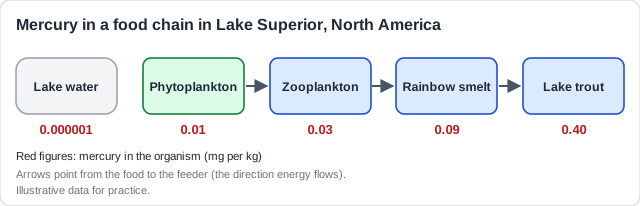
Figure 1 shows mercury levels in a food chain in Lake Superior, North America.
Identify the primary consumer in the food chain shown in Figure 1.
Model answer plan
See the mark-by-mark plan — for / against / judgement, with marking guidance — in study mode.