Losses along a food chain at Higher Level: The same four losses as SL, with different examples: a Serengeti lion pride and a lake food chain. At HL you also work out the percentage passed on, as ecological efficiency, on 2.2.28.
Practise this as you read
- Outline each loss as its own point, with an organism.
- Compare aquatic and land food chains.
Free preview
This is the free notes preview
You're reading the free notes. Aimnova Pro unlocks the full study experience — and you can try it with your first topic free to keep:
- FlashcardsLock in vocabulary and key terms with spaced repetition.
- Practice questionsAnswer exam-style questions and get instant AI marking.
- Mock exams & past-paper vaultSit full mocks and see exactly how examiners award marks.
- Personalised study planA daily plan built around your exam date and weak areas.
Every step leaks: As food is passed along a food chain, energy and organic matter are lost at every step. Only a small part reaches the next trophic level.
The points to remember
- The sun is the main source of energy for almost every food chain; producers capture it.
- At each step only a small part of the energy and organic matter becomes new biomass in the next level.
- The rest is lost: most as heat from respiration, some in waste and in parts not eaten.
- Energy is not destroyed (2.2.2): it leaves as heat, which no organism can use again.
- So there is never 100% transfer of organic matter from one trophic level to the next.
Remember it as: Every step leaks, mostly as heat.
Real example: on the Serengeti, the energy in a zebra that a lion eats started as sunlight on the grass; at each of those two steps most of the energy was lost as heat.
Where this fits: Why transformations are never 100% efficient (the second law) is on 2.2.8; heat from respiration on 2.2.7.
See how examiners mark answers
Access past paper questions with model answers. Learn exactly what earns marks and what doesn't.
Energy and matter are lost at four gates between one trophic level and the next. Each gate is a separate point in an answer.
Where the energy and matter go
- Not all the food available is harvested: prey escapes, some plants are never reached.
- Of what is harvested, not all is consumed: bones, bark, shells, roots and skin are left.
- Of what is consumed, not all is absorbed: undigested food leaves as faeces.
- Of what is absorbed, not all is stored: most is respired for movement and warmth, and lost as heat.
- Some absorbed matter also leaves as urine and other waste (excretion).
Remember it as: Harvested, consumed, absorbed, stored: less at every gate.
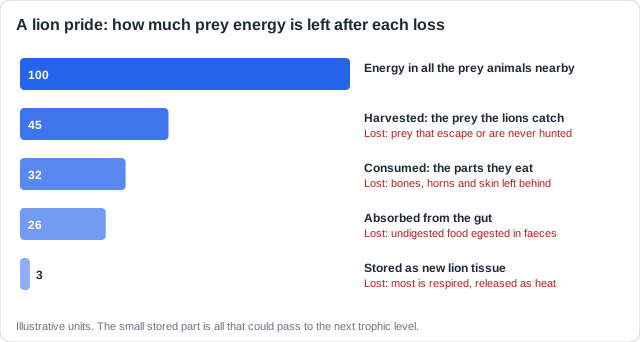
Real example: Serengeti lions catch only a fraction of the prey around them, leave bones, horns and skin for hyenas and vultures, and, as warm-blooded hunters, respire away most of what they absorb.
'Energy is lost' is not enough: Always say how: 'lost as heat from respiration', 'lost in faeces', 'parts not eaten'. The bare phrase 'energy is lost' is not credited.
Put the four losses together and only a small share passes on each time.
The points to remember
- Typically only about 10% of the energy in one trophic level reaches the next: about 90% is lost.
- The figure varies, roughly 5-20%, between ecosystems, levels and species.
- Aquatic food chains are often a little more efficient than food chains on land.
- Warm-blooded birds and mammals lose more energy as heat than cold-blooded animals such as fish and insects.
- Less energy at each level is why food chains are short (2.2.14).
Remember it as: About a tenth goes up; nine tenths go out.
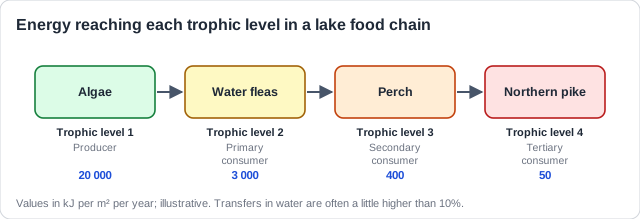
Real example: a northern pike depends on many perch, which depend on huge numbers of water fleas grazing the algae of the lake.
Numbers, not rules: The 10% figure is neither fixed nor a true average. Working out the percentage from data is ecological efficiency, on 2.2.28.
Study smarter, not longer
Most students waste 40% of study time on topics they already know. Our AI tracks your progress and optimizes every minute.
How this comes up: Paper 2, Section A: outline the reasons for energy losses between trophic levels in the food chain shown [4].
On the Serengeti, red oat grass is eaten by zebras, and zebras are hunted by lions.
Outline the reasons for energy losses between trophic levels in this food chain.
Model answer plan
See the mark-by-mark plan — for / against / judgement, with marking guidance — in study mode.