Producers and consumers at Higher Level: The same ideas as SL, with different examples: the North Sea off Shetland and the hydrothermal vents of the deep sea. At HL you meet the chemical energy route in more depth in 2.2.22.
Practise this as you read
- Describe several roles of producers, one per point.
- Build a four-level food chain from any food web.
Free preview
This is the free notes preview
You're reading the free notes. Aimnova Pro unlocks the full study experience — and you can try it with your first topic free to keep:
- FlashcardsLock in vocabulary and key terms with spaced repetition.
- Practice questionsAnswer exam-style questions and get instant AI marking.
- Mock exams & past-paper vaultSit full mocks and see exactly how examiners award marks.
- Personalised study planA daily plan built around your exam date and weak areas.
Producers come first: Producers make their own carbon compounds by photosynthesis: grass, trees, pondweed, seaweed, phytoplankton. That is why they are at the start of every food chain.
The points to remember
- Producers make their own carbon compounds from carbon dioxide and water, by photosynthesis.
- So they are always first in a food chain.
- Every consumer depends on them, directly (eating them) or indirectly (eating something that did).
- Without producers, no carbon compounds and no energy would enter the food chain at all.
Remember it as: No producer, no chain.
Real example: in the North Sea, a spring bloom of phytoplankton starts the chain that feeds copepods, sand eels and the puffins of Shetland.
Where this fits: What photosynthesis is (2.2.4) and producers as the first trophic level (2.2.5) have their own pages. Here: why producers start the chain and what comes after them.
Feeling unprepared for exams?
Get a clear study plan, practice with real questions, and know exactly where you stand before exam day. No more guessing.
Producers do far more than feed herbivores. Each job below is a separate point in a 'role of producers' answer.
What producers do for an ecosystem
- They turn light energy into chemical energy by photosynthesis.
- They turn carbon dioxide and water into glucose and oxygen.
- Glucose becomes biomass: the basis of food chains, food and energy for consumers.
- They release the oxygen that most living things need.
- They take in carbon dioxide, helping keep its level in the air in balance.
- They give habitats, hold soil in place and help cycle matter.
Remember it as: Food, oxygen, a carbon store and a home.
Real example: at hydrothermal vents, discovered in 1977 near the Galápagos Islands, bacteria use chemosynthesis in total darkness, and giant tube worms, crabs and fish all depend on them.
A few producers do not use light: Some bacteria make carbon compounds using energy from chemical reactions instead of light: chemosynthesis. They are producers too.
Consumers get their carbon compounds from producers or from other consumers. Each step away from the producer is a new trophic level.
The points to remember
- Primary consumers eat producers.
- Secondary consumers eat primary consumers.
- Tertiary consumers eat secondary consumers, and so on up the chain.
- So organic matter flows producer, primary, secondary, tertiary consumer: each a new trophic level.
Remember it as: Make it, eat it, eat the eater.
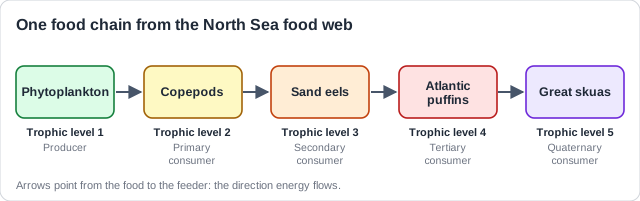
Real example: off Shetland, puffins feed their chicks on sand eels, which eat copepods, which eat phytoplankton; great skuas hunt the puffins.
Numbering the levels: How to number trophic levels and state the level of any organism is on the next page (2.2.11).
Memorize terms 3x faster
Smart flashcards show you cards right before you forget them. Perfect for definitions and key concepts.
A common task: the paper gives a food web and asks you to construct, sketch or draw a food chain with four trophic levels. Five checks make it right.
Building a food chain from given data
- Start with a producer named in the figure.
- Each next organism must eat the one before it, as the figure shows.
- Use the species names as written: never just 'plants', 'trees' or 'fish'.
- Draw one set of arrows, each pointing to the eater: the direction energy flows.
- Use only links shown in the figure: a link you know from elsewhere does not count.
Remember it as: Producer first, arrows to the eater, names from the figure.
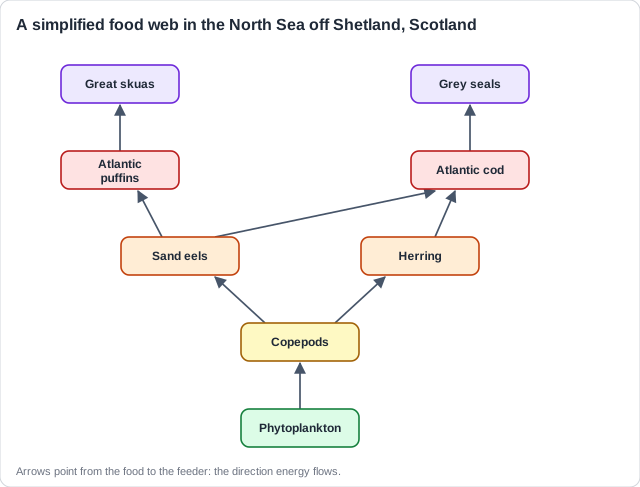
Two separate marks: One mark for four organisms that really form a chain in the figure; one for arrows that all point to the eater. A second set of arrows, for example for waste or heat, loses the arrow mark.
Try it: phytoplankton, copepods, herring, Atlantic cod is four levels; adding grey seals makes five.
How this comes up: Paper 2: describe the role of producers in an ecosystem [4], one role per point.
In the North Sea, phytoplankton are eaten by copepods, which are eaten by sand eels, herring and the fish and seabirds that hunt them.
Describe the role of producers in the North Sea ecosystem.
Model answer plan
See the mark-by-mark plan — for / against / judgement, with marking guidance — in study mode.