Density dependence at Higher Level: The same ideas as SL. At HL, practise explaining each factor as part of a feedback loop, step by step.
Practise this as you read
- Sort each factor: does its effect grow with crowding?
- Trace the loop: change, response, and the change reversed.
Free preview
This is the free notes preview
You're reading the free notes. Aimnova Pro unlocks the full study experience — and you can try it with your first topic free to keep:
- FlashcardsLock in vocabulary and key terms with spaced repetition.
- Practice questionsAnswer exam-style questions and get instant AI marking.
- Mock exams & past-paper vaultSit full mocks and see exactly how examiners award marks.
- Personalised study planA daily plan built around your exam date and weak areas.
Does crowding matter?: A density-dependent factor gets stronger as a population gets more crowded. A density-independent factor does not care how crowded it is.
The points to remember
- Density-dependent factors grow stronger as a population gets denser: competition, predation, disease, parasites.
- In a crowded population, predators find prey more easily and pathogens pass from one to another faster.
- Density-independent factors hit a population whatever its density: storms, floods, fires, droughts, hard frosts.
- Density-independent factors can kill many, but they do not hold a population near its carrying capacity.
- It is the density-dependent factors that regulate a population around its carrying capacity.
Remember it as: Crowding makes it worse? Density-dependent. Weather that hits everyone? Density-independent.
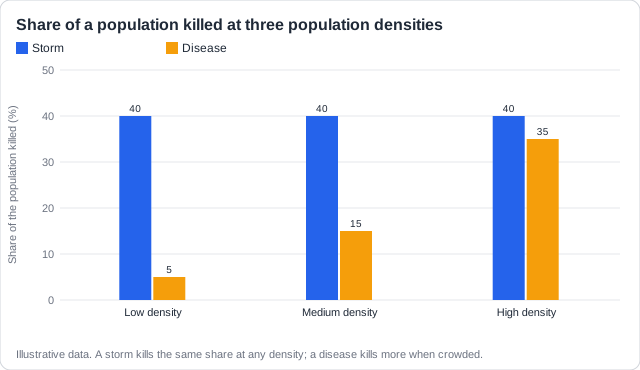
Real example: in 2022, bird flu spread fast through the tightly packed gannets on Bass Rock, Scotland, killing thousands: density-dependent.
Study smarter, not longer
Most students waste 40% of study time on topics they already know. Our AI tracks your progress and optimizes every minute.
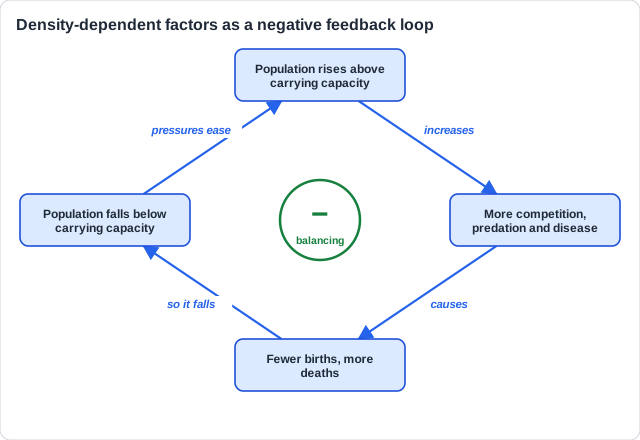
Back to balance: Density-dependent factors work as negative feedback: they push a population back towards its carrying capacity whenever it moves away.
The points to remember
- The population rises above its carrying capacity.
- Competition, predation and disease all increase.
- Fewer births and more deaths, so the population falls back.
- Below the carrying capacity these pressures ease, so the population rises again.
- This is negative feedback: it returns the population to equilibrium around the carrying capacity.
Remember it as: Too many: more squeeze, fewer survive. Too few: less squeeze, more survive.
Real example: in Wytham Woods, Oxford, great tits have been studied since 1947; in years with more breeding pairs, each pair raises fewer chicks.
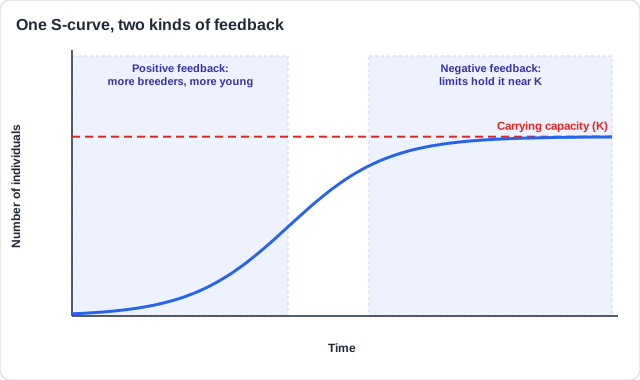
Two loops, one curve: An S-shaped growth curve shows both kinds of feedback: positive feedback drives the early growth, and negative feedback slows it and holds it at the carrying capacity.
The points to remember
- At the start, more individuals breed, making more young, who breed in turn: positive feedback.
- Positive feedback is a change that leads to more of the same change: fast, exponential growth.
- Near the carrying capacity, density-dependent factors (food, water, predation, disease) grow stronger.
- They slow the growth rate and hold numbers near the carrying capacity: negative feedback.
- Negative feedback is a change that leads to less of that change: it stabilises the population.
Remember it as: Positive: more makes more. Negative: more makes less.
Real example: collared doves spread across Europe from Turkey in the 1900s; in each new country their numbers grew fast, then levelled off.
Name both loops: Write 'positive feedback' and 'negative feedback' by name, each with its part of the curve. Describing the curve without naming the loops scores far fewer marks.
Practice with real exam questions
Answer exam-style questions and get AI feedback that shows you exactly what examiners want to see in a full-marks response.
How this comes up: Paper 2, Section B (b): explain how positive and negative feedback produce an S-curve [7]. Short questions ask you to tell density-dependent factors from density-independent ones [2].
A few yeast cells are added to a flask of sugar solution kept at a steady, warm temperature. Their numbers are counted every hour.
Explain how both positive and negative feedback mechanisms may play a role in producing a typical S population growth curve for a species.
Model answer plan
See the mark-by-mark plan — for / against / judgement, with marking guidance — in study mode.