Environmental sustainability at Higher Level: The same ideas as SL. At HL, link them to how economists treat nature as capital, and to laws that limit its use.
Practise this as you read
- Compare the use of a resource with its natural income.
- Explain why the timescale of replacement matters.
Free preview
This is the free notes preview
You're reading the free notes. Aimnova Pro unlocks the full study experience — and you can try it with your first topic free to keep:
- FlashcardsLock in vocabulary and key terms with spaced repetition.
- Practice questionsAnswer exam-style questions and get instant AI marking.
- Mock exams & past-paper vaultSit full mocks and see exactly how examiners award marks.
- Personalised study planA daily plan built around your exam date and weak areas.
Can nature keep up?: Environmental sustainability means using nature in a way it can keep up with.
The points to remember
- Use resources no faster than they are replaced: take only what regrows or refills.
- Let ecosystems recover and regenerate after they are used or damaged.
- Avoid resource depletion: do not run a resource down.
- Cut pollution to what nature can absorb.
- Conserve biodiversity: protect species and their habitats.
- Active regeneration: people help nature back, for example by replanting or restoring land.
On the Loess Plateau, China: from the 1990s, farmers built terraces, planted trees and kept goats off the slopes. Plants came back, and far less soil now washes into the Yellow River. This is active regeneration.
Remember it as: Use it, don't use it up.
Practice with real exam questions
Answer exam-style questions and get AI feedback that shows you exactly what examiners want to see in a full-marks response.
A stock of a resource is natural capital. What it adds each year is natural income.
The points to remember
- Natural capital: the stock of a resource, such as a forest or a fish stock.
- Natural income: what the stock adds each year, its growth or yield.
- Sustainable: use no more than the natural income, and leave the stock as you found it.
- Take more than the income and the stock shrinks: that is unsustainable.
- How a resource is extracted, transported and processed can also make its use unsustainable.
- Laws, policies and campaigns change what people do, so less is overused.
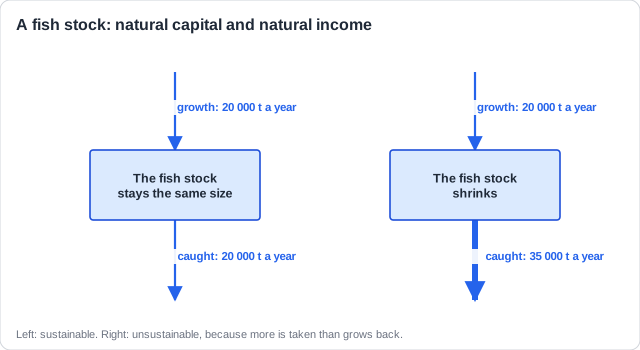
Laws help: the European Union sets a yearly catch limit for each fish stock, so boats cannot take more than the stock can replace.
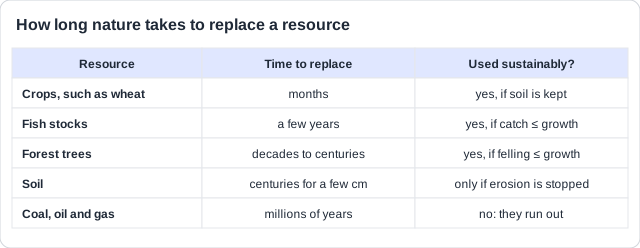
Every natural resource is replaced by nature, but on a very different timescale.
The points to remember
- Resources are replaced on different timescales: months, years, centuries.
- Renewable resources (crops, fish, trees) can be used sustainably, within their growth.
- Soil forms so slowly that soil washed away is lost for lifetimes.
- Non-renewable resources (coal, oil, gas, metals) form over millions of years.
- So a non-renewable resource can never be used sustainably: every use runs it down.
Old groundwater: the Nubian Sandstone Aquifer filled up thousands of years ago and is hardly refilled today, so pumping it uses it up.
A common slip: 'Renewable' does not mean 'sustainable'. A renewable resource used faster than it is replaced runs out too.
Feeling unprepared for exams?
Get a clear study plan, practice with real questions, and know exactly where you stand before exam day. No more guessing.
How this comes up: Paper 1: a figure shows a traditional and a modern object; outline one reason one is more sustainable [1]. Paper 2: outline how sustainability applies to managing natural capital [4].
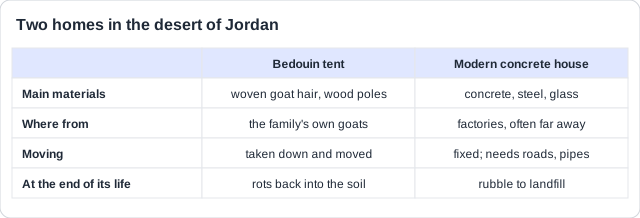
Figure 1 compares the Bedouin tent with the modern concrete house in the desert of Jordan.
With reference to Figure 1, outline one reason why the Bedouin tent is more sustainable than the modern concrete house.
Model answer plan
See the mark-by-mark plan — for / against / judgement, with marking guidance — in study mode.
Paper 2 asks about the same idea in general, for four marks.
A government manages its country's fish stocks and its oil fields.
Outline how the concept of sustainability can be applied to managing natural capital.
Model answer plan
See the mark-by-mark plan — for / against / judgement, with marking guidance — in study mode.