The pillars at Higher Level: The same three pillars as SL. At HL, link the strong and weak models to how economists value nature.
Practise this as you read
- Check each change against all three pillars.
- Explain why the strong model nests the circles.
Free preview
This is the free notes preview
You're reading the free notes. Aimnova Pro unlocks the full study experience — and you can try it with your first topic free to keep:
- FlashcardsLock in vocabulary and key terms with spaced repetition.
- Practice questionsAnswer exam-style questions and get instant AI marking.
- Mock exams & past-paper vaultSit full mocks and see exactly how examiners award marks.
- Personalised study planA daily plan built around your exam date and weak areas.
Three things to check: Sustainability rests on three pillars: environmental, social and economic.
The points to remember
- Environmental: nature and its resources, used so they can recover.
- Social: people's well-being: health, education, fairness and culture.
- Economic: jobs, income and producing what people need, into the future.
- The pillars interact: a change in one affects the other two.
- Judge any change on all three: who gains, who loses, and what happens to nature.
In the Sella Alps: a new ski lift brings jobs and tourist spending (economic), clears forest for pistes (environmental), and makes housing too costly for young locals (social).
Remember it as: Planet, people, prosperity: check all three.
Never wonder what to study next
Get a personalized daily plan based on your exam date, progress, and weak areas. We'll tell you exactly what to review each day.
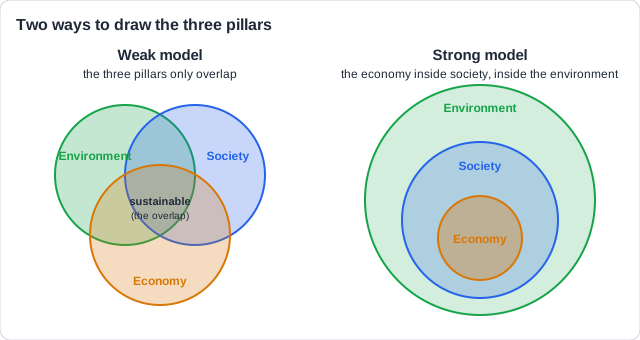
How the pillars fit together can be drawn in two ways.
The points to remember
- Weak model: three pillars that overlap; sustainable where all three meet.
- It treats the pillars as equal, so lost nature can be made up for with money or technology.
- Strong model: the economy inside society, and both inside the environment.
- No environment, no society; no society, no economy.
- Strong sustainability says some nature cannot be replaced.
Try it: switch between the two models.
Equal pillars (weak) against the nested model (strong).
Interactive diagram
Explore the labelled diagram, charts and maps for this topic in full study mode.
A link to environmental economics: Weak sustainability lets natural capital be swapped for human-made capital; strong sustainability does not, because nature is the base everything else stands on.
How this comes up: Paper 1: a figure shows a trend, such as tourist numbers. Identify one advantage and one disadvantage [2].
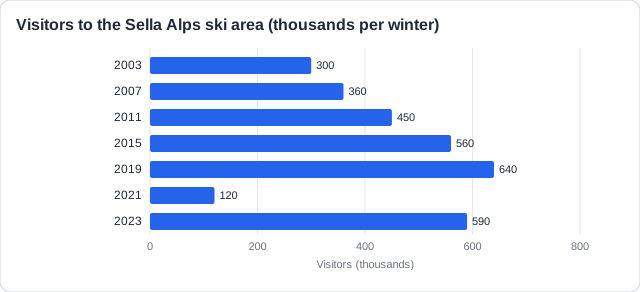
Figure 1 shows the number of visitors to the Sella Alps ski area between 2003 and 2023.
Identify one advantage and one disadvantage of the trend in visitor numbers shown in Figure 1.
Model answer plan
See the mark-by-mark plan — for / against / judgement, with marking guidance — in study mode.