aimnova.
DashboardMy LearningPaper MasteryStudy Plan

Stay in the loop

Study tips, product updates, and early access to new features.

aimnova.

AI-powered IB study platform with personalised plans, instant feedback, and examiner-style marking.

IB Subjects
  • All IB Subjects
  • IB Diploma
  • IB ESS
  • IB Economics
  • IB Business Management
  • IB Math AI
  • IB Math AA
  • IB Physics
  • IB Biology
  • IB Chemistry
  • IB History
  • IB History (2028+)
  • IB Global Politics
  • IB Psychology
  • IB Philosophy
  • IB Geography
  • IB Spanish B
  • IB German B
  • IB Italian B
  • IB French B
  • IB English B
  • IB English A Lang & Lit
  • IB Spanish A Lang & Lit
  • IB French A Lang & Lit
Question Banks
  • ESS Question Bank
  • Economics Question Bank
  • Business Management Question Bank
  • Math AI Question Bank
  • Math AA Question Bank
  • Physics Question Bank
  • Biology Question Bank
  • Chemistry Question Bank
  • History Question Bank
  • History (2028+) Question Bank
  • Global Politics Question Bank
  • Psychology Question Bank
  • Philosophy Question Bank
  • Geography Question Bank
  • Spanish B Question Bank
  • German B Question Bank
  • Italian B Question Bank
  • French B Question Bank
  • English B Question Bank
  • English A Lang & Lit Question Bank
  • Spanish A Lang & Lit Question Bank
  • French A Lang & Lit Question Bank
Predicted Topics 2026
  • ESS Predictions 2026
  • Economics Predictions 2026
  • Business Management Predictions 2026
  • Math AI Predictions 2026
  • Math AA Predictions 2026
  • Physics Predictions 2026
  • Geography Predictions 2026
  • Spanish B Predictions 2026
  • German B Predictions 2026
  • Italian B Predictions 2026
  • French B Predictions 2026
  • English B Predictions 2026

Study Resources

  • Free Study Notes
  • Mock Exams
  • Revision Guide
  • Flashcards
  • Exam Skills
  • Command Terms
  • Past Paper Feedback
  • Grade Calculator
  • Exam Timetable 2026

Company

  • Features
  • Pricing
  • About Us
  • Blog
  • Contact
  • Terms
  • Privacy
  • Cookies

© 2026 Aimnova. All rights reserved.

Made with 💜 for IB students worldwide

097e145
NotesESS HLTopic 1.3Sustainability
Back to ESS HL Topics
1.3.14 min read

Sustainability (ESS HL)

IB Environmental Systems and Societies • Unit 1

Smart study tools

Turn reading into results

Move beyond passive notes. Answer real exam questions, get AI feedback, and build the skills that earn top marks.

Get Started Free

Contents

  • Sustainability
  • Environmental Sustainability
  • Social Sustainability
  • Economic Sustainability
  • Exam-style question (step by step)
Sustainability at HL: What sustainability means — living within the Earth's limits, now and in future — is identical for SL and HL. HL adds a little more later: a few extra ways of measuring and modelling it, in topics such as nutrient cycles, freshwater use and population.

Don't worry about the extras yet — just get the core idea of sustainability clear first.

Free preview

This is the free notes preview

You're reading the free notes. Aimnova Pro unlocks the full study experience — and you can try it free for 7 days:

  • FlashcardsLock in vocabulary and key terms with spaced repetition.
  • Practice questionsAnswer exam-style questions and get instant AI marking.
  • Mock exams & past-paper vaultSit full mocks and see exactly how examiners award marks.
  • Personalised study planA daily plan built around your exam date and weak areas.
Start your 7-day free trial Full access to Aimnova Pro · cancel anytime

🌍 Sustainability

What is sustainability?: Using resources today without ruining things for tomorrow. Think of it like not eating all the pizza so there's some left for later! 🍕

🐟 A Real Example: Overfishing

The Cod Collapse: In the 1990s, Canada's Atlantic cod fishery collapsed. Fishermen caught so many fish that the population couldn't recover. 40,000 people lost their jobs, and 30 years later the cod still haven't returned! 🚫🐟
  • 🎣 Short-term: Fishermen caught more fish = more money
  • 📉 Problem: Fish couldn't reproduce fast enough
  • 💥 Result: Entire fishery collapsed — no fish, no jobs, no food
  • ⏰ Lesson: Taking too much now = nothing left for later
The Problem: Earth is like a bank account 🏦 — if you keep withdrawing without depositing, eventually you run out!

🎯 The Three Pillars of Sustainability

You MUST know these three for the exam! They always appear in essay questions.

Interactive diagram

Explore the labelled diagram, charts and maps for this topic in full study mode.

Unlock free for 7 days
Think of a three-legged stool 🪑 — remove any leg and it falls over! All three pillars must work together.
  • 🐟 Environmental: Overfishing destroys fish populations
  • 👥 Social: Fishing communities lose their way of life
  • 💰 Economic: 40,000 jobs disappeared overnight

💪 Strong vs Weak Sustainability

❌ Weak Sustainability

  • Economy comes first
  • "We can replace nature with technology"
  • "Fish farms can replace wild fish!"
  • Short-term thinking

✅ Strong Sustainability

  • Environment comes first
  • "Some things can't be replaced"
  • Wild ocean ecosystems are irreplaceable
  • Long-term thinking
The simple truth: No environment 🌍 = No society 👥 = No economy 💰. The environment is the foundation of everything else!

📝 Exam Cheat Sheet

  • Sustainability = meeting today's needs without harming future generations
  • 3 pillars = Environmental + Social + Economic
  • All connected = damage one, damage all
  • Strong sustainability = environment is irreplaceable (this is the IB view!)
  • Key phrase to use: "long-term system stability"
When the exam asks about sustainability, ALWAYS mention that the three domains are interconnected — you can't have one without the others!

Know your predicted grade

Take timed mock exams and get detailed feedback on every answer. See exactly where you're losing marks.

Try Mock Exams Free7-day free trial • No card required

🌱 Environmental Sustainability

The Big Idea 💡: Environmental sustainability = using nature's resources slowly enough that nature can keep up. Think of it like a bank account — if you spend faster than you earn, you go broke!

🎯 The 4 Goals of Environmental Sustainability

  • 🐢 Don't use faster than nature replaces — fish can breed, trees can grow, but only so fast
  • 🚫 Reduce pollution — stop dumping trash in nature's living room
  • 🦋 Protect biodiversity — every species plays a role
  • ♻️ Let ecosystems recover — give nature a break to heal
Simple test: Can nature bounce back? ✅ = Sustainable. Can't recover? ❌ = Unsustainable.

🌿 How Nature Does It Right (Biomimicry)

Nature has been "sustainable" for billions of years. Here's its secret playbook:

Exam phrase: "Healthy ecosystems are sustainable because they recycle materials and can recover naturally from disturbances."

🏭 How Humans Get It Wrong

Compare nature's approach to how most human societies work:

The Problem: When we ignore nature's limits, we're basically writing cheques nature can't cash 💸

💥 What Happens When It's Unsustainable?

When humans push past nature's limits, things collapse like dominoes:

  • 🐟 Ecosystems collapse — cod fishery crashed in 1992, still hasn't recovered
  • 🦤 Species go extinct — once gone, gone forever
  • 👨‍🌾 People lose livelihoods — no fish = no fishing jobs
  • 💰 Economies suffer — environmental damage costs billions
It's all connected: Environmental damage → Economic damage → Social damage. You can't have a healthy economy on a dead planet! 🌍

📝 Exam Cheat Sheet

5 Things to Remember: 1️⃣ Environmental sustainability = ecosystems can recover and keep working

2️⃣ Nature recycles everything; humans mostly waste

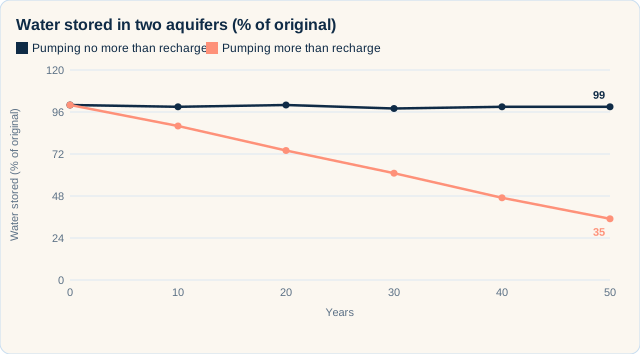
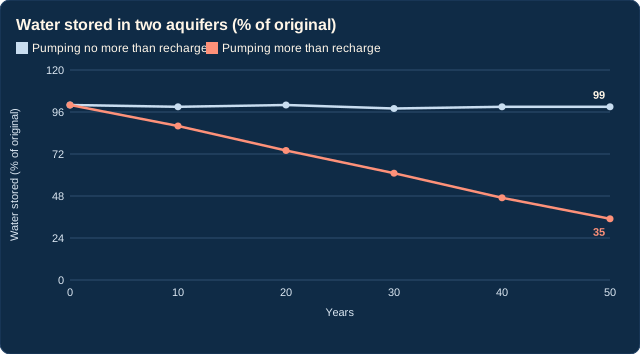
3️⃣ Overuse = collapse (see: cod, rainforests, aquifers)

4️⃣ Human well-being depends on healthy ecosystems

5️⃣ The test: Can nature bounce back? That's sustainability.

Interactive diagram

Explore the labelled diagram, charts and maps for this topic in full study mode.

Unlock free for 7 days

👥 Social Sustainability

In simple words: Social sustainability means building societies where people can live healthy, fair, and meaningful lives, now and in the future.

What social sustainability includes

  • Access to healthcare
  • Access to education
  • Fairness and equality in society
  • Strong communities
  • Protection of culture, beliefs, and traditions
A society is not sustainable if people’s basic social needs are not met.

Beyond basic needs

Humans need more than food, water, and shelter to live well. People also need support, safety, and opportunities to develop their abilities.

  • Supportive families and friendships
  • Strong schools and healthcare systems
  • Communities where people help each other
  • Institutions that protect people in difficult times

Social capital (important idea)

When people are connected through trust, cooperation, and support, this is called social capital.

  • People feel supported, not isolated
  • Communities are more resilient
  • People cope better during crises
  • Overall well-being and happiness increase
Think of social sustainability as a safety net that stops people from falling through society.

Why social sustainability matters

  • Helps people reach their potential
  • Reduces vulnerability during hard times
  • Keeps societies stable over time
  • Strengthens human resilience
In exams, link social sustainability to human well-being, strong institutions, and long-term societal stability.

Get feedback like a real examiner

Submit your answers and get instant feedback — what you did well, what's missing, and exactly what to write to score full marks.

Try AI Tutor Free7-day free trial • No card required

💰 Economic Sustainability

In simple words: Economic sustainability means organising the economy so people’s needs are met now and in the future, without the system breaking down.

What economic sustainability is about

  • Producing goods and services people need
  • Making sure basic needs stay affordable
  • Supporting long-term jobs and income
  • Avoiding systems that collapse under stress

Provisioning systems (important term)

A provisioning system is how humans turn raw materials and energy into goods and services.

  • Markets provide food, clothing, and shelter
  • Governments help when markets fail or prices are too high
  • Different systems work together to meet people’s needs
An economy is not sustainable if people cannot afford basic necessities.

The hidden role of households

Households are a vital but often overlooked part of the economy.

  • Unpaid care and domestic work supports daily life
  • This work helps maintain health and well-being
  • Households create social stability and resilience
  • Without households, economic systems would struggle
If households are under stress, the whole economy becomes less sustainable.

What a sustainable economy needs

  • Affordable access to basic goods
  • Markets that work for most people
  • Government support when people are struggling
  • Households that can perform their caring role
In exams, link economic sustainability to meeting basic needs over time, not just economic growth.

IB-style question — the 'to what extent is it sustainable?' question

A small island reports: 72% of its electricity now comes from solar and wind; native forest cover rose from 48% to 53% over ten years. However, its ecological footprint is 1.8× its biocapacity, groundwater is falling ~0.4 m per year, and 60% of food is imported. To what extent is the island being managed sustainably? [6]

How to answer it, step by step

  1. Sort the evidence into two columns

    • Sustainable: 72% renewable electricity; forest cover rising (48%→53%)

    • Unsustainable: footprint 1.8× biocapacity; groundwater falling 0.4 m/yr; 60% food imported — quote these figures
  2. Reach a justified conclusion (1 mark is reserved for it)

    • Weigh both sides, then give a clear verdict: e.g. "largely unsustainable, because the footprint exceeds biocapacity and water is being depleted, despite real progress on renewable energy"

    • Use the numbers given — don't just list facts

Final answer

Use the figures on BOTH sides and finish with a balanced, data-based conclusion — one mark is reserved for that judgement (not for listing facts).

Try an IB Exam Question — Free AI Feedback

Test yourself on Sustainability. Write your answer and get instant AI feedback — just like a real IB examiner.

the three pillars (domains) of sustainability. [2 marks]

Key Terms

Carrying capacity
The maximum population size or activity level that an environment can sustain indefinitely.
Natural capital
The world's stock of natural resources, including ecosystems, that provide goods and services to people.
Non-renewable resource
A natural resource that cannot be replaced once used, or takes millions of years to form.
Renewable resource
A natural resource that can be replenished at a rate equal to or faster than the rate at which it is consumed.
Sustainability
Development that meets the needs of the present without compromising the ability of future generations to meet their own needs.
Sustainable development
Economic and social development that improves quality of life while protecting environmental systems for the future.

Related ESS HL Topics

Continue learning with these related topics from the same unit:

1.1.1Perspectives
1.1.2Worldviews
1.1.3EVS
1.1.4Values Surveys
View all ESS HL topics

Practice with flashcards

Spaced repetition flashcards for Sustainability

Improve your exam technique

Command terms, paper structure, and mark-scheme tips for ESS HL

Previous
1.2.6Resilience
Next
Environmental Justice1.3.2

48 practice questions on Sustainability

Students who practiced this topic on Aimnova scored 82% on average. Try free practice questions and get instant AI feedback.

Try 3 Free QuestionsView All ESS HL Topics