Planetary boundaries at Higher Level: The same nine processes as SL. At HL, you also use numbers to decide when, and if, a boundary has been crossed.
Practise this as you read
- Read a measured value against its boundary value.
- Check which side of the boundary is safe before you decide.
Free preview
This is the free notes preview
You're reading the free notes. Aimnova Pro unlocks the full study experience — and you can try it with your first topic free to keep:
- FlashcardsLock in vocabulary and key terms with spaced repetition.
- Practice questionsAnswer exam-style questions and get instant AI marking.
- Mock exams & past-paper vaultSit full mocks and see exactly how examiners award marks.
- Personalised study planA daily plan built around your exam date and weak areas.
Nine limits for one planet: The planetary boundaries model describes the nine processes and systems that have kept the Earth stable and resilient through the Holocene.
The points to remember
- Nine processes and systems have kept the Earth stable and resilient in the Holocene.
- Each has a boundary: the limit of human disturbance it can take.
- Inside all nine boundaries is the safe operating space for humanity.
- Crossing a boundary increases the risk of abrupt and irreversible change.
Remember it as: Nine names, exact words. Inside the circle: safe. Outside: risk.
The nine processes (use these exact names)
- Climate change
- Biosphere integrity (loss of biodiversity)
- Land-system change (e.g. forests cleared)
- Freshwater use
- Biogeochemical flows (nitrogen and phosphorus)
- Ocean acidification
- Atmospheric aerosol loading (tiny particles in the air)
- Stratospheric ozone depletion
- Novel entities (new substances such as plastics and pesticides)
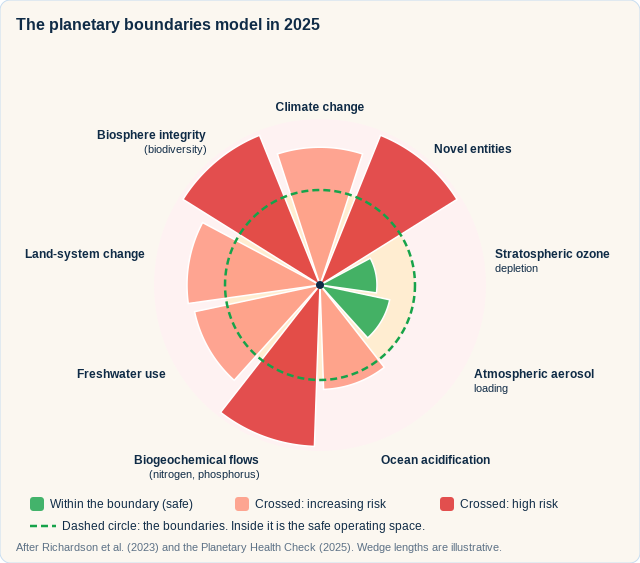
Use the model's own names: Write 'novel entities', not just 'pollution'; 'biosphere integrity', not just 'nature'.
Real example: hundreds of thousands of chemicals are sold worldwide, and most have never been tested for safety: this is why novel entities is judged crossed.
Get feedback like a real examiner
Submit your answers and get instant feedback — what you did well, what's missing, and exactly what to write to score full marks.
Scientists check each boundary as new data come in: three were judged crossed in 2009, six in 2023 and seven in 2025.
Crossed, and the human activities that caused it
- Climate change: burning coal, oil and gas; clearing forests.
- Biosphere integrity: habitat loss, overfishing and hunting, invasive species.
- Land-system change: forests cleared for farms, cattle and cities.
- Freshwater use: irrigation, dams and over-pumping of rivers and aquifers.
- Biogeochemical flows: nitrogen and phosphorus fertilisers washing into rivers and seas.
- Novel entities: plastics, pesticides and other new chemicals released untested.
- Ocean acidification: the sea absorbs carbon dioxide from burning fossil fuels.
Remember it as: Seven out, two in: ozone and aerosols are still safe.
Still inside: ozone
- CFCs were banned in 1987.
- The ozone layer is recovering.
Still inside: aerosols
- Safe for the world as a whole.
- But very high over parts of South Asia.
Real example: fertiliser washing down the Mississippi River causes a dead zone in the Gulf of Mexico every summer: biogeochemical flows.
Like every model, it simplifies the Earth, so it has uses and limitations.
The points to remember
- Use: it sets science-based limits to human disturbance of Earth systems.
- Use: it shows we must focus on more than climate change, which dominates discussion.
- Use: it alerts the public and policymakers that action is urgent.
- Limitation: it covers only ecological systems, not the human side needed for environmental justice.
- Limitation: it is a work in progress: assessments change as new data arrive.
- Limitation: global boundaries may not guide local or national action.
Remember it as: Uses: limits, beyond climate, a wake-up call. Limits: no people, still changing, too global.
Real example: the world uses too much nitrogen, yet many farms in sub-Saharan Africa have too little: one global limit does not tell each country what to do.
Link it to the doughnut: Because the model leaves out people, the doughnut economics model (1.3.20) adds a social foundation inside it.
Learn what examiners really want
See exactly what to write to score full marks. Our AI shows you model answers and the key phrases examiners look for.
When, and if, a boundary was crossed: At HL, use numbers to decide when, and if, a boundary has been crossed.
The points to remember
- Find the boundary value and the measured value.
- Check the direction: for most, higher is worse; for forest and ozone, lower is worse.
- Crossed means the value is on the unsafe side of the boundary.
- On a graph, the year the line passes the boundary is when it was crossed.
- Say how far beyond it is: 190 is about three times 62.
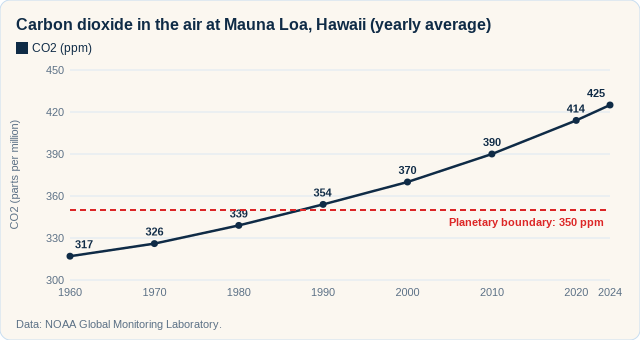
Carbon dioxide passed the 350 ppm boundary in the late 1980s (354 ppm in 1990), and reached 425 ppm in 2024.
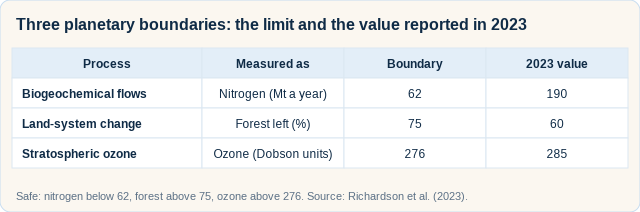
Nitrogen: 190 against 62, crossed, about three times the limit. Forest: 60% against 75%, crossed, because less forest is worse. Ozone: 285 against 276, not crossed, because more ozone is safer.
How this comes up: Paper 2, Section B (a): identify four processes in the planetary boundaries model [4].
A government report says the world must stay within the planetary boundaries to avoid abrupt change.
Identify four processes included in the planetary boundaries model.
Model answer plan
See the answer broken into clear points, with guidance on how each point earns marks.