Humans and resilience at Higher Level: The same idea as SL. At HL, weigh the activities that weaken systems against those that protect them.
Practise this as you read
- Link each activity to a storage or to diversity.
- Balance damage against protection.
Free preview
This is the free notes preview
You're reading the free notes. Aimnova Pro unlocks the full study experience — and you can try it with your first topic free to keep:
- FlashcardsLock in vocabulary and key terms with spaced repetition.
- Practice questionsAnswer exam-style questions and get instant AI marking.
- Mock exams & past-paper vaultSit full mocks and see exactly how examiners award marks.
- Personalised study planA daily plan built around your exam date and weak areas.
Humans remove what makes systems resilient: Resilience comes from large storages and high diversity (1.2.17). Many human activities shrink both.
The points to remember
- Resilience rests on large storages and high diversity (1.2.17).
- Humans lower resilience by shrinking storages or cutting diversity.
- Deforestation: less biomass, soil and water stored, and fewer species.
- Every point: activity + what it changes + resilience up or down.
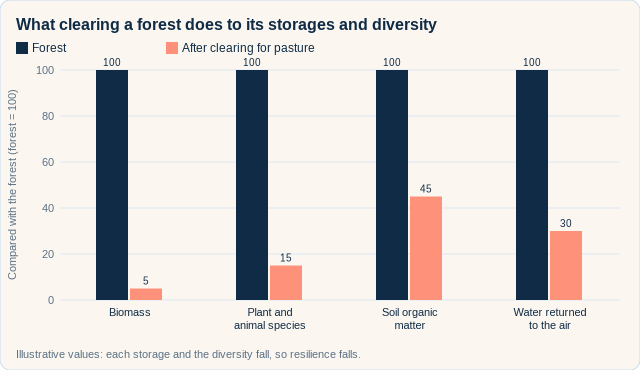
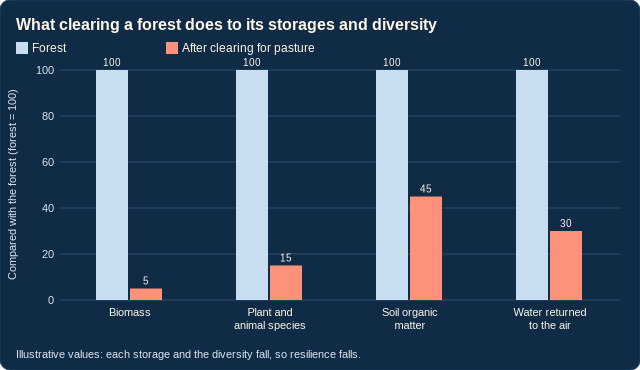
So the cleared land
- Loses its biomass and soil storages, so it recovers slowly.
- Loses species, so there are no back-ups.
- Returns less water to the air, so rainfall falls: a step towards a tipping point.
Remember it as: Shrink the stores or the species, and resilience falls.
Feeling unprepared for exams?
Get a clear study plan, practice with real questions, and know exactly where you stand before exam day. No more guessing.
Deforestation is one example. Most damage works the same way: a storage or diversity shrinks.
The points to remember
- Farming: monocultures and pesticides cut diversity; cattle strip plant biomass and pollute water.
- Overfishing and water extraction shrink the storage itself.
- Pollution (acid rain, air pollution) kills sensitive species such as lichens, so food webs get simpler.
- Eutrophication overrides the negative feedback that keeps a lake stable.
- Burning fossil fuels warms the climate: drier soils, lower productivity, fewer species.
- Urban growth and mining remove whole habitats.
| Human activity | What it reduces | Effect on resilience |
|---|---|---|
| Overfishing | Fish storage, genetic diversity | Stock cannot recover (Newfoundland cod) |
| Intensive farming | Diversity, soil storage | Pests spread; soil erodes |
| Water extraction | Lake and groundwater storage | Drought hits harder |
| Burning fossil fuels | Productivity, species (warming) | Coral reefs bleach and tip |
Humans can also raise resilience, by protecting or rebuilding storages and diversity.
The points to remember
- Protected areas and species reintroductions keep and rebuild diversity.
- Replanting forests and restoring wetlands rebuild storages.
- Agroforestry with a well-chosen mix of species adds diversity (a poor mix cuts it).
- Laws: fishing quotas and pollution limits let storages rebuild.
- Ecotourism pays to keep forest standing, so forest area grows.
- Dams and reservoirs add a water storage.
- Sustainable development: soil conservation and renewable energy keep productivity high.
Rebuild storages
- Reforestation and wetland restoration.
- Fishing quotas let stocks rebuild.
Protect diversity
- Reserves and species reintroductions.
- Mixed agroforestry instead of monocultures.
Both directions score: In the exam, an activity that raises resilience earns marks too, as long as you say how.
Memorize terms 3x faster
Smart flashcards show you cards right before you forget them. Perfect for definitions and key concepts.
How this comes up: Discuss the role of humans in destabilising ecological systems [9], or outline four human impacts [4].
Discuss the role of humans in the destabilization of ecological systems.
Model answer plan
See the answer broken into clear points, with guidance on how each point earns marks.