The big idea: Psychology here is the study of the mind, including all the senses that send information to it.
A designer has five channels — sight, sound, touch, smell, taste — and most products use only one of them properly.
Each sense with the design decision it supports. Step through to see what smell and taste are actually used for.
Interactive diagram
Explore the labelled diagram, charts and maps for this topic in full study mode.
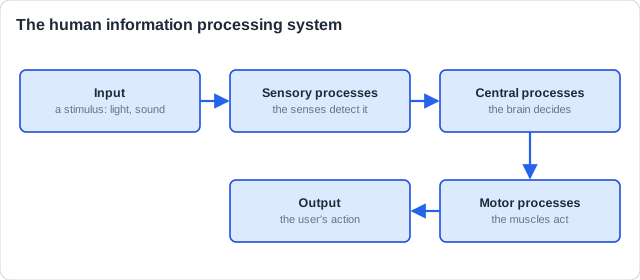
Every use of a product runs through the same chain, the human information processing system: the senses pick up a signal, the brain decides what it means, and the muscles act.
A design can fail at any link
Sensing
A signal too faint to notice: a quiet beep in a noisy kitchen.
Deciding
A display too confusing to understand: a washing machine menu of unexplained icons.
Acting
A control too hard to work: a stiff dial for a user with weak hands.
Free preview
This is the free notes preview
You're reading the free notes. Aimnova Pro unlocks the full study experience — and you can try it with your first topic free to keep:
- FlashcardsLock in vocabulary and key terms with spaced repetition.
- Practice questionsAnswer exam-style questions and get instant AI marking.
- Mock exams & past-paper vaultSit full mocks and see exactly how examiners award marks.
- Personalised study planA daily plan built around your exam date and weak areas.
Vision — fastest and richest
Shape, size, position and colour say what a control does before any label is read. A hazard switch is red, guarded and a different shape from its neighbours, so the hand knows before the eye finishes reading.
Sound — reaches you when you are looking away
A click confirms a switch latched; a tone carries across a noisy room. Sound is the channel that works when the user's eyes are busy — which is why reversing sensors beep rather than flash.
Touch — confirms without looking
A detent you can feel, a ridged dial, a textured grip. A touchscreen has none of this, which is why phones simulate it with haptics — and why cars are putting physical knobs back.
Smell — almost entirely safety
Natural gas is odourless. The smell is added so a leak is noticed, turning an invisible hazard into a warning that needs no device.
Taste — deterrence
Detergent capsules carry a bittering agent so a child spits one out rather than swallowing it. A design decision using a sense almost no product considers.
Get feedback like a real examiner
Submit your answers and get instant feedback — what you did well, what's missing, and exactly what to write to score full marks.
Redundancy: Critical information should reach the user through more than one sense.
An alarm that flashes and sounds still works for a user who cannot hear it, who wears ear defenders, or who is looking the other way.
One channel
- A colour-only status light
- A silent touchscreen button
- A quiet tone in a noisy workshop
- Fails completely for part of the user group
Two channels
- Colour plus a symbol or position
- A button that clicks and highlights
- A beacon plus a tone
- Degrades gracefully — one channel can fail
The exam move: When a scenario describes a product with one channel, the mark is almost always in naming the second one you would add and saying who it helps.
Collecting psychological data
Feelings cannot be measured with callipers
So designers observe users, and ask them to rate a sound, a texture or a colour on a scale in user trials and questionnaires.
Less reliable than a body measurement
Perception differs from person to person, and alertness changes with tiredness and time of day.
The surroundings change alertness
Temperature
A warm, stuffy carriage or room makes people drowsy; a cool one keeps them more alert.
Lighting
Dim light lowers alertness; bright, even light keeps people awake and able to read signs.
Noise
Background noise distracts and tires people, so a warning sound must be louder than it.
How this is tested — discussing how the senses are used to influence a product's design. It comes up two ways:
Paper 1 — multiple choice
- Identify which sense a described feature uses.
- Pick the change that adds a second sensory channel.
Paper 2 — analysing a product
- Explain how the senses influence the design of a named product.
- Suggest a second channel for information currently carried by one.
The trap: Listing the five senses without attaching a design decision to each. The command is explain — every sense you name needs a product consequence.
Explain how a designer uses the human senses in the design of a domestic oven.
Model answer plan
See the answer broken into clear points, with guidance on how each point earns marks.
Explain how a child's night light satisfies the psychological factors of light and sound.
Model answer plan
See the answer broken into clear points, with guidance on how each point earns marks.