The big idea: A percentile is the value that a given percentage of the population falls below.
Two examples
- The 5th percentile of arm reach: 5% of people reach less far than this.
- The 95th percentile of hip breadth: 95% of people are narrower than this.
Percentiles exist so a designer can answer one question: how many people does this dimension exclude? A measurement with no percentile attached cannot answer it.
Step through each percentile to see the slice of the population it covers, and the design decision it serves.
Interactive diagram
Explore the labelled diagram, charts and maps for this topic in full study mode.
Free preview
This is the free notes preview
You're reading the free notes. Aimnova Pro unlocks the full study experience — and you can try it with your first topic free to keep:
- FlashcardsLock in vocabulary and key terms with spaced repetition.
- Practice questionsAnswer exam-style questions and get instant AI marking.
- Mock exams & past-paper vaultSit full mocks and see exactly how examiners award marks.
- Personalised study planA daily plan built around your exam date and weak areas.
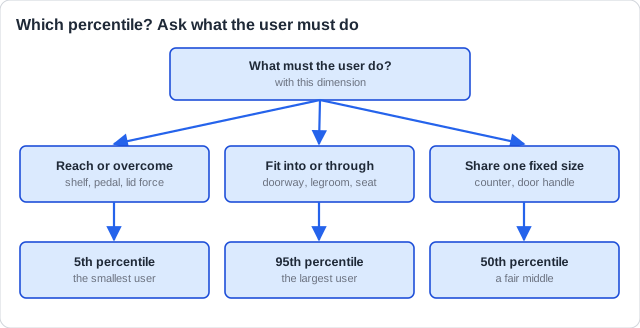
The rule worth memorising: Reach comes from the smallest user — the 5th percentile. Clearance comes from the largest user — the 95th percentile.
If the shortest person can reach it, everyone can. If the largest person fits through it, everyone fits.
5th percentile
- Height of a shelf or a control
- Distance to a foot pedal
- Force needed to open a lid
- Anything the user must REACH or OVERCOME
95th percentile
- Doorway and headroom height
- Legroom and knee clearance
- Seat and gangway width
- Anything the user must FIT INTO or THROUGH
50th percentile
- Height of a door handle
- Position of a light switch
- A fixed height everyone shares: kitchen counter, trolley or lawnmower handle
- Almost never the answer for reach or clearance
The classic error: "Design for the average user" fails half the population when the dimension is a reach or a clearance. Nobody is average in every dimension at once — a person at the 50th percentile for height is rarely at the 50th for arm length. Where one fixed height must suit everyone moderately, the 50th is the usual choice.
Practice with exam-style questions
Answer exam-style questions and get AI feedback that shows you exactly what examiners want to see in a full-marks response.
Most workstations, seats and vehicle cabs are designed to suit the 5th to 95th percentile range — one product that adjusts across 90% of the population.
Why 5th to 95th, and not everyone?
The curve has no end. Covering the last 5% at each extreme usually costs far more in mechanism, materials and testing than it gains in users, so the extremes are excluded as a deliberate, stated decision.
When is excluding 10% not acceptable?
Where the excluded users are the intended ones, or where the risk is severe. An emergency stop, a fire-door handle or a medical alarm must be reachable by the smallest user, not the 5th percentile of a general population.
Which percentile for a bus grab rail?
The 5th, because it must be reached. Setting it from the 50th puts it above the reach of roughly half of standing passengers — exactly the ones least steady on their feet.
Some safety-critical adjustable products widen the range further. Car seats, for example, are often designed to adjust across the 1st to 99th percentile.
Name the users first, then the percentile
Data belongs to a population
A percentile only means something for a stated group. The 5th percentile hand of adults is far bigger than that of 6-year-olds.
Children's products
A scooter grip for ages 5 to 12 uses the 5th to 95th percentile of children aged 5 to 12, so the smallest and largest hands in that group can hold it.
In the answer
Give three things: the percentile range, the age range, and why it suits most of the users.
How this is tested — choosing the right percentile for a stated design decision, and justifying it. It comes up two ways:
Paper 1 — multiple choice
- Identify the percentile appropriate to a given dimension.
- Spot the dimension where the 50th percentile is the wrong choice.
Paper 2 — analysing a product
- Justify the percentile chosen for a named part of a product.
- Explain who a chosen percentile excludes, and whether that matters.
The trap: Deciding by the size of the number rather than the kind of decision. "It should suit big people, so 95th" is wrong for a control that has to be reached — bigger users can always reach further.
A manufacturer is designing a domestic washing machine. Justify the percentile used for (a) the height of the detergent drawer and (b) the width of the door opening.
Model answer plan
See the answer broken into clear points, with guidance on how each point earns marks.
Outline the percentile a designer would use for the fixed height of a bathroom washbasin.
Model answer plan
See the answer broken into clear points, with guidance on how each point earns marks.