The big idea: A work envelope is the three-dimensional space a user can reach without moving from their position.
Everything the product asks them to touch has to be inside it — and how often they touch it decides which part of it.
Normal reach, maximum reach and knee clearance on one seated user. Step through to see which percentile sets each.
Interactive diagram
Explore the labelled diagram, charts and maps for this topic in full study mode.
Machines have work envelopes too. The work envelope of a robot arm is the space its gripper can reach. Designers use it to place parts within reach of the robot, and to mark a safety zone that people must stay out of while it moves.
Free preview
This is the free notes preview
You're reading the free notes. Aimnova Pro unlocks the full study experience — and you can try it with your first topic free to keep:
- FlashcardsLock in vocabulary and key terms with spaced repetition.
- Practice questionsAnswer exam-style questions and get instant AI marking.
- Mock exams & past-paper vaultSit full mocks and see exactly how examiners award marks.
- Personalised study planA daily plan built around your exam date and weak areas.
Normal reach
- Upper arm at the side, forearm extended
- Sustainable for hours
- For controls used constantly — a mouse, a till keypad, a gearstick
- And for anything safety-critical, however rarely used
Maximum reach
- Whole arm extended, shoulder rotated forward
- Causes shoulder fatigue if repeated
- For controls used occasionally — a service switch, a rarely changed setting
- Never for something touched hundreds of times a shift
Frequency decides: The same distance can be right or wrong depending on how often the user goes there. A reach that is fine twice a shift is an injury risk 400 times a shift.
Learn what examiners really want
See exactly what to write to score full marks. Our AI shows you model answers and the key phrases examiners look for.
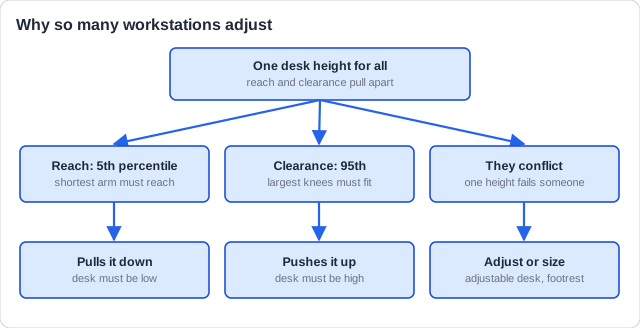
The rule again: Reach is sized from the 5th percentile — the shortest-armed user. Clearance is sized from the 95th percentile — the largest user.
They pull in opposite directions, which is why so many workstations adjust.
Reach
- How far a person can stretch to touch or grasp something from a set position
- Example: the controls a seated driver can operate without leaning forward
Clearance
- The space between two objects, or around the body, so the user can fit, pass or move
- Examples: knee space under a desk, the gap between office desks, headroom in a doorway
When one fixed size cannot meet reach (5th percentile) and clearance (95th percentile) at once, there are two ways out:
Make it adjustable
- One product changes to fit each user
- Office chair: seat height and armrests move
Sell a range of sizes
- Several fixed versions, one per group of users
- School desks and chairs made in several heights, one for each age group
Either way, every user from the 5th to the 95th percentile can be fitted.
Where the two collide
Raise a desk to give the tallest user knee clearance and the shortest user's feet leave the floor. Lower it for the shortest user and the tallest user's knees hit the underside. Neither fixed height works — which is the argument for adjustability, and for a footrest.
Why a footrest exists at all
It is the cheap fix for a desk whose height was set by clearance. Once the desk cannot come down, the floor has to come up.
Standing envelopes differ
A standing user can step and lean, so the envelope is larger but less precise. Anything needing accuracy or force still belongs in the seated-style normal reach zone.
How this is tested — placing controls inside a work envelope and sizing clearances correctly. It comes up two ways:
Paper 1 — multiple choice
- Identify which zone a named control belongs in.
- Pick the percentile that sets a stated clearance.
Paper 2 — analysing a product
- Explain the layout of a workstation in terms of reach zones.
- Explain why a fixed-height desk cannot suit both the 5th and 95th percentile.
The trap: Treating the envelope as one zone. "Inside reach" is not enough — say normal or maximum, and justify it by how often the control is used.
A supermarket checkout has a scanner used on every item, a receipt printer refilled twice a day, and a till the operator sits at. Explain how reach and clearance should be applied to its layout.
Model answer plan
See the answer broken into clear points, with guidance on how each point earns marks.
Explain how the design of a train driver's cab considers clearance, reach and adjustability.
Model answer plan
See the answer broken into clear points, with guidance on how each point earns marks.