The big idea: Drawings — freehand or in CAD — are used to explore, refine and communicate ideas.
Those are three different jobs, and they need three different kinds of drawing. Using the wrong one wastes hours.
The same block drawn four ways. Step through: any difference you see is the convention, not the object.
Interactive diagram
Explore the labelled diagram, charts and maps for this topic in full study mode.
Free preview
This is the free notes preview
You're reading the free notes. Aimnova Pro unlocks the full study experience — and you can try it with your first topic free to keep:
- FlashcardsLock in vocabulary and key terms with spaced repetition.
- Practice questionsAnswer exam-style questions and get instant AI marking.
- Mock exams & past-paper vaultSit full mocks and see exactly how examiners award marks.
- Personalised study planA daily plan built around your exam date and weak areas.
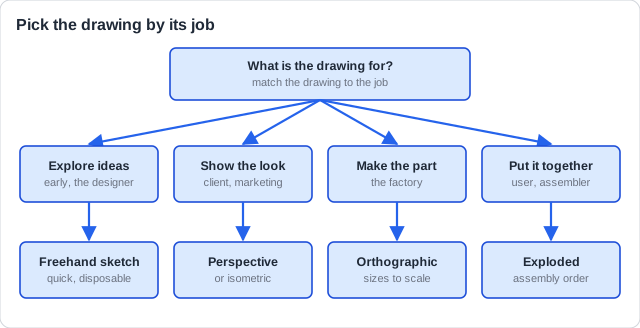
Informal — freehand sketching
- Fast: ideas arrive as quickly as you can draw them
- No equipment, no software, no setup
- Disposable — you make many and reject most
- But: not to scale, so nothing can be made from it
- But: ambiguous — two people can read it differently
Formal — isometric, orthographic, exploded
- Unambiguous: conventions mean one reading only
- To scale, so it can be dimensioned and manufactured
- Understood by anyone trained, in any country
- But: slow, and needs software or instruments
- But: too slow to explore with — you commit before you know
The sequence: Sketch to explore, because exploring means rejecting most of what you draw. Move to formal drawing only once there is something worth communicating precisely.
Stop wasting time on topics you know
Our AI identifies your weak areas and focuses your study time where it matters. No more overstudying easy topics.
Assembled (isometric)
All three axes at 30° to the horizontal, and nothing shrinks with distance — so measurements stay true along each axis. Use it to show a whole assembled object in one view. Weakness: circles become ellipses, and it is much slower than a sketch.
Orthographic projection
Separate flat views — front, plan and side — each viewed perpendicular. Use it to specify for manufacture: every view is true to scale, so it can be dimensioned. Weakness: the reader has to assemble the object mentally from three pictures.
Exploded
Parts separated along the axes they assemble on, held in order. Use it to show assembly sequence and every component at once — flat-pack instructions and service manuals. Weakness: shows relationships, not dimensions.
Matching the drawing to the job: "How do I put it together?" → exploded. "What size is that hole?" → orthographic. "What does it look like?" → isometric.
A question naming a purpose is telling you which drawing to name.
Two more names the papers use
Perspective drawing
Lines meet at vanishing points, so things look smaller further away, as the eye sees them. The most realistic view: an architect shows a client how a new lobby will look.
Assembly drawing
Shows how the parts fit together, often drawn exploded. Flat-pack furniture instructions are assembly drawings.
How this is tested — choosing a drawing type for a purpose and stage, and knowing its limits. It comes up two ways:
Paper 1 — multiple choice
- Identify a described drawing as isometric, orthographic or exploded.
- Pick the drawing type that suits a stated purpose.
Paper 2 — analysing a product
- Outline why designers use drawings to explore, refine and communicate.
- Explain which drawing type suits a stage of a product's development.
The trap: Describing what the drawing looks like instead of what it is for. "Three views" is a description; "true to scale so it can be dimensioned for manufacture" is the mark.
A designer is developing a wall-mounted bottle opener. Outline which drawing technique is appropriate at four points: generating ideas, presenting the chosen concept to a client, specifying it for the workshop, and writing the fitting instructions.
Model answer plan
See the answer broken into clear points, with guidance on how each point earns marks.