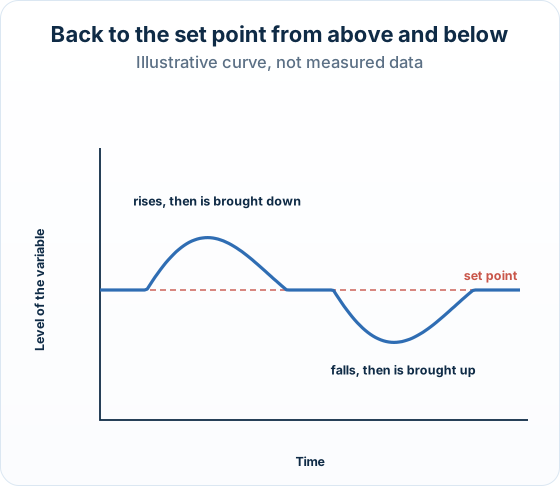
The big idea: In negative feedback the response opposes the change. A level that rises is brought down; a level that falls is brought up. Either way it returns to the set point.
See it drawn, step by step
In My Learning, handwritten diagrams build one step at a time. Play, pause and replay each explanation until it clicks. Create your free account to try it.
| Part of the loop | What it does |
|---|---|
| Receptor | Detects that the level has moved away from the set point |
| Control centre | Compares the level with the set point and signals the effectors |
| Effector | A muscle or gland that carries out the response |
| Response | Moves the level back towards the set point |
The points to remember
- Negative feedback works from above the set point and from below it.
- An increase leads to a decrease; a decrease leads to an increase.
- The level moves a little around the set point but stays within limits.
Remember it as: Too high: bring it down. Too low: bring it up.
Free preview
This is the free notes preview
You're reading the free notes. Aimnova Pro unlocks the full study experience — and you can try it with your first topic free to keep:
- FlashcardsLock in vocabulary and key terms with spaced repetition.
- Practice questionsAnswer exam-style questions and get instant AI marking.
- Mock exams & past-paper vaultSit full mocks and see exactly how examiners award marks.
- Personalised study planA daily plan built around your exam date and weak areas.
Start Studying Free Full access to Aimnova Pro · cancel anytime
Why homeostasis uses negative feedback: Only negative feedback reverses a change, so only negative feedback can keep a variable within limits.
Positive feedback is not homeostasis: If positive feedback controlled blood glucose, a small rise would cause a bigger rise. The level would run out of control. This is why homeostasis depends on negative feedback.
| Negative feedback | Positive feedback | |
|---|---|---|
| Effect on a change | Reverses it | Amplifies it (makes it bigger) |
| Effect on the variable | Returns it to the set point | Moves it further from the starting level |
| Equilibrium | Maintained | Disrupted |
| How long it acts | All the time | Usually for a short time |
| Used for homeostasis | Yes | No |
Remember it as: Negative reverses. Positive amplifies.
Learn what examiners really want
See exactly what to write to score full marks. Our AI shows you model answers and the key phrases examiners look for.
Try AI Feedback FreeYour first topic is free to keep • No credit card required
How it is asked: A Paper 2 Discuss question on both types of feedback, and Paper 1A items that ask you to spot negative feedback in a loop or on a graph.
IB-style questionDiscuss[4 marks]
Discuss the use of negative feedback and positive feedback in the control of variables in the blood.
Model answer plan
See the answer broken into clear points, with guidance on how each point earns marks.