The big idea: Translation is the second step of making a protein. It turns the coded message in an mRNA molecule into a chain of amino acids — a polypeptide.
Translation at a glance
At the ribosome
Translation happens at a ribosome.
Read codons
The ribosome reads the mRNA three bases at a time; each group of three bases is a codon.
Bring amino acids
For each codon, a matching tRNA brings the correct amino acid.
Join in order
The amino acids are joined together in order, building up the polypeptide one amino acid at a time.
Translation happens at the ribosome (the bottom arrow): the mRNA is read three bases at a time, a tRNA whose anticodon matches each codon delivers the right amino acid, and the amino acids are joined in order into a polypeptide.
Interactive diagram
Explore the labelled diagram, charts and maps for this topic in full study mode.
- Translation
- The process in which a ribosome reads an mRNA molecule and builds the matching chain of amino acids (a polypeptide).
- Ribosome
- The structure that carries out translation: it reads the mRNA codons and joins the amino acids together.
- mRNA (messenger RNA)
- The molecule that carries the coded message from the gene to the ribosome; it is read in 3-base codons.
- Codon
- A group of three bases on the mRNA that codes for one amino acid (or a 'stop' signal).
- tRNA (transfer RNA)
- A molecule that brings a specific amino acid to the ribosome; its anticodon base-pairs with an mRNA codon.
- Anticodon
- The three bases on a tRNA that base-pair with a complementary codon on the mRNA.
- Polypeptide
- The chain of amino acids produced by translation, which folds up to form a protein.
Why 'three bases at a time' matters: There are only 4 bases but 20 amino acids, so a single base could not specify each amino acid.
Reading bases in groups of three (codons) gives more than enough combinations to code for all 20 — which is why translation always reads the mRNA in triplets, never one base at a time.
Free preview
This is the free notes preview
You're reading the free notes. Aimnova Pro unlocks the full study experience — and you can try it with your first topic free to keep:
- FlashcardsLock in vocabulary and key terms with spaced repetition.
- Practice questionsAnswer exam-style questions and get instant AI marking.
- Mock exams & past-paper vaultSit full mocks and see exactly how examiners award marks.
- Personalised study planA daily plan built around your exam date and weak areas.
Once an mRNA reaches a ribosome, translation runs as a repeating cycle, adding one amino acid for each codon it reads.
One cycle is the whole mechanism: The ribosome works along the mRNA from one end to the other. Follow the cycle once and you have the whole mechanism — it simply repeats for every codon.
The translation cycle
- Read: the ribosome binds the mRNA and reads the next codon (three bases).
- Match: a tRNA whose anticodon is complementary to that codon arrives, carrying its specific amino acid.
- Join: the amino acid is joined to the growing chain by a peptide bond (made by the ribosome).
- Move on: the ribosome shifts by one codon, the empty tRNA leaves, and the next matching tRNA arrives.
- Repeat: this continues codon by codon, so the polypeptide grows in the exact order set by the mRNA.
- Stop: when the ribosome reaches a stop codon, no tRNA matches it, so translation ends and the finished polypeptide is released.
Codon meets anticodon: The order of amino acids is decided by complementary base pairing between each mRNA codon and a tRNA anticodon.
Why this gives the right order
- Each tRNA carries only one specific amino acid.
- So matching the anticodon to the codon automatically delivers the correct amino acid for that position.
- Get the codon order right and you get the amino-acid order right — that is the whole point of the genetic code.
Peptide bonds join the chain: As each amino acid arrives, the ribosome joins it to the previous one with a peptide bond.
Repeating this many times links the amino acids into a single polypeptide — a chain held together by peptide bonds, in the order the mRNA specified.
mRNA codon
- Three bases on the mRNA
- Read by the ribosome
- Specifies one amino acid (or stop)
- Set during transcription from the gene
tRNA anticodon
- Three bases on a tRNA
- Base-pairs with the matching codon
- The tRNA carries the correct amino acid
- This is how the right amino acid is delivered
How long will the mRNA be?: Because the ribosome reads three bases per amino acid: number of mRNA bases = number of amino acids × 3.
Worked example: A polypeptide of 100 amino acids needs at least 300 bases of coding sequence (plus 3 more for the stop codon). This 'bases = amino acids × 3' link is a favourite quick calculation.
| If the polypeptide has… | Number of coding codons | Number of mRNA bases (× 3) |
|---|---|---|
| 10 amino acids | 10 codons | 30 bases |
| 50 amino acids | 50 codons | 150 bases |
| 100 amino acids | 100 codons | 300 bases |
| n amino acids | n codons | n × 3 bases (add 3 more for the stop codon) |
Transcription vs translation: Don't mix up the two steps of protein synthesis:
Transcription makes mRNA in the nucleus (using RNA polymerase).
Translation makes a polypeptide at the ribosome (using tRNA and the ribosome to read codons).
| Feature | Transcription | Translation |
|---|---|---|
| What is made | mRNA (a copy of the gene) | A polypeptide (a chain of amino acids) |
| Where it happens | In the nucleus | At a ribosome (in the cytoplasm) |
| What is read | A DNA template strand | The mRNA, in 3-base codons |
| The decoder | RNA polymerase | tRNA anticodons + the ribosome |
| The bond formed | Between RNA nucleotides | Peptide bonds between amino acids |
Never wonder what to study next
Get a personalized daily plan based on your exam date, progress, and weak areas. We'll tell you exactly what to review each day.
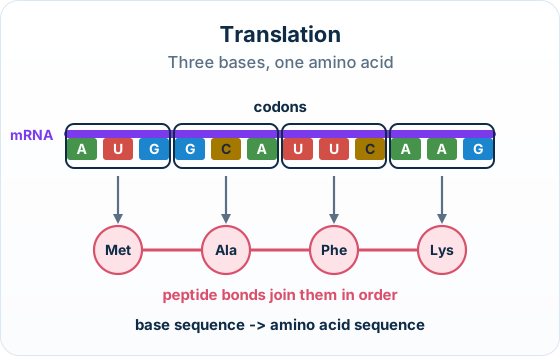
The big idea: Translation turns the base sequence of mRNA into the amino acid sequence of a polypeptide.
The points to remember
- mRNA is read in codons: groups of three bases.
- Each codon stands for one amino acid (or stop).
- The amino acids are joined in the same order as the codons.
- So the order of bases in mRNA sets the order of amino acids.
Remember it as: Three bases, one amino acid, same order.
Real example: insulin. The B chain of human insulin begins Phe-Val-Asn-Gln-His-Leu. Each of those amino acids was set by one codon of the insulin mRNA, read in order at a ribosome.
How this is tested: Translation is tested on Paper 2 (diagrams and long Explain answers) and on Paper 1A (calculations and true/false events).
| Paper | Task | What to give |
|---|---|---|
| Paper 2 | A labelled diagram of protein synthesis in the cytoplasm — identify the labelled structures | Usually the ribosome, the mRNA, a tRNA and the polypeptide |
| Paper 2 | A longer Explain (up to 7 marks) on the role of RNA in translation | mRNA carrying codons, tRNA bringing amino acids via its anticodon, the ribosome reading codons and forming peptide bonds |
| Paper 1A | Calculate the number of mRNA bases that code for a peptide, or select which listed events truly happen during translation | Amino acids × 3 |
Exam-style question — label the structures of translation
A diagram shows protein synthesis taking place in the cytoplasm. Identify the structure that reads the mRNA codons, and the structure that carries an amino acid to match each codon. [2]
How to score both marks
- The reader. The structure that holds the mRNA and reads it three bases (one codon) at a time is the ribosome.
- The carrier. The structure that brings the correct amino acid for each codon — base-pairing its anticodon to the codon — is a tRNA (transfer RNA).
Final answer
The ribosome reads the mRNA codons; a tRNA (transfer RNA) carries the matching amino acid to each codon.
The same overview labelled for translation: mRNA (the messenger being read), the ribosome (where reading happens), tRNA (carrying amino acids) and the growing polypeptide product.
Interactive diagram
Explore the labelled diagram, charts and maps for this topic in full study mode.
Why this scores full marks: Each mark is a named structure with the right job: the ribosome does the reading, the tRNA does the carrying.
Naming the molecule is not enough on its own — make sure the structure you name matches the role the question asks about.
Exam-style question — how many mRNA bases?
A polypeptide is made of 75 amino acids. Calculate the minimum number of mRNA bases needed to code for it. [1]
Model answer
- Use the codon rule. Each amino acid is coded by one codon = 3 bases, so multiply the number of amino acids by 3.
- Do the multiplication. 75 amino acids × 3 = 225 bases. If the stop codon is counted too, the answer is 228.
Final answer
75 × 3 = 225 mRNA bases (228 if the stop codon is counted).
| Molecule / structure | What it does in translation | Key feature |
|---|---|---|
| mRNA (messenger RNA) | Carries the coded message from the gene; it is read in 3-base codons | Sequence of codons = the order of amino acids |
| Ribosome | Reads the mRNA codons and joins the amino acids together | Has two subunits; holds mRNA and tRNA in place and catalyses peptide bonds |
| tRNA (transfer RNA) | Brings the correct amino acid for each codon | Has an anticodon that base-pairs with the codon, and carries one specific amino acid |
| Polypeptide | The product — a chain of amino acids in the coded order | Folds up into a functional protein |