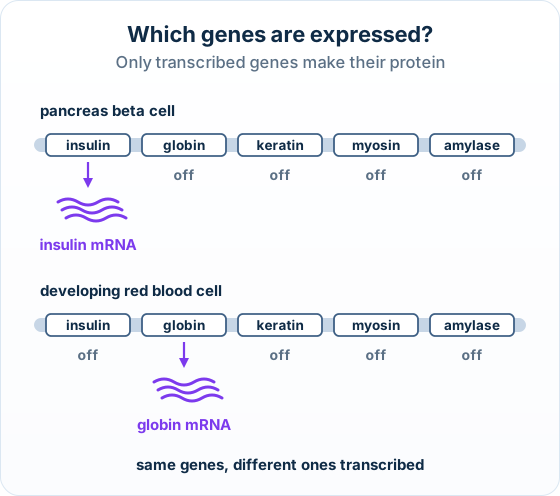
The big idea: Almost every cell has all the genes, but at any time it expresses only some of them. A gene is expressed only if it is transcribed.
The points to remember
- Gene expression means making the product of a gene, usually a protein.
- Expression starts with transcription (DNA to mRNA), then translation (mRNA to polypeptide).
- Not all genes are expressed in a cell at any given time.
- A gene that is not transcribed makes no mRNA, so no protein.
Remember it as: No transcription, no expression.
Free preview
This is the free notes preview
You're reading the free notes. Aimnova Pro unlocks the full study experience — and you can try it with your first topic free to keep:
- FlashcardsLock in vocabulary and key terms with spaced repetition.
- Practice questionsAnswer exam-style questions and get instant AI marking.
- Mock exams & past-paper vaultSit full mocks and see exactly how examiners award marks.
- Personalised study planA daily plan built around your exam date and weak areas.
Start Studying Free Full access to Aimnova Pro · cancel anytime
Transcription is the switch: Because transcription is the first stage of gene expression, it is the main place where a gene is switched on or off.
Gene switched on
- Transcribed into mRNA
- mRNA is translated
- The protein is made
Gene switched off
- Not transcribed
- No mRNA to translate
- No protein made
Real example: lactase. Most mammals switch off transcription of the lactase gene after weaning, so they can no longer digest milk sugar well. Many adult humans keep the gene switched on.
Switched off is not lost: A gene that is switched off is still in the DNA. It can be switched on again later.
Memorize terms 3x faster
Smart flashcards show you cards right before you forget them. Perfect for definitions and key concepts.
Try Flashcards FreeYour first topic is free to keep • No credit card required
How it is asked: Why different cells make different proteins, or where gene expression is switched on and off.
IB-style questionExplain[2 marks]
A skin cell and a pancreas cell contain the same genes but make different proteins. Explain why.
Model answer plan
See the answer broken into clear points, with guidance on how each point earns marks.