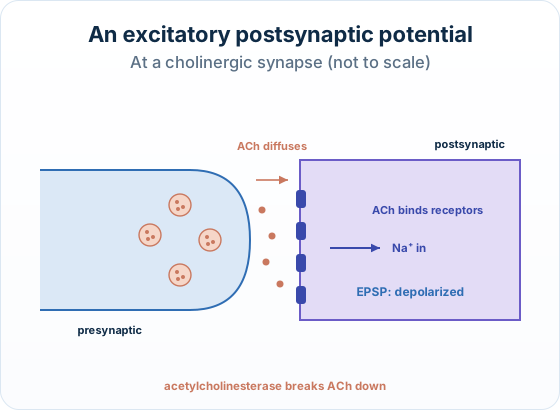
The big idea: Acetylcholine diffuses across the synaptic cleft and binds transmembrane receptors on the postsynaptic membrane. The receptors open, sodium ions diffuse in, and the membrane depolarizes: an excitatory postsynaptic potential (EPSP). Acetylcholinesterase then breaks acetylcholine down.
The points to remember
- Acetylcholine diffuses across the cleft.
- It binds transmembrane receptors on the postsynaptic membrane.
- The receptors open: Na⁺ diffuses in.
- The membrane depolarizes: an EPSP.
- Acetylcholinesterase breaks acetylcholine down.
Remember it as: Diffuse, bind, sodium in, depolarize.
Real example: everywhere in the body. Acetylcholine is used at every neuromuscular junction between motor neurons and skeletal muscle, and at many synapses in the brain and in the nerves that control the heart and gut.
Trap: An EPSP is a depolarization of the postsynaptic membrane, not yet an action potential; only if it is large enough does the postsynaptic cell fire.
Free preview
This is the free notes preview
You're reading the free notes. Aimnova Pro unlocks the full study experience — and you can try it with your first topic free to keep:
- FlashcardsLock in vocabulary and key terms with spaced repetition.
- Practice questionsAnswer exam-style questions and get instant AI marking.
- Mock exams & past-paper vaultSit full mocks and see exactly how examiners award marks.
- Personalised study planA daily plan built around your exam date and weak areas.
Start Studying Free Full access to Aimnova Pro · cancel anytime
How it is asked: Expect a Describe question on how an EPSP is generated, or MCQs on the ions and the receptors.
IB-style questionDescribe[3 marks]
Describe the events at the postsynaptic membrane when acetylcholine arrives at a synapse.
Model answer plan
See the answer broken into clear points, with guidance on how each point earns marks.