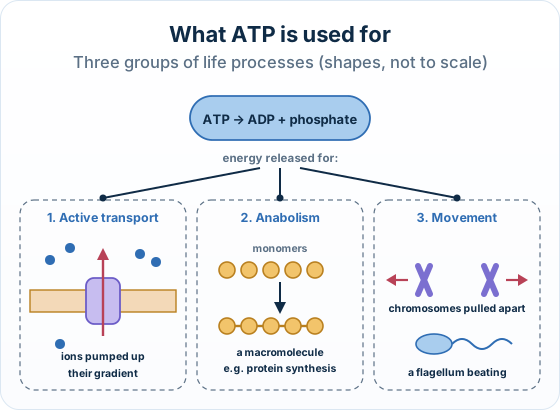
The big idea: ATP supplies energy to three groups of life processes: active transport, anabolism (building macromolecules) and movement.
The points to remember
- Active transport: pump proteins move ions or molecules against their concentration gradient.
- Anabolism: joining monomers into macromolecules, such as proteins, DNA and glycogen.
- Movement: muscle contraction, flagella and cilia, and chromosomes moving in cell division.
- Each use hydrolyses ATP to ADP and phosphate, releasing the energy.
Remember it as: Pump, build, move: the three jobs of ATP.
Real example: the brain's pumps. Your brain uses about a fifth of the body's energy at rest. Much of its ATP powers sodium-potassium pumps, which keep neurons ready to send impulses.
Trap: Diffusion and osmosis do not use ATP: substances move down their gradient on their own.
Free preview
This is the free notes preview
You're reading the free notes. Aimnova Pro unlocks the full study experience — and you can try it with your first topic free to keep:
- FlashcardsLock in vocabulary and key terms with spaced repetition.
- Practice questionsAnswer exam-style questions and get instant AI marking.
- Mock exams & past-paper vaultSit full mocks and see exactly how examiners award marks.
- Personalised study planA daily plan built around your exam date and weak areas.
Start Studying Free Full access to Aimnova Pro · cancel anytime
How it is asked: Expect a State question asking for two processes powered by ATP, or a longer Outline of its uses, each with an example.
IB-style questionOutline[3 marks]
Outline three different life processes in cells that use energy from ATP, with an example of each.
Model answer plan
See the answer broken into clear points, with guidance on how each point earns marks.