The big idea: Cells cannot use the energy locked in food directly. Instead they transfer it to a small carrier molecule called ATP (adenosine triphosphate).
The cell's energy currency
- Every energy-needing process in the cell is paid for in ATP.
- That is why ATP is called the cell's energy currency: like cash that any process can 'spend'.
- Removing ATP's third phosphate group releases energy the cell can use.
The ATP–ADP cycle
Bond broken
When the cell needs energy, the bond to the third phosphate is broken.
Energy released
ATP turns into ADP + a phosphate (Pi), releasing the energy.
Recharged
Respiration then re-adds the phosphate, recharging ADP back into ATP.
A continuous ATP–ADP cycle.
The ATP–ADP cycle: breaking the third phosphate bond turns ATP into ADP + Pi and releases energy for cell work; respiration re-adds the phosphate to recharge ADP back to ATP.
Interactive diagram
Explore the labelled diagram, charts and maps for this topic in full study mode.
- ATP (adenosine triphosphate)
- The cell's energy-carrying molecule. It has three phosphate groups; removing the third one releases usable energy.
- ADP (adenosine diphosphate)
- The 'discharged' form of ATP, with only two phosphate groups. It is formed when ATP releases its energy.
- Pi (inorganic phosphate)
- The single phosphate group released when ATP is broken down to ADP.
- Energy currency
- A description of ATP: it is the universal, spendable form of energy that powers every energy-requiring process in the cell.
- ATP–ADP cycle
- The continuous interconversion in which ATP is broken to ADP + Pi (releasing energy) and rebuilt from ADP + Pi by respiration (storing energy).
Where the energy comes from: Energy is released when ATP is hydrolysed and its third phosphate is removed.
Break that bond → energy is released (ATP → ADP + Pi).
Remake it (using energy from respiration) → energy is needed to make ATP again (ADP + Pi → ATP).
Free preview
This is the free notes preview
You're reading the free notes. Aimnova Pro unlocks the full study experience — and you can try it with your first topic free to keep:
- FlashcardsLock in vocabulary and key terms with spaced repetition.
- Practice questionsAnswer exam-style questions and get instant AI marking.
- Mock exams & past-paper vaultSit full mocks and see exactly how examiners award marks.
- Personalised study planA daily plan built around your exam date and weak areas.
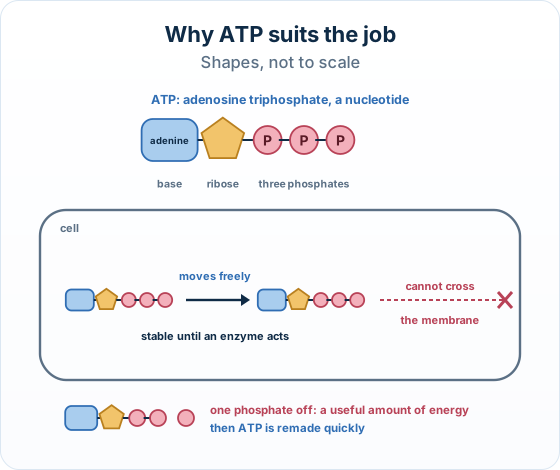
The big idea: ATP (adenosine triphosphate) is a nucleotide. Its properties make it the cell's energy currency: it carries energy to every process that needs it.
The points to remember
- ATP = adenine + ribose + three phosphates: a nucleotide.
- Small and soluble: it moves quickly to wherever energy is needed.
- Stable: it does not release energy until an enzyme acts; it cannot cross membranes, so it stays in the cell.
- Removing one phosphate releases an amount of energy suitable for many tasks; ATP is quickly regenerated.
Remember it as: Small, soluble, stable, quick to remake: the perfect currency.
Real example: a day's ATP. At any moment your body holds only a small amount of ATP, yet each day you make and use roughly your own body mass of it: each ATP molecule is remade over and over.
Trap: ATP is not a long-term energy store. Cells store energy in fat, starch or glycogen, and make ATP from them as it is needed.
Never wonder what to study next
Get a personalized daily plan based on your exam date, progress, and weak areas. We'll tell you exactly what to review each day.
How this is tested: ATP questions are short written answers. Each format below rewards a different kind of answer.
The common formats
- 3 marks: explain the features of ATP that suit it to powering a specific process (such as nerve-impulse transmission).
- Score with separate features: releases a small/usable amount of energy, releases it quickly in one step, is soluble/moves freely, and is rapidly recharged.
- 2 marks (State): name cellular processes powered by converting ATP into ADP. Give two from active transport, muscle contraction, synthesis of macromolecules or nerve-impulse transmission.
- Active-transport data questions: spot the energy-using process and link it back to the ATP–ADP cycle.
Exam-style question — explain ATP's features for nerve cells
A neuron uses a large amount of ATP to keep transmitting impulses. Explain three features of ATP that make it well suited to supplying this energy. [3]
Step by step
- Small, usable release. Breaking ATP to ADP + Pi releases a small amount of energy in one step, so the neuron gets just enough energy for each task without wasting it as heat.
- Fast and on demand. The energy is released quickly, exactly when the neuron needs it, so impulses can fire rapidly one after another.
- Soluble and reusable. ATP is soluble and moves freely through the cytoplasm to where it is needed, and it is rapidly recharged by respiration (ADP + Pi → ATP), so the same molecules are reused continuously.
Final answer
ATP releases a small, usable amount of energy in a single step; it releases that energy quickly and on demand; and it is soluble (moving freely to where it is needed) and rapidly recharged by respiration, so it is reused over and over.
Why this works: Each point is a separate feature of ATP — small/single-step release, fast release, soluble/reusable — and each is linked to the job of powering the neuron.
An 'explain [3]' needs three distinct features, each explained, not the same idea rephrased three times.
| Feature of ATP | What it means | Why it suits powering cell processes |
|---|---|---|
| Releases a small amount of energy | Splitting off one phosphate gives a small, manageable burst | The cell gets just enough energy for one task, with little wasted as heat |
| Releases energy in a single step | One bond is broken, releasing energy instantly | Energy is available immediately, exactly when and where it is needed |
| Soluble in water | ATP dissolves and moves freely in the cytoplasm | It can be delivered to wherever in the cell the energy is required |
| Quickly recharged | Respiration rapidly rebuilds ATP from ADP + Pi | The same molecules are reused over and over — a renewable currency, not used up |
Another question in the papers' style:
Explain why ATP is suitable as the energy currency of a cell.
Model answer plan
See the answer broken into clear points, with guidance on how each point earns marks.