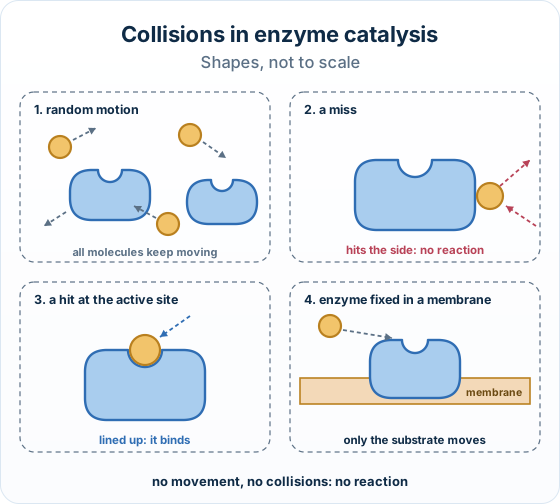
The big idea: A reaction happens only when a substrate molecule collides with an active site. Molecules must move to meet, so molecular motion is needed for catalysis.
The points to remember
- Enzyme and substrate molecules move at random in solution and keep colliding.
- Only a collision where the substrate meets the active site, lined up the right way, leads to binding.
- More movement (for example, a higher temperature) means more collisions per second.
- Sometimes one partner is fixed: a large substrate, or an enzyme embedded in a membrane. The other partner must move to it.
Remember it as: No movement, no collisions; no collisions, no reaction.
Real example: ATP synthase. ATP synthase is an enzyme fixed in the inner membrane of mitochondria. It cannot move about, so its substrates, ADP and phosphate, must move through the fluid and collide with it.
Trap: Not every collision works. The substrate must hit the active site; a collision anywhere else on the enzyme does nothing.
Free preview
This is the free notes preview
You're reading the free notes. Aimnova Pro unlocks the full study experience — and you can try it with your first topic free to keep:
- FlashcardsLock in vocabulary and key terms with spaced repetition.
- Practice questionsAnswer exam-style questions and get instant AI marking.
- Mock exams & past-paper vaultSit full mocks and see exactly how examiners award marks.
- Personalised study planA daily plan built around your exam date and weak areas.
In industry the enzyme is often not left floating in the mixture. Instead it is immobilized: attached to, or trapped on, a solid support such as tiny gel beads.
How an immobilized enzyme works
Substrate in
The substrate flows past the fixed enzyme.
Reaction
The reaction happens.
Product out
The product flows on, but the enzyme stays behind.
- Immobilized enzyme
- An enzyme attached to or trapped on a solid support (for example gel beads) so it stays in one place instead of mixing freely with the substrate.
- Free enzyme
- An enzyme dissolved and mixed freely in solution with its substrate.
- Solid support
- The material the enzyme is fixed to or trapped in — commonly small beads of gel through which the substrate flows.
Why immobilize an enzyme?: Immobilizing an enzyme gives several practical advantages.
The advantages
- Reuse: the enzyme stays put, so it can be used over and over instead of thrown away (cheaper).
- Pure product: the enzyme doesn't end up mixed into the product, so the product is not contaminated.
- Greater stability: the support helps the enzyme tolerate a wider range of temperature and pH before it denatures.
- Easy to stop and control: you can simply remove the beads to halt the reaction.
| Feature | Free enzyme (in solution) | Immobilized enzyme (fixed to a surface) |
|---|---|---|
| Where the enzyme is | Dissolved freely, mixed in with the substrate | Attached to / trapped on a solid support (e.g. tiny gel beads) |
| Recovering the enzyme afterwards | Hard — it is mixed into the product | Easy — the beads are simply removed or the product runs past them |
| Reusing the enzyme | Usually used once, then lost | Can be used again and again (cost-effective) |
| Contaminating the product | The enzyme ends up in the product | The product stays enzyme-free / purer |
| Stability | Denatures more easily with heat or pH change | More stable — the support helps it tolerate a wider range of conditions |
A real application to remember: The classic example is lactase.
Lactase is immobilized on beads, and milk is passed over them. The lactase breaks the lactose in the milk into glucose and galactose.
The result is lactose-free milk for people who are lactose intolerant — and because the lactase is immobilized, none of it ends up in the milk and the beads can be reused.
| Immobilized enzyme | What it does | Application |
|---|---|---|
| Lactase | Breaks lactose into glucose and galactose | Making lactose-free milk for people who are lactose intolerant |
| Protease | Breaks proteins into amino acids | Removing protein stains / making protein-digested foods |
| Glucose isomerase | Converts glucose into sweeter fructose | Producing high-fructose syrup for the food industry |
Free enzyme
- Dissolved and mixed with the substrate
- Hard to recover — ends up in the product
- Usually used once, then lost
- Denatures more easily with heat / pH change
Immobilized enzyme
- Fixed to a solid support (e.g. beads)
- Easy to recover — the product stays pure
- Can be reused many times (cheaper)
- More stable over a wider range of conditions
An easy way to remember: Immobilized = 'not moving'. The enzyme is stuck in place, so you keep it, reuse it, and get a clean product.
Think beads of lactase + milk → lactose-free milk.
Stop wasting time on topics you know
Our AI identifies your weak areas and focuses your study time where it matters. No more overstudying easy topics.
How it is asked: Expect collisions as part of an explanation of rate, or questions on immobilized enzymes and their uses.
Explain the role of molecular motion in enzyme catalysis.
Model answer plan
See the answer broken into clear points, with guidance on how each point earns marks.