The big idea: Each pulse is the artery wall stretching as a surge of blood passes after one heartbeat, so counting pulses gives the heart rate.
The points to remember
- Feel the radial artery (wrist, thumb side) or the carotid artery (neck, beside the windpipe).
- Use two fingertips, pressing lightly, never the thumb: it has a pulse of its own.
- Count for a set time and give the rate in beats per minute: 15 s count × 4, or count for 60 s.
- Pulses are felt in arteries, not veins: veins carry blood at low pressure, with no surge.
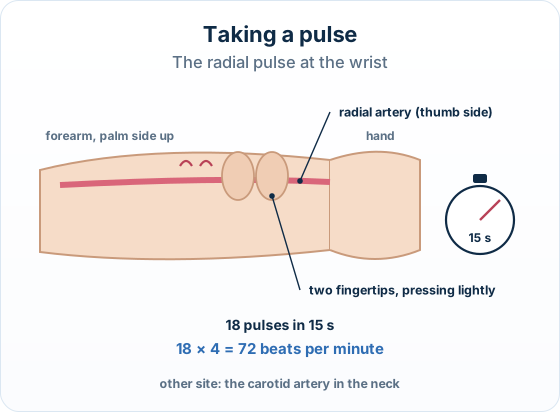
Remember it as: Two fingers, one minute, beats per minute.
Real example: a PE lesson. In a PE lesson, a class takes their radial pulse at rest and again straight after a 100 m sprint, to see how much the heart rate rises with exercise.
Free preview
This is the free notes preview
You're reading the free notes. Aimnova Pro unlocks the full study experience — and you can try it with your first topic free to keep:
- FlashcardsLock in vocabulary and key terms with spaced repetition.
- Practice questionsAnswer exam-style questions and get instant AI marking.
- Mock exams & past-paper vaultSit full mocks and see exactly how examiners award marks.
- Personalised study planA daily plan built around your exam date and weak areas.
Traditional or digital?: Heart rate can be counted by hand or read from a digital monitor: a finger clip, a smartwatch or a chest strap.
Counting by hand
- No equipment needed
- Counting a whole minute uses more data: a miscount matters less, and the rate can change during the minute
- Short counts (15 s × 4) multiply any error by 4
- You can miscount or lose the pulse
Digital monitor
- Objective: no human counting, no miscounting
- Gives continuous readings, so patterns show
- Its sensor picks up weak pulses
- Must fit firmly and work correctly
The points to remember
- Repeat the measurement and take a mean for a more reliable value.
- Measure under the same conditions: same position, same time after exercise.
Trap: 'It is more accurate' scores nothing on its own. Say why: more data, errors magnified less, or no human counting.
Practice with exam-style questions
Answer exam-style questions and get AI feedback that shows you exactly what examiners want to see in a full-marks response.
How it is asked: Expect 'describe how to measure heart rate', or two methods to compare: why one count is more accurate, or what a digital monitor adds.
Ana counts her radial pulse for 1 minute; Ben counts his for 10 seconds and multiplies by 6. (i) Suggest one reason why Ana's method would be more accurate. [1] (ii) Suggest one advantage of a smartwatch over feeling the radial artery. [1]
Model answer plan
See the answer broken into clear points, with guidance on how each point earns marks.